
The Dangerous Illusion of Deterrence
There is a dangerous illusion being sold to the Filipino people—especially to communities in Davao—that a proposed U.S.-linked fuel depot in the Davao Gulf will enhance security through “deterrence.” While still in the planning stage, the involvement of the U.S. Defense Logistics Agency and the backing of the Armed Forces of the Philippines (AFP) signal that this is more than a tentative —it is a strategic move with long-term consequences. Authorities argue that the facility, capable of storing up to 977,000 barrels or 41 million gallons of naval and aviation fuel, will strengthen maritime security and disaster response. But deterrence is not a shield; it is a signal. Across global conflict zones, infrastructure that supports military operations—especially fuel depots—becomes a prime target. The claim that the greater risk lies in having “no deterrence at all” dangerously ignores the reality that such facilities often invite the very threats they are meant to prevent.
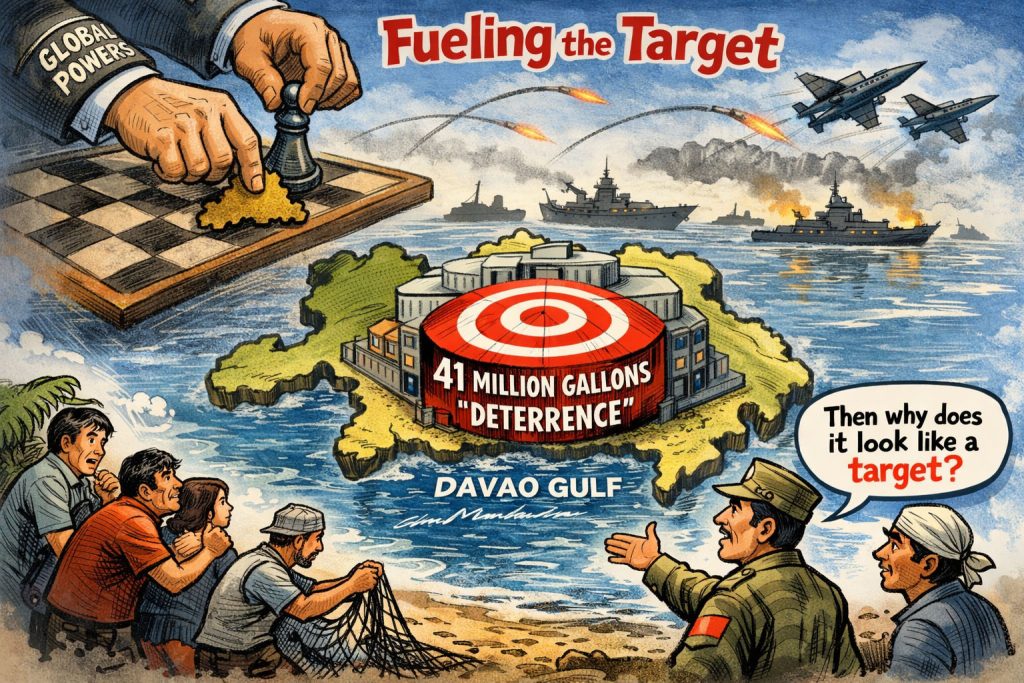
From Safe Distance to Strategic Target
Davao Gulf has long remained outside the network of Enhanced Defense Cooperation Agreement (EDCA) sites, sparing it from being viewed as a high-value military location. This proposal changes that equation entirely. A depot designed to supply naval vessels and military aircraft is not just a passive structure—it is a logistical backbone of military operations. Even if officials insist it will remain under Philippine control, its integration into a broader U.S. defense network effectively places Davao within the strategic map of potential adversaries. The lesson from other regions is clear: countries hosting foreign military infrastructure, even indirectly, often find themselves within the strike radius during conflicts. By hosting a fuel hub of this magnitude, Davao risks shifting from a place of relative peace to a potential bullseye.
The Humanitarian Narrative Falls Short
Supporters of the project frequently cite humanitarian assistance and disaster response (HADR) as justification. While the Philippines undoubtedly needs stronger disaster response capabilities, the scale and nature of this facility tell a different story. The storage of massive volumes of Naval Distillate F-76 and Aviation Turbine Fuel JP-5—both essential for warships and combat aircraft—reveals its primary purpose: sustaining military operations. Humanitarian missions do not require integration into a global logistics network stretching across the Indo-Pacific. Invoking disaster response may soften public perception, but it does not change the fundamental reality that this is a military-oriented project with strategic implications far beyond relief operations.
Sovereignty or Strategic Entanglement?
Officials assure the public that the facility will remain Philippine-controlled, but sovereignty is not defined solely by ownership—it is defined by function and alignment. If the depot’s core role is to supply U.S. forces operating in the region, then Philippine territory becomes functionally embedded within U.S. strategic interests. This raises a critical concern: when tensions escalate between global powers, the Philippines may find itself entangled in conflicts not of its own making. China has already expressed concern over expanding U.S. military infrastructure in the region, underscoring how such developments heighten geopolitical tensions. Whether one agrees with these concerns or not, the implication is clear: this is not neutrality, but alignment—and alignment carries risks.
The People’s Voice Must Matter
Perhaps the most glaring issue is the apparent lack of meaningful consultation with the people of Davao. The growing opposition reflects a deep awareness among communities that this is not just an infrastructure project—it is a geopolitical shift with direct consequences on their safety and future. Davao has long been regarded as a stable and relatively peaceful region in Mindanao. Introducing a high-value military asset into its coastal waters risks undermining that stability. The question is simple but urgent: should the people bear the risks of a project they did not ask for?
A Line Must Be Drawn
The Philippines has every right to strengthen its defenses and improve disaster response capabilities. But not all strategies are without consequence. Establishing a massive fuel depot tied to a global military network is not a neutral act—it is a decision that could redefine Davao’s role from a peaceful region to a strategic target. The lessons from other parts of the world are clear: once a place becomes part of a military network, it also becomes part of its vulnerabilities. Davao is not a chess piece in a geopolitical game—it is home to millions of Filipinos whose safety must come first. The proposal may still be on paper, but the time to question, to challenge, and to resist is now—before a peaceful coastline is turned into a potential bullseye.