
There are public institutions whose importance is measured not by the number of buildings they operate, the size of their budgets, or the awards displayed on their walls, but by what happens when an ordinary citizen suddenly finds themselves facing an extraordinary emergency. A medical crisis. A fire. A road accident. A missing person. A flooding incident. A disaster. A life hanging in the balance. In those moments, people do not ask for complicated systems. They ask for help. In Davao City, that request has, for 24 years, been answered by three numbers: 911.
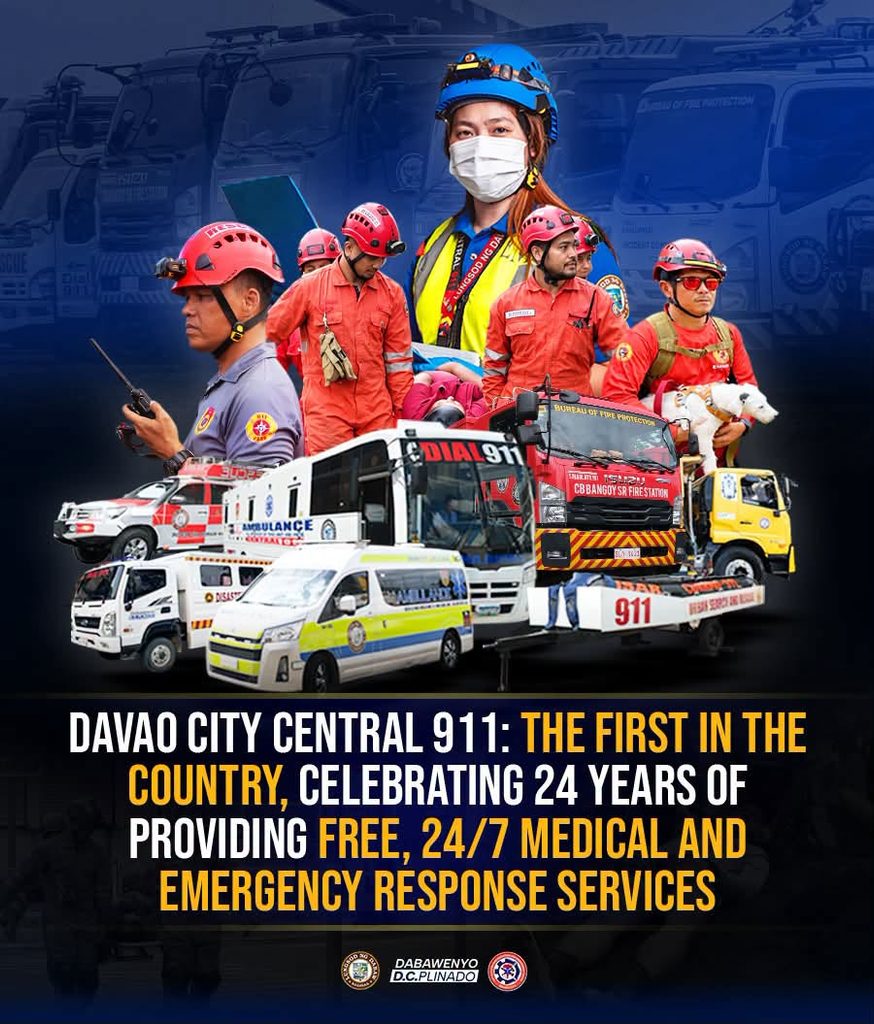
As Davao City Central 911 marks its 24th anniversary, the occasion deserves more than a ceremonial greeting. It is an opportunity to recognize an institution that has become deeply woven into the city’s public-safety architecture and, more importantly, into the collective consciousness of generations of Dabawenyos. Central 911 was formally launched on September 27, 2002, under then Davao City Mayor Rodrigo R. Duterte. It was established as a centralized emergency response mechanism providing free, round-the-clock assistance for medical emergencies, fires, search-and-rescue operations and other urgent situations. Twenty-four years later, its greatest achievement may be found in something deceptively simple: people know where to call when they need help. That simplicity is the product of years of organization, training, coordination, investment and institutional development.
It is easy to think of 911 as simply a telephone number. It is not. Behind those three digits is an entire chain of people and systems that must work under pressure. A call has to be received. Information has to be gathered. The emergency has to be assessed. The appropriate responders have to be identified. Dispatch has to happen. Responders have to reach the location. Other agencies may have to be brought into the operation. Medical, fire, rescue, police, traffic or other specialized assistance may have to converge. A failure at any point can cost precious time.
Central 911’s evolution reflects an understanding of that reality. The system began as a collaborative undertaking between the Davao Light and Power Company and the City Government of Davao. Its origins were connected to a street-lighting project incorporating Geographic Information System technology, initially intended to improve lighting facilities and address growing crime concerns. It eventually developed into a centralized and integrated emergency response system connecting residents who need assistance with nearby responders. That evolution is worth emphasizing. A system that began with a technological and public-safety concept eventually became something much larger: an institutional commitment to making emergency assistance accessible to ordinary citizens. This is what public innovation should look like. It should not exist merely because a technology is fashionable. It should exist because technology can help government perform its fundamental responsibility to protect life and serve people.
On the 24th anniversary of Central 911, the most important recognition should go to the men and women who make the system work. The call takers. The dispatchers. The emergency medical personnel. The search-and-rescue teams. The fire auxiliary personnel. The K-9 personnel. The drivers. The coordinators. The supervisors. The administrators. And the countless responders who must be prepared to move toward danger while everyone else is trying to get away from it. The official anniversary message itself recognizes these dedicated men and women who remain ready to serve day and night, including during emergencies and disasters. That deserves genuine commendation.
Emergency response is not glamorous work. Much of it happens away from cameras. There may be no audience when a dispatcher answers a desperate voice in the middle of the night. There may be no applause when an ambulance races through traffic. There may be no public recognition when a responder spends hours assisting a family through a crisis. Yet these are precisely the moments when public service matters most. The measure of a responder is not whether the work attracts attention. It is whether the responder is ready when somebody needs help.
Central 911’s significance also lies in its ability to serve as a coordinating mechanism. Its operational structure includes the Emergency Calls Answering Point and Dispatch, Emergency Medical Dispatch, Emergency Medical Services, Urban Search and Rescue, and Fire Auxiliary Services. The system also maintains coordination and linkages with other agencies, including the Davao City Police Office, the City Transport and Traffic Management Office, the Public Safety and Security Command Center and the Philippine Coast Guard. This multi-agency character is critical because emergencies rarely respect organizational boundaries. A vehicular crash may require medical responders, traffic personnel and police officers. A fire may require fire suppression, medical assistance and traffic management. A coastal emergency may involve search and rescue, maritime authorities and medical teams. A disaster can require virtually every component of the emergency-response system.
A citizen experiencing an emergency should not be expected to understand which government office handles which part of the crisis. That is the point of centralized emergency response. The system should carry that complexity on behalf of the citizen. The person calling 911 should be able to say, in effect: I need help. The machinery of government should then determine what kind of help is necessary. That is an important principle of citizen-centered governance.
The most reassuring feature of Central 911 may be the one that sounds most ordinary: it operates around the clock. Emergencies do not observe office hours. Heart attacks do not wait for morning. Fires do not wait for government offices to open. Accidents do not check the calendar. Floodwaters do not care whether it is a weekend. Disasters do not happen according to administrative schedules. For that reason, a 24-hour emergency response system represents more than convenience. It represents continuity of public service.
At three in the afternoon and three in the morning, the basic expectation remains the same: somebody should be there to answer. That expectation is one of the strongest forms of institutional trust a government can build. The legacy of Central 911, therefore, cannot be measured solely through individual operations. It is also measured through the confidence of residents who know that there is an established mechanism to call when something goes terribly wrong. The anniversary material puts this idea plainly: Central 911’s legacy lives in the enduring trust of a city that knows that, regardless of the hour, help is only three digits away. That kind of trust is earned.
Commending Central 911 should not mean treating its present system as the finished product. Quite the opposite. The strongest public institutions are those willing to acknowledge changing circumstances and improve. Central 911 has confronted operational challenges associated with the country’s centralized 911 system, including instances where calls intended for Davao City are initially routed elsewhere. According to the material provided, Central 911 has responded by strengthening coordination with other emergency response centers, training call takers to use more adaptive scripts, shortening interviews to obtain essential information more quickly, and improving inter-center coordination.
That is precisely the attitude an emergency service should have. Problems should not simply be explained. They should be addressed. The planned development of a new mapping system and mobile application also points toward the next stage of emergency response in Davao City. The proposed Davao Smart Emergency Response and Locator–Computer-Aided Response and Emergency Dispatch, or Seral-Cared, system is intended to provide a GPS-enabled, geospatially integrated platform designed to improve dispatch and caller-location tracking. Its planned features include GPS-based caller location tracking, geospatial mapping, a barangay geotagging registry, a mobile emergency application, responder GPS tracking and data-privacy safeguards.
For a city where location can determine how quickly responders reach someone in distress, this technological direction is particularly significant. A caller experiencing an emergency may not know the exact street name. They may not know the barangay. They may be frightened, injured or disoriented. A system capable of accurately helping responders identify where assistance is needed can reduce the burden on the person asking for help. Technology, in this context, should serve one purpose above all: getting the right help to the right place as quickly and safely as possible.
There is another important lesson in Central 911’s history. The system’s origins were connected to Geographic Information System technology. Today, geospatial technology remains central to modern emergency management because emergencies are fundamentally spatial problems. Where did the incident happen? Where are the nearest responders? Which roads are accessible? Where are hospitals? Which areas are vulnerable to flooding? Where are evacuation centers? Which communities are isolated? Where are responders currently located? These are geographic questions.
The more accurately an emergency-response system understands location, the more intelligently it can allocate resources. This makes the continued integration of GIS, GPS, mapping and real-time data not simply a technological upgrade but a natural continuation of Central 911’s original evolution. The proposed system’s geospatial mapping, barangay geotagging and responder-tracking components point toward precisely this direction.
For Davao, the opportunity is substantial. A citywide emergency-response map can eventually become more than a dispatch tool. Properly governed, protected and used, it can support disaster preparedness, emergency planning, resource allocation and post-incident analysis. The challenge, of course, is ensuring that technological modernization is accompanied by strong data protection, appropriate access controls, reliable infrastructure, adequate training and continuous maintenance. A sophisticated system is only as dependable as the people, infrastructure and institutions behind it.
Central 911’s success ultimately depends on a relationship between government and the public. Citizens must know when and how to use the service. They must provide accurate information. They must understand that emergency lines are not entertainment. And government must ensure that genuine calls are treated seriously and processed efficiently. The reported persistence of prank calls is therefore not a trivial problem. According to the material provided, Central 911 continues to receive prank calls, while efforts are being considered to address the problem through legislation.
Every unnecessary call consumes some portion of a finite emergency-response capacity. Behind every prank call could be a real caller waiting for assistance. A real child could be injured. A real parent could be unconscious. A real house could be burning. A real community could be experiencing a disaster. The public therefore has a responsibility to protect the emergency system as much as government has a responsibility to maintain it. Calling 911 should be treated with the seriousness it deserves.
There are many things a city can build. Roads. Bridges. Buildings. Parks. Government centers. Digital platforms. But among the most valuable things a city can build is the public’s confidence that, when life suddenly becomes dangerous, help is available. That confidence cannot be manufactured through advertising. It is accumulated one response at a time. One rescued victim at a time. One medical emergency at a time. One fire at a time. One frightened caller at a time. One family reunited with a loved one at a time.
That is the deeper meaning of Central 911’s 24-year history. It is not merely the history of a hotline. It is the history of a city deciding that emergency assistance should be accessible, centralized and available to its people around the clock. And behind that decision are thousands of responders who have accepted a difficult responsibility: to be ready when others are at their most vulnerable.
For that, they deserve more than congratulations. They deserve recognition. They deserve continued investment. They deserve institutional support. And they deserve a public that understands the seriousness of the service they provide.
Twenty-four years is long enough to establish a legacy, but not long enough to justify complacency. Cities change. Populations grow. Traffic patterns change. Climate-related hazards evolve. Technology changes. Communications systems change. Public expectations change. Emergency-response institutions must change with them. That means continued training. It means modern equipment. It means adequate staffing. It means reliable communications. It means interoperable systems. It means properly maintained vehicles and facilities. It means resilient information technology. It means strong data protection. It means constant coordination among agencies. And it means listening to the experiences of the people who actually use the system.
A 911 system cannot be considered modern simply because it uses modern technology. It must remain responsive to the realities faced by the people it serves. The planned expansion of geospatial technologies, caller-location capabilities, mobile emergency applications and responder tracking offers an opportunity to make emergency response more connected and data-driven. But technology should remain a tool, never the substitute for people.
At the end of every emergency call is a human being. At the other end of the response is another human being. Between them stands an institution whose job is to close the distance as quickly and effectively as possible. That is why the people of Davao should continue to value and support Central 911. Not because it is perfect. No emergency system is. But because the principle behind it is profoundly important: when somebody needs help, the city must be ready to answer.
For 24 years, Central 911 has carried that responsibility. To the emergency call takers who answer anxious voices, to the dispatchers who make critical decisions, to the medical teams who rush toward patients, to search-and-rescue personnel who enter dangerous environments, to fire auxiliary teams, K-9 personnel, coordinators and every responder working behind the scenes — this anniversary belongs to you.
Your work may often happen outside the spotlight. But when a citizen dials 911, your service becomes the difference between waiting and responding, between uncertainty and action, and sometimes between tragedy and survival.
Twenty-four years of answering the call is a remarkable public-service legacy.
May Central 911 continue to evolve, innovate and strengthen its capacity to serve. And may Davao City continue to recognize that emergency response is not an expense to be taken for granted, but an essential investment in human life.
Happy 24th anniversary, Davao City Central 911.
Padayon, Central 911.
For 24 years, the number has remained simple. The responsibility behind it never has.