
DAVAO CITY, Philippines — Seven tons of steamed saba bananas from Davao are set to make their way to Sydney, Australia, marking a significant step for a Davao-based food processor and the banana growers in the upland communities of Marilog.
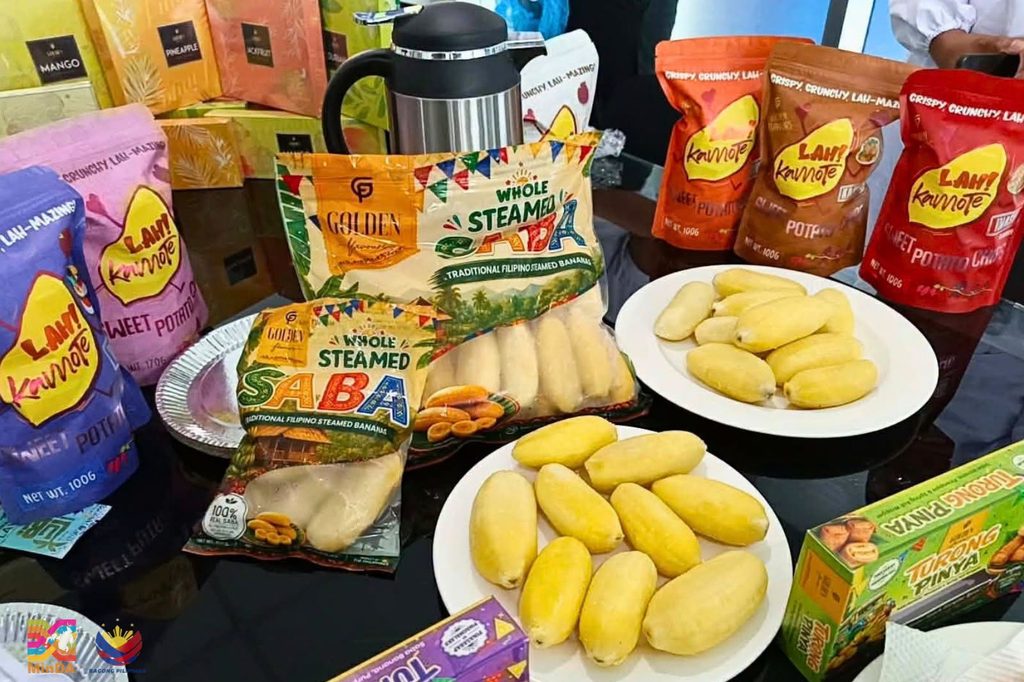
Golden Flavours Pastries and Gourmet Inc. held a send-off ceremony Tuesday for its first trial shipment of steamed saba, scheduled for shipment to Sydney on September 27. The initial consignment represents the company’s entry into the international market and an attempt to connect locally grown bananas with consumers thousands of kilometers away.
More than a shipment of processed fruit, the initiative highlights how value-adding and market linkages can potentially give small agricultural producers access to markets beyond their traditional trading areas.
Golden Flavours said it sources its bananas locally and works with farmers in upland Marilog, where agricultural communities continue to depend heavily on farming for their livelihoods.
For the growers involved, the export arrangement creates a new link in the agricultural value chain: from farms in the highlands of Davao City, to a local processor, and eventually to Filipino and other consumers in Australia.
From Marilog farms to the Australian market
Mindanao Development Authority (MinDA) Assistant Secretary Romeo Montenegro said the shipment demonstrates the potential of Mindanao agriculture to reach high-value international markets.
“This project creates a direct link from our small farmers and Indigenous Peoples who grow the bananas to high-value markets as far as Australia,” Montenegro said.
He said Golden Flavours’ initiative also illustrates the importance of helping small producers meet the volume, quality and value-adding requirements of larger markets.
“We commend Golden Flavours for this endeavor, and for helping small producers achieve the volume, quality, and value-adding required by larger markets,” Montenegro said.
“The goal is not simply to produce more, but to enable our farmers to move up the value chain, access better markets, and earn more from what they produce,” he added.
The distinction is important. Producing agricultural commodities is only one part of the chain. For farmers to benefit from expanding markets, their products must also be consolidated, processed, packaged, transported and connected to buyers who are willing to pay for consistent quality.
That is where processors such as Golden Flavours can play a crucial role.
Adding value to a familiar Filipino crop
Saba is one of the Philippines’ most widely recognized cooking bananas, commonly used in traditional dishes and snacks. Processing the fruit into a ready-to-market product gives it a different commercial pathway from selling fresh bananas at the farm or local market.
Golden Flavours’ own product portfolio includes whole steamed saba, which it markets as a frozen product. The company describes itself as a Davao-based food manufacturer producing Filipino food products using local ingredients and supporting farming communities.
The planned shipment therefore carries significance beyond its seven-ton volume. It represents an effort to transform a familiar agricultural commodity into a processed product that can travel farther, remain commercially viable in an overseas supply chain and reach consumers outside the Philippines.
The company said it is looking at succeeding shipments to Australia and is also exploring other agricultural products that could be prepared for export.
Golden Flavours CEO Razel Ann Suy Tan described the Sydney shipment as a trial intended to test the market and determine whether the product can establish a sustained presence in Australia.
“So this is our first shipment trial. So we’re hoping that it will push through the market there in Australia,” Tan said.
Another shipment to Australia is tentatively planned for next month, she added.
Bringing the Filipino taste closer to Filipinos abroad
For the Department of Agriculture Regional Field Office XI, the initiative also carries a cultural dimension.
DA XI Regional Technical Director for Operations Marie Ann M. Constantino said the shipment could allow Filipinos living in Australia to once again taste a product sourced and processed in the Philippines.
“So makakarating po ito sa ating mga kababayan Pilipino po, yan po ang pinakapunto namin na nagre-request na sana po ang ating produkto makakarating sa kanila at matikman ulit nila ano yung tikim Pilipino po,” Constantino said.
The statement reflects a broader opportunity for Philippine food products abroad: not only to compete as commodities, but also to carry Filipino flavors and food traditions into international markets.
Golden Flavours’ products already include Filipino-inspired food items such as turon, coconut cookies, kamote chips and other pastries and gourmet products, while its website identifies Australia as an international market.
Part of a broader push for agricultural exports
The Davao shipment comes as the Department of Agriculture continues to pursue a more export-oriented approach to Philippine agriculture.
The DA said in July that it was strengthening the country’s agricultural export strategy through a dedicated export development structure focused on opening new markets, strengthening priority industries and making more Philippine farm products globally competitive. Bananas, coconuts and pineapples remain among the country’s traditional agricultural export products, while the government is also seeking to expand markets for other commodities.
The agency has also identified cardaba or saba bananas among the high-value crops being promoted for export, alongside products such as cacao, pomelo, rambutan, mango, pineapple, durian, avocado, dragon fruit, calamansi and ube.
President Ferdinand Marcos Jr.’s administration has likewise emphasized agricultural exports and improving market access for farmers. In July, Agriculture Secretary Francisco Tiu Laurel Jr. said the administration’s export strategy is intended not simply to increase overseas sales but to create better income opportunities for Filipino producers.
The government has also been emphasizing stronger connections between farms and markets, including improvements in logistics, post-harvest systems and food distribution infrastructure.
The Golden Flavours initiative provides a local example of that approach: farmers supply the raw material, a Davao company adds value and prepares the product for a foreign market, and the finished food product moves beyond the domestic supply chain.
The bigger challenge: making exports sustainable
The first shipment is only a beginning.
A successful trial shipment does not automatically guarantee a long-term export market. Sustained international trade requires consistent supply, quality control, food safety compliance, competitive pricing, reliable logistics and dependable relationships with overseas buyers.
For farmers in Marilog, however, establishing such a market could potentially create another avenue for selling their produce.
For the processor, succeeding shipments would mean demonstrating that a locally sourced product can meet the requirements of an international market.
And for Davao and Mindanao, the shipment offers a tangible example of how agricultural products from communities far from major export centers can enter global supply chains when farmers, processors and government agencies are connected.
The seven tons of steamed saba bound for Sydney may therefore be modest in volume compared with the scale of the international agricultural trade.
But its significance lies in the connection it represents—from the upland farms of Marilog to a processor in Davao City, and from there to tables and stores in Australia.
If succeeding shipments push through, the next chapter could involve more bananas, more products and potentially more farmers participating in a value chain that reaches far beyond Mindanao.
For a region known for its agricultural abundance, that connection between farm, processor and global market could be just as important as the export shipment itself.