
SAN MIGUEL, SURIGAO DEL SUR — Several vegetable and fruit vendors in Barangay Poblacion, San Miguel, Surigao del Sur expressed distress after their goods were reportedly thrown away during an incident at the barangay’s Taboan early in the morning.
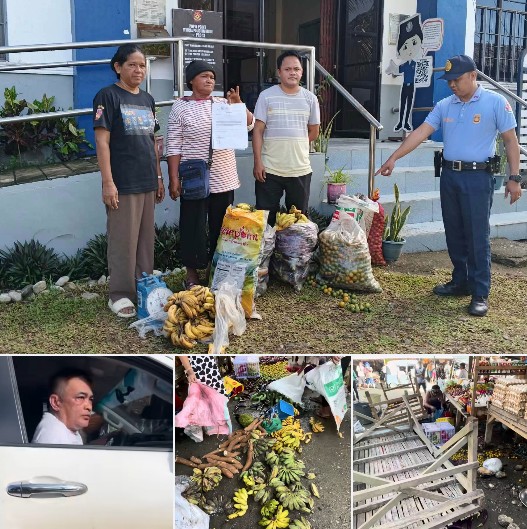
The affected vendors said the incident resulted in the loss of goods that represented their livelihood and daily income. Details surrounding the incident, including the exact quantity and value of the discarded produce, remain subject to verification.
The controversy intensified after Barangay Captain Arnel Tasa issued a statement explaining why he confronted and drove away vendors selling at the Taboan.
According to Tasa, the vendors were allegedly selling on a Saturday, which he said was not the scheduled day for the Taboan under the existing municipal ordinance. He claimed that the unauthorized Saturday selling was also affecting vendors who regularly pay for or rent stalls inside the Public Market because some customers were buying from the Taboan instead.
Tasa said he had previously raised the matter with the San Miguel Municipal Police Station, but claimed that his complaint did not result in a resolution. He said this eventually led him to personally intervene and order the vendors to leave.
That intervention, however, resulted in the throwing away of some of the vendors’ goods.
Tasa acknowledged that what he did was wrong, saying he was carried away by his emotions.
Ordinances cited in the dispute
Documents provided in connection with the incident show that San Miguel has enacted ordinances governing its Taboan or market-day system.
Ordinance No. 27, Series of 2022, entitled “An Ordinance Prescribing Guidelines and Imposing Fees and Charges for the Operation & Maintenance of Taboan at Poblacion Public Market,” defines the Taboan as the building, structure or area at the Poblacion Public Market intended as a transaction area for producers and retailers of locally produced and outsourced products.
The ordinance also identifies the Municipal Economic Enterprise Development and Management Office (MEEDMO) as the municipal office responsible for the collection of fees and charges and the operation and maintenance of the municipal government-owned enterprise.
However, another document supplied in connection with the controversy requires careful consideration.
Ordinance No. 02, Series of 2014, entitled “An Ordinance Enacting the Conduct of Market Day (Tabo System) in the Municipality of San Miguel Every Thursday of the Week,” expressly states that the municipality established a Market Day or Tabo System every Thursday to help farmers sell their agricultural products.
The 2014 ordinance says the system was intended to support farmers and the business sector and specifically mentions agricultural products such as fruits, vegetables, bananas and root crops.
This creates an important issue that should be clarified by the municipal government: whether Ordinance No. 02, Series of 2014 remains effective, and whether it was subsequently amended, repealed, superseded or otherwise modified by Ordinance No. 27, Series of 2022 or another later issuance.
Based on the documents available for this report, the claim that the Taboan is legally limited to Tuesday has not independently been established. Tasa specifically cited Tuesday as the authorized market day, while the 2014 ordinance supplied for this report expressly identifies Thursday.
The municipality should therefore make the currently effective Taboan ordinance publicly available to settle the question.
Public interest and treatment of vendors
The dispute goes beyond the question of what day the Taboan should operate.
For small vendors, vegetables and fruits are not merely merchandise. They are capital purchased with limited resources, products that can quickly spoil, and, in many cases, the source of a family’s income for the day.
At the same time, municipal and barangay authorities have a legitimate responsibility to enforce valid market regulations and to ensure that rules are applied fairly to all vendors, including those who pay for stalls inside the public market.
The challenge for local authorities is to enforce those rules without unnecessarily destroying the livelihood of the people they are supposed to serve.
Republic Act No. 6713, or the Code of Conduct and Ethical Standards for Public Officials and Employees, states that public officials must uphold public interest, professionalism, justness and sincerity, and responsiveness to the public. It specifically calls for public officials to respect the rights of others and to provide prompt, courteous and adequate service. Lawphil
The Local Government Code likewise provides that local governments are tasked with promoting general welfare, including economic prosperity, social justice and full employment among their residents. Official Gazette
These principles do not remove the authority of local governments to enforce legitimate ordinances. But they underscore the importance of proportionate, orderly and humane enforcement.
If vendors are violating an established market rule, the appropriate response should include clear notice of the regulation, communication of where and when they are allowed to sell, and proper enforcement mechanisms. Where disputes arise, coordination with the municipal offices responsible for market management may also help prevent confrontations from escalating.
Vendors deserve clarity and dignity
The affected vendors deserve to know why their goods were removed, what specific ordinance was allegedly violated, and what rules currently govern the Taboan.
They also deserve an opportunity to be heard.
At the same time, the public deserves the full story—including the barangay government’s explanation and the actual provisions of the ordinance currently in force.
This is not simply a dispute between a barangay official and several vendors. It raises a broader question about how local governments balance market regulation, fair competition, public order and the livelihood of ordinary residents.
Barangay Captain Tasa has acknowledged that throwing away the vendors’ goods was wrong and attributed his action to emotion. That acknowledgment is an important part of the account, but the circumstances surrounding the incident—including the exact rule governing the market schedule and the authority and procedure used to remove the vendors—still need to be fully established.
For now, the most important next step is transparency: the municipal government should clarify which Taboan ordinance is currently effective, when vendors are legally allowed to sell, and what enforcement procedure should be followed when violations occur.
Rules should be enforced. But rules should also be communicated clearly, applied fairly and implemented in a manner that respects the dignity and livelihood of the people affected.