
Metro Manila vs. the Rest of the Country
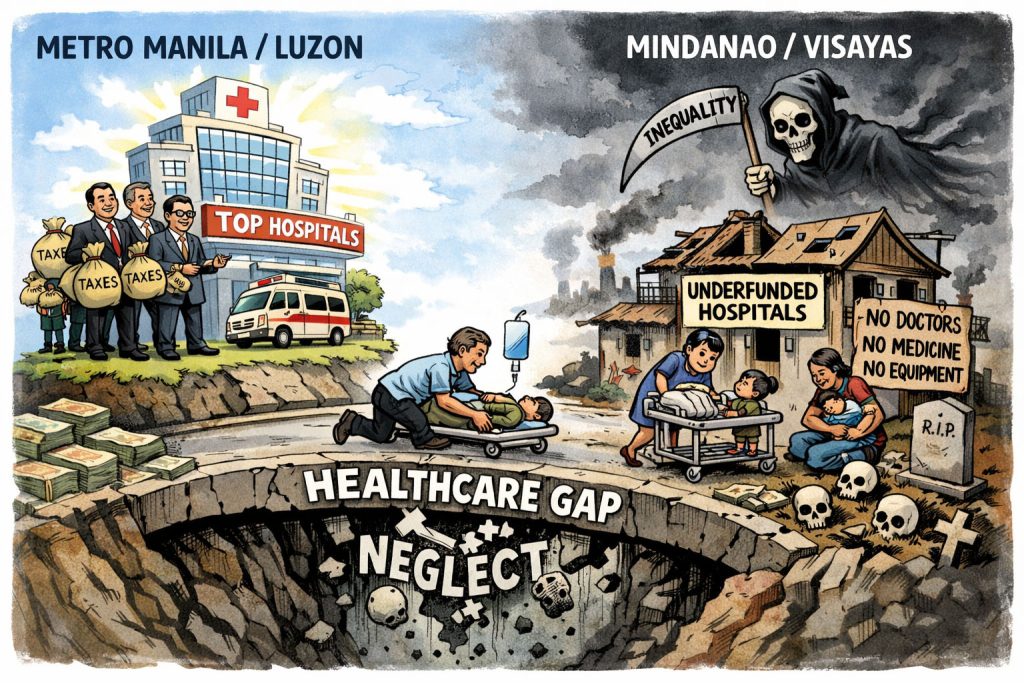
When Newsweek and Statista released the World’s Best Hospitals 2026, it was intended as a guide for patients navigating uncertain health crises. Instead, for millions of Filipinos outside Luzon, it confirmed a painful reality: the Philippines’ healthcare system is deeply unequal. While Metro Manila boasts multiple hospitals in the top tier, Mindanao and much of the Visayas barely make a mark. Out of the country’s top 35 hospitals, only three hail from Mindanao: Davao Doctors Hospital (Rank 14, private), Southern Philippines Medical Center (SPMC) (Rank 29, public), and Adventist Medical Center – Valencia (Rank 30, private). Cebu carries much of the Visayan representation. The dominance of Luzon-based hospitals such as St. Luke’s Medical Center – Global City, Makati Medical Center, and Asian Hospital and Medical Center highlights a stark geographic disparity that is both longstanding and systemic.
Public Hospitals Left Behind
The ranking exposes not just private hospital dominance, but also public healthcare inequality. SPMC, the largest government hospital in Mindanao serving millions, lags far behind Luzon’s public and private institutions. Compare this to UP-Philippine General Hospital (PGH), which ranks 6th nationally, showing that high-quality public healthcare is achievable—but only if you are in Manila. For Mindanaoans and Visayans, the reality is overcrowded wards, delayed diagnostics, and preventable deaths. This is a glaring failure of equitable healthcare delivery.
Taxes Without Returns
Every Filipino contributes to the national treasury, whether through income, consumption, or indirect levies. Yet, when illness strikes, access to quality care is uneven. Farmers in Bukidnon, fisherfolk in Samar, and laborers in Maguindanao all pay taxes, but often cannot access the services their contributions help fund. In effect, citizens in underserved regions are subsidizing a system they cannot fully utilize.
The Human Cost
Healthcare disparities are not abstract—they are fatal. Every hour spent traveling to a tertiary hospital increases risk. Delays in diagnosis and treatment cost lives, whether it’s cancer detected too late, stroke patients missing the critical window for intervention, or mothers and newborns lost during transit. These are not isolated incidents; they are systemic consequences of decades-long neglect.
A Problem Decades in the Making
The imbalance between Luzon and the rest of the Philippines did not begin in 2026. It has persisted across administrations, budgets, and policy promises. Investments have been made—new hospitals, equipment, and expansions—but Luzon remains prioritized, leaving the rest of the country in a perpetual state of waiting. “Eventually” has stretched into decades, and the human cost continues to mount.
The Path Forward
Incremental adjustments are no longer enough. The Philippines needs bold, decisive action: massive investment in regional medical centers, deployment of specialists to underserved areas, equitable distribution of advanced medical equipment, and strengthened public hospitals outside Metro Manila. Data transparency must expose—not obscure—the gaps. Most importantly, the mindset that Manila is the center of healthcare must change. Health outcomes should not be determined by geography.
A Moral Imperative
The World’s Best Hospitals 2026 ranking was meant to guide patients, but for many Mindanaoans and Visayans, it serves as a grim reminder that quality and affordable healthcare remains a distant dream. This is not merely a policy gap—it is a moral failure. In a country where survival depends on your ZIP code, the system is not just unequal; it is profoundly unjust.