
The unfolding war between the United States–Israel coalition and Iran is more than just another Middle Eastern conflict. It is a warning about how modern wars are fought—and how smaller countries caught within alliance networks can suddenly find themselves on the front line. The pattern is already visible: after the initial strikes by the United States and Israel, Iran did not retaliate directly against American soil. Instead, it targeted U.S. military bases scattered across the region—installations located in countries like Qatar, Bahrain, Jordan, and Iraq. This is the reality of 21st-century warfare: bases hosting allied forces become immediate targets, and host nations inevitably become part of the battlefield whether they intend to or not.

The Parallel Situation in the West Philippine Sea
This scenario should resonate deeply in the Philippines. The tension between the Philippines and China in the contested waters known internationally as the South China Sea and domestically as the West Philippine Sea continues to intensify. At the same time, the rising confrontation between China and Taiwan adds another layer of danger in the region. Geographically, the Philippines sits near one of the most dangerous flashpoints in the world. If a war were to erupt around Taiwan, it would be nearly impossible for the Philippines to remain untouched.
In such a scenario, the country’s alliance with the United States—while strategically important—also carries risks that many Filipinos are only beginning to understand.
EDCA: Shield or Target?
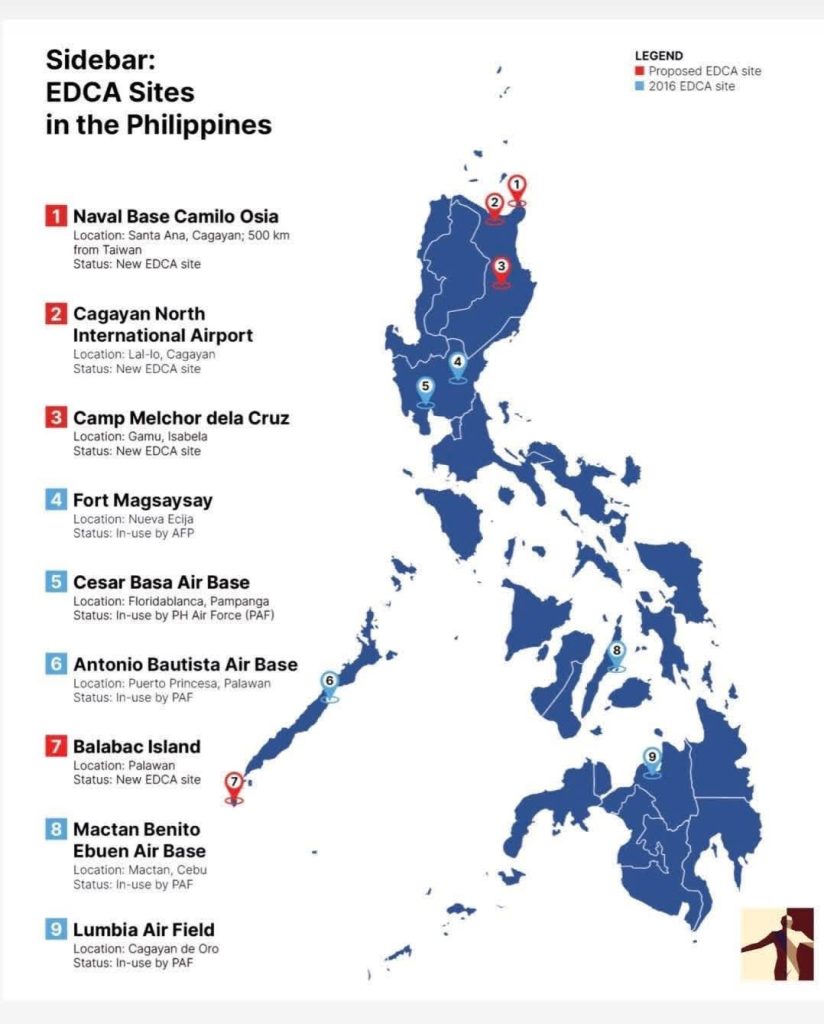
The expansion of U.S. access to Philippine military facilities under the Enhanced Defense Cooperation Agreement has been justified as a deterrent against aggression. Under this arrangement, multiple locations across the country now host American troops, equipment, and logistics capabilities.
These include bases in Cagayan, Isabela, Nueva Ecija, Pampanga, Palawan, Cebu, and Cagayan de Oro—some of which are strategically positioned near Taiwan and major sea lanes. In theory, these installations strengthen the country’s defense posture. In reality, however, they also create potential targets in the event of a regional war.
What we are witnessing in the Middle East today demonstrates this clearly: military bases linked to the United States become priority targets during retaliation. If such a pattern were replicated in Asia, the Philippines would not simply be a bystander. It could become one of the first places struck in a broader conflict.
The Hard Question: Can the Philippines Survive the First 30 Days?
The Armed Forces of the Philippines has previously acknowledged a sobering reality: in the event of a major conflict, the country may need to hold its ground for a period of time before allied reinforcements fully arrive. This has often been described as a 30-day defensive window.
But the question that many Filipinos are beginning to ask is this: can the country realistically last that long?
Unlike countries such as Japan and South Korea, which possess sophisticated missile defense systems, advanced fighter fleets, and deep stockpiles of weapons, the Philippines is still in the process of modernizing its military capabilities. Air defense systems remain limited. The number of combat aircraft is relatively small. Missile interception capability is minimal compared to regional powers. Infrastructure such as air bases and ports are still vulnerable to precision strikes.
In a modern war dominated by missiles, drones, cyber attacks, and rapid strikes against critical infrastructure, the opening days could determine the outcome.
Geography: Advantage or Exposure?
The Philippines is an archipelago of more than 7,000 islands—a geography that can be both a strength and a vulnerability. In theory, the country could adopt a distributed defense strategy, making it difficult for an adversary to control the entire territory. However, without sufficient air and missile defense coverage, key military facilities could be neutralized early in a conflict.
And if the pattern seen in the Middle East repeats itself in Asia, the first targets would likely be:
- Air bases hosting allied forces
- Radar installations
- Naval facilities
- Logistics hubs
Many of these are precisely the sites now linked to joint operations under EDCA.
Are We Prepared for Modern Warfare?
This is the question that deserves urgent national debate—not driven by fear, but by realism. Wars today are faster, more technological, and more devastating than ever before. Countries that survive the first phase of conflict are those with layered defenses, hardened infrastructure, and strong domestic production of weapons and supplies.
Japan and South Korea have spent decades building such capabilities. Taiwan has invested heavily in missile defense and asymmetric warfare strategies designed to make invasion extremely costly.
The Philippines, by contrast, is still transitioning from a military historically focused on internal security operations toward one capable of defending external territory against a major power.
That transition is happening—but many experts believe it is not happening fast enough.
Deterrence or Dependence?
Supporters of the alliance with the United States argue that EDCA and joint defense arrangements strengthen deterrence. The presence of American forces signals that any attack on the Philippines could trigger a broader conflict involving a global superpower.
But critics warn of another reality: dependence.
If the country’s defense relies too heavily on external forces, then the Philippines risks becoming vulnerable during the critical early phase of conflict—especially if adversaries decide to strike preemptively at alliance-linked infrastructure.
The war unfolding in the Middle East is showing exactly how such strategies unfold.
A Nation at a Strategic Crossroads
The Philippines today stands at a strategic crossroads. On one side is the necessity of alliances in a region where power balances are shifting rapidly. On the other is the urgent need to strengthen independent defense capabilities—particularly air defense, missile systems, and hardened military infrastructure.
This is not merely a military issue. It is a national security question that affects the entire population.
If war were to break out in the region, the Philippines would not just be defending a disputed sea. It would be defending cities, communities, and millions of civilians living near strategic military sites.
The Real Danger: Complacency
Perhaps the greatest risk is not weakness—but complacency. Many Filipinos still see large-scale war as something distant, something that happens in other parts of the world. But global events are increasingly interconnected. The war in the Middle East is a reminder that alliances and geography can pull countries into conflicts faster than expected.
The Philippines cannot afford to assume that it will have time to prepare once a crisis begins.
Preparation must happen now.
Because in modern warfare, the countries that survive are not the ones that react—they are the ones that are ready before the first missile is ever launched.