
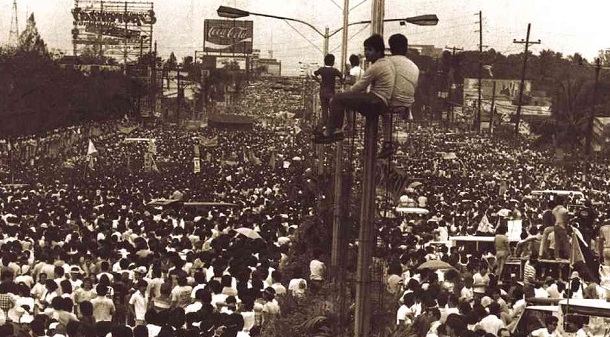
The story of the People Power Revolution is often told as a triumph: millions of Filipinos filling Epifanio de los Santos Avenue, praying the rosary in front of tanks, and peacefully ending the rule of Ferdinand Marcos. It is remembered as a global symbol of nonviolent resistance, the moment when dictatorship fell and democracy returned.
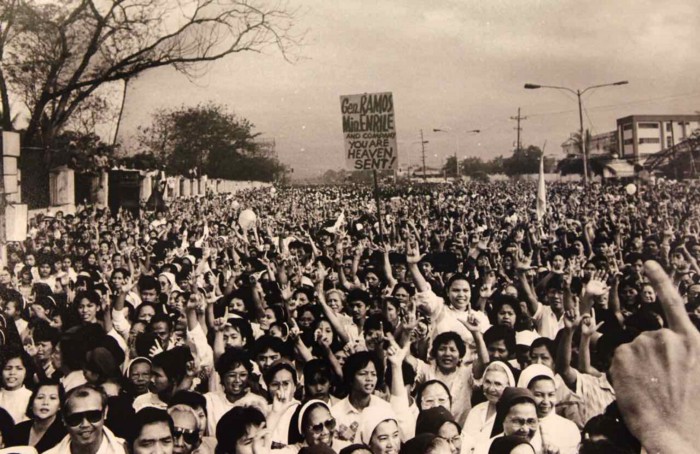
But nearly four decades later, many Filipinos are asking a harder question: what did the revolution truly change—and what did it fail to fix?
For supporters, EDSA restored democratic institutions, reopened the press, and ended martial law abuses. Yet for critics and skeptics, the revolution replaced one system with another that still allowed corruption, political dynasties, and deep inequality to persist. The promise of reform, they argue, slowly faded into disappointment.
The dark road that led to EDSA
Before the uprising, the Philippines had endured years of authoritarian rule under Marcos, who declared martial law in 1972. Political opponents were jailed, media outlets shut down, and civil liberties curtailed. The assassination of opposition leader Benigno Aquino Jr. in 1983 shocked the nation and ignited widespread resistance. Religious leaders such as Jaime Sin called on Filipinos to take to the streets.
By February 1986, protests erupted after disputed elections between Marcos and opposition candidate Corazon Aquino. What followed was a four-day mass uprising that forced Marcos into exile and installed Aquino as president.
At the time, the world celebrated it as a miracle—a revolution without bloodshed.
But revolutions are judged not only by how they begin, but by what comes after.
From fighting corruption to multiplying it?
One of the rallying cries of EDSA was the fight against corruption and cronyism during the Marcos era. Yet critics argue that the post-EDSA political order did not eliminate corruption—it decentralized and multiplied it.
Instead of a single powerful circle accused of monopolizing wealth and influence, corruption scandals in later decades spread across multiple branches of government: national agencies, local political clans, and entrenched dynasties.
Many Filipinos began to feel that the system merely changed faces. Elections returned, but the same families often remained in power. Political competition became intense—but not always cleaner.
For those who once believed EDSA would fundamentally reform governance, this has been one of the most painful contradictions of the revolution.
The economy: from promise to uneven growth
Another criticism often raised is economic trajectory. Before the crises of the early 1980s, the Philippines had once been described by some observers as one of Asia’s promising economies. After the debt crisis, political instability, and transition period, recovery proved slow and uneven.
In the decades that followed EDSA, the country did achieve periods of growth—but poverty remained widespread, inequality persisted, and millions of Filipinos were forced to seek work abroad.
Critics argue that large-scale privatization of state assets and infrastructure during later administrations reduced government control over vital sectors. Supporters say these reforms were necessary for modernization. The debate continues to shape Philippine politics today.
National defense and sovereignty concerns
Another issue raised by skeptics of the post-EDSA era is national defense. They argue that political instability, budget limitations, and policy priorities weakened the country’s territorial defense over time.
As tensions in regional waters increased in recent years, many Filipinos questioned whether decades of underinvestment in defense capabilities had left the country vulnerable.
To them, democracy alone did not guarantee national strength.
Democracy delivered—but not equally
There is no doubt that EDSA restored freedoms that were suppressed during martial law: elections, a free press, civil society activism, and constitutional protections.
Yet democracy, critics say, did not automatically translate into social justice.
Poverty remains deeply rooted in many regions. Government aid programs—often called “ayuda”—have helped struggling families, but they are also frequently criticized for being politicized, used by some politicians to maintain loyalty rather than solve structural problems.
Meanwhile, taxpayers—especially workers and small businesses—continue to carry the financial burden of governance.
This has created a bitter divide: a political class that thrives within the system and millions of citizens who feel left behind by it.
The uncomfortable question today
Perhaps the most controversial question surrounding EDSA is this:
Did the revolution transform the system, or did it only reset it?
For some Filipinos, EDSA remains sacred—a moment when ordinary people reclaimed their freedom and proved that peaceful protest could topple a dictatorship.
For others, the revolution represents a missed opportunity: a historic uprising that removed a ruler but failed to dismantle the deeper structures of corruption, political dynasties, and economic inequality.
The fact that the Marcos family eventually returned to national power decades later shows how complex and unresolved the legacy of EDSA remains.
A revolution still being debated
History rarely delivers simple verdicts. The People Power Revolution ended authoritarian rule, but it also opened a new chapter that is still unfolding.
In the end, the real measure of EDSA may not lie in what happened in February 1986—but in whether the Philippines can still achieve the deeper reforms that millions of Filipinos once hoped the revolution would bring.
Because for many today, the question is no longer whether EDSA happened, but whether its promise was ever fully realized.