
Davao-led agricultural initiative dispatches 50 metric tons of coconuts worth US$22,400 for rural feeding programs in West Africa
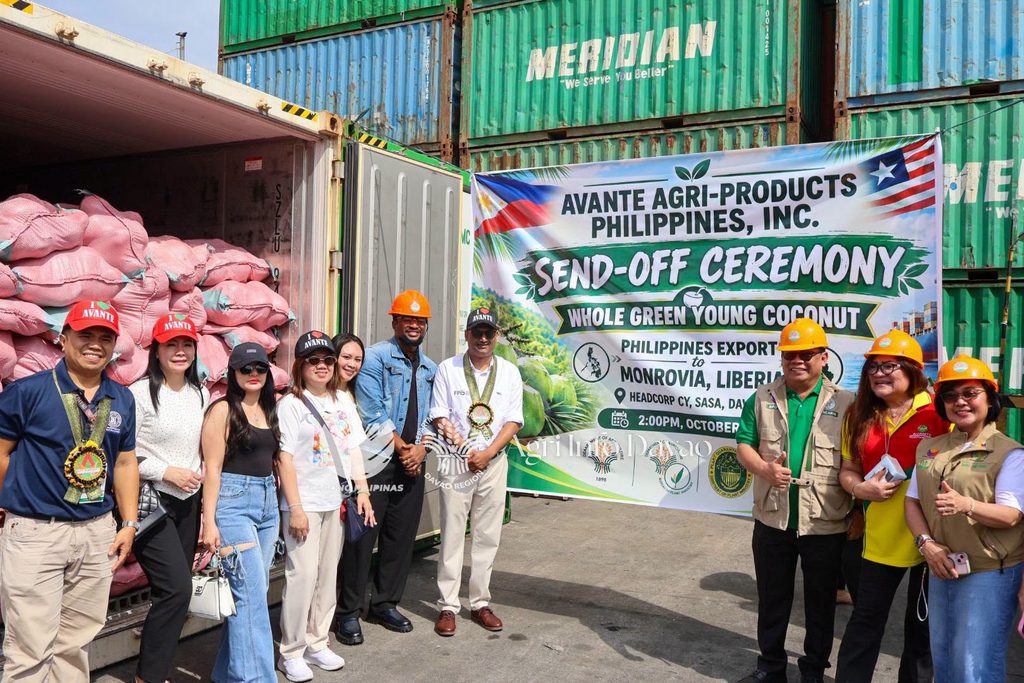
DAVAO, Philippines — From the coconut-producing communities of Davao to rural villages in West Africa, a shipment of 32,000 fresh young coconuts is carrying a message of agricultural cooperation and humanitarian assistance as the Philippines marks what the Department of Agriculture–Regional Field Office 11 (DA-11) and Avante Agri-Products Philippines Inc. describe as the country’s first-ever export of whole green fresh young coconuts to the Republic of Liberia.
The milestone shipment, formally dispatched through a send-off ceremony in Davao, underscores the potential of the region’s agricultural sector to connect local producers with international initiatives addressing food and nutrition needs.
The cargo, bound for Monrovia, Liberia’s capital, consists of two 40-foot refrigerated containers carrying 1,600 sacks, equivalent to 32,000 whole green fresh young coconuts. With an estimated total weight of 50 metric tons and a declared value of US$22,400, the shipment represents a significant logistical undertaking for the participating agricultural stakeholders.
Transported through CMA CGM shipping lines, the coconuts are being carried in containers equipped with Smart Reefer technology to help maintain suitable conditions for the perishable produce during its journey across international waters.
But beyond the shipment’s volume and destination, the initiative puts Davao’s agricultural sector at the center of an effort linking Philippine-grown produce with humanitarian assistance for communities thousands of kilometers away.
Davao at the center of an international agricultural initiative
The shipment was undertaken through collaboration among DA-11, Avante Agri-Products Philippines Inc., the Philippine Coconut Authority (PCA), the Davao City Agriculture Office, local coconut partner-farmers and other stakeholders.
Coordination with Liberia’s Ministry of Agriculture helped facilitate the initiative, with the coconuts designated as a direct donation to rural Liberian communities.
The participation of government agencies, a private agricultural enterprise and coconut farmers demonstrates how Davao-based agricultural initiatives can mobilize different parts of the supply chain—from production and consolidation to international shipping—to deliver Philippine agricultural products abroad.
For Davao and the wider Davao Region, the shipment offers an example of how agricultural commodities can reach destinations beyond conventional trading routes when producers, exporters, government institutions and logistics providers work together.
The significance of the initiative, however, extends beyond establishing a new export destination. It also raises the question of whether similar efforts can develop into sustained opportunities for local farmers and agricultural enterprises.
A single shipment does not establish a permanent international market, but it can provide a starting point for testing logistics arrangements, strengthening partnerships and exploring future demand.
From local coconut production to global humanitarian assistance
Unlike an ordinary commercial consignment intended for supermarket shelves or wholesale distribution, the coconuts are earmarked for donation to rural communities in Liberia.
The shipment is intended to support local feeding programs and provide practical nutritional benefits to households receiving the produce.
This humanitarian purpose gives the Davao-led initiative a broader significance: agricultural production and export logistics are being used to connect producers in the Philippines with communities in need of food assistance abroad.
The actual impact will depend on how the coconuts are distributed, how many people benefit and how the donation is incorporated into existing feeding programs. Details regarding the recipient communities, beneficiary numbers and distribution schedule have not been provided.
Nevertheless, the initiative demonstrates a potential role for agricultural partnerships in supporting humanitarian efforts while showcasing Philippine-grown products to international stakeholders.
Preserving freshness across thousands of kilometers
Moving fresh young coconuts from the Philippines to Liberia requires more than sufficient agricultural production. It also depends on proper handling, storage and transportation to help preserve product quality throughout the journey.
The shipment is being transported in two refrigerated containers using CMA CGM’s Smart Reefer technology, which is intended to help maintain the required conditions for the perishable cargo.
Cold-chain logistics are particularly important when fresh agricultural produce must travel long distances across international waters. Without appropriate transport conditions and coordinated handling, exporters face challenges in ensuring that produce remains suitable for its intended use upon arrival.
For agricultural enterprises in Davao seeking to expand into overseas markets, the operation illustrates the importance of combining production capacity with dependable logistics and international partnerships.
The shipment information does not specify the expected transit time, precise temperature settings or final distribution arrangements in Liberia.
Can the shipment open new opportunities for Davao’s coconut farmers?
The historic dispatch provides a concrete example of how local agricultural producers can participate in an international supply chain, but its long-term implications for farmers remain to be established.
Sustained export opportunities would require reliable supplies, consistent quality, competitive shipping costs, compliance with import requirements and dependable overseas partners. Future shipments would also depend on whether additional demand can be developed and whether participating producers can meet the necessary volume and quality standards.
For coconut farmers in Davao and surrounding producing communities, the potential value of such initiatives lies in whether they can eventually generate more stable demand, diversify market access and create tangible livelihood benefits.
Those outcomes cannot yet be determined from the initial shipment alone. Further information on future orders, farmer participation, purchase arrangements and the distribution of economic benefits would help establish whether the initiative can grow beyond its initial humanitarian purpose.
A milestone for Davao, with a mission beyond the Philippines
The dispatch of 32,000 fresh young coconuts to Liberia marks a notable development for the agricultural stakeholders involved in Davao and for the Philippine coconut industry.
It brings together local agricultural production, refrigerated international transport and a humanitarian objective aimed at supporting rural communities in West Africa.
For DA-11, Avante Agri-Products Philippines Inc. and their partners, the initiative highlights what coordinated action among farmers, government agencies, exporters and logistics providers can accomplish.
For Davao, it offers an opportunity to demonstrate the potential of its agricultural sector to contribute to international initiatives while exploring new pathways for Philippine-grown products to reach overseas destinations.
Whether the shipment becomes the foundation for recurring exports or remains a one-time humanitarian initiative will depend on what follows. Its lasting significance will ultimately be measured by the assistance delivered to Liberian communities and the opportunities it creates for the farmers and agricultural enterprises behind the shipment.