
DAVAO CITY — Davao City is reinforcing its commitment to education and public service on two fronts: expanding access to quality learning facilities for students and helping produce more doctors who can serve communities in need.
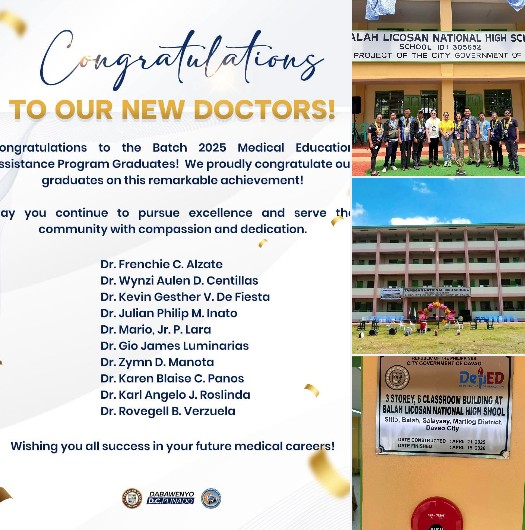
On October 19, the city government announced the opening of 26 new classrooms in two public secondary schools while celebrating 10 new doctors, including scholars supported through its Educational Benefits System Unit (EBSU), who passed the 2026 Physician Licensure Examination (PLE).
Together, the developments highlight a broader approach to education that goes beyond building schools or providing financial assistance. Davao City is investing in the educational journey from the classroom to professional qualification, strengthening the foundations for a future workforce that can contribute to the city’s development and the welfare of its residents.
The twin milestones also underscore the role of local government in making education more accessible, supporting students through different stages of learning, and creating opportunities for Dabawenyos to pursue careers that can benefit the wider community.
26 new classrooms expand access to public education
In partnership with the Department of Education’s Davao City division, the city government officially opened 26 newly constructed classrooms on October 19, providing additional learning spaces for students in two public secondary schools.
The facilities comprise a four-storey building with 20 classrooms at Tamugan National High School and a three-storey building with six classrooms at Balah Licosan National High School.
Both projects were funded through the city’s Special Education Fund (SEF), which supports education-related programs and infrastructure.
The additional classrooms are expected to help accommodate the needs of public school students by expanding available learning spaces and supporting the delivery of education in a more suitable school environment.
For communities served by these schools, the new buildings represent a tangible investment in the next generation. Adequate classrooms are essential to creating conditions in which students can participate in lessons, teachers can deliver instruction effectively, and schools can better respond to growing educational needs.
The latest opening also adds to the city’s continuing school infrastructure program. Since January 2026, the city government has completed a total of 88 classrooms, with additional facilities expected to open before the end of the year.
The growing number of completed classrooms points to an ongoing effort to address infrastructure requirements across the public education system, rather than treating school construction as a one-time undertaking.
While the opening of new buildings does not, by itself, resolve every challenge facing public schools, sustained investment in facilities provides an important foundation for improving access to education and supporting students throughout their basic education.
From educational assistance to producing more doctors
Beyond the construction of school facilities, Davao City is also celebrating the achievements of 10 new physicians who passed the 2026 Physician Licensure Examination, including graduates supported by the city through its Educational Benefits System Unit.
The new doctors are:
- Dr. Frenchie C. Alzate
- Dr. Wynzi Aulen D. Centillas
- Dr. Kevin Gesther V. De Fiesta
- Dr. Julian Philip M. Inato
- Dr. Mario, Jr. P. Lara
- Dr. Gio James Luminarias
- Dr. Zymn D. Manota
- Dr. Karen Blaise C. Panos
- Dr. Karl Angelo J. Roslinda
- Dr. Rovegell B. Verzuela
Their success marks another milestone for the city’s Medical Education Assistance Program, which was established in 2018 to help make medical education more accessible.
With the latest group of passers, the program has recorded a cumulative total of 106 licensure examination passers since its establishment.
The milestone illustrates how local educational assistance can extend beyond basic education and help qualified students pursue demanding professional degrees. Medical training requires years of academic preparation and clinical education, making financial support an important consideration for students who might otherwise face barriers to completing their studies.
By supporting aspiring physicians, the city is helping expand opportunities for Dabawenyos to enter a profession that plays a critical role in public health, disease prevention, patient care and community well-being.
The achievement also carries an expectation of responsibility. Passing the licensure examination marks an important professional milestone, but the broader value of medical education lies in how physicians apply their knowledge, uphold professional standards and provide compassionate care to patients.
The city government congratulated the new doctors and encouraged them to continue pursuing excellence while serving the community with dedication and compassion.
A longer-term investment in Davao’s future
What makes the two announcements significant when viewed together is the range of educational needs they address.
The opening of 26 classrooms responds to the immediate need for adequate learning facilities for schoolchildren. The Medical Education Assistance Program, meanwhile, supports students pursuing one of the country’s most demanding professional qualifications.
These efforts reflect two complementary responsibilities of local government: creating the conditions for children to receive an education and helping capable students advance toward careers that contribute to society.
The city’s record of 88 completed classrooms since January and 106 medical licensure examination passers under its assistance program since 2018 provides measurable indicators of progress in these areas.
However, the long-term impact of these investments will ultimately depend on more than the number of buildings completed or graduates who pass professional examinations. It will also depend on the quality of education delivered, the continued availability of learning opportunities, and whether graduates can translate their training into meaningful service.
For Davao City, the challenge is to sustain these gains while ensuring that investments in education reach communities and students who need them most.
The latest developments offer a picture of a city working to strengthen both the infrastructure of education and the people who will shape its future. Classrooms provide the spaces where young Dabawenyos begin building their ambitions; educational assistance helps some of them continue that journey toward professional careers.
From Tamugan National High School and Balah Licosan National High School to the ranks of newly licensed physicians, the common thread is an investment in human potential.
As the city continues opening additional classrooms and supporting students through higher education, its broader goal is clear: to make educational opportunities more accessible and equip more Dabawenyos with the knowledge and skills needed to contribute to their communities.
For Davao City, building a stronger future means investing not only in structures made of concrete, but also in the people who will carry the city forward.