
SIASI, Sulu — In a province long shaped by cycles of conflict and fragile ceasefires, a quiet but significant effort to rebuild trust unfolded on May 4, as government troops and Moro National Liberation Front (MNLF) community leaders gathered not for confrontation, but for conversation.
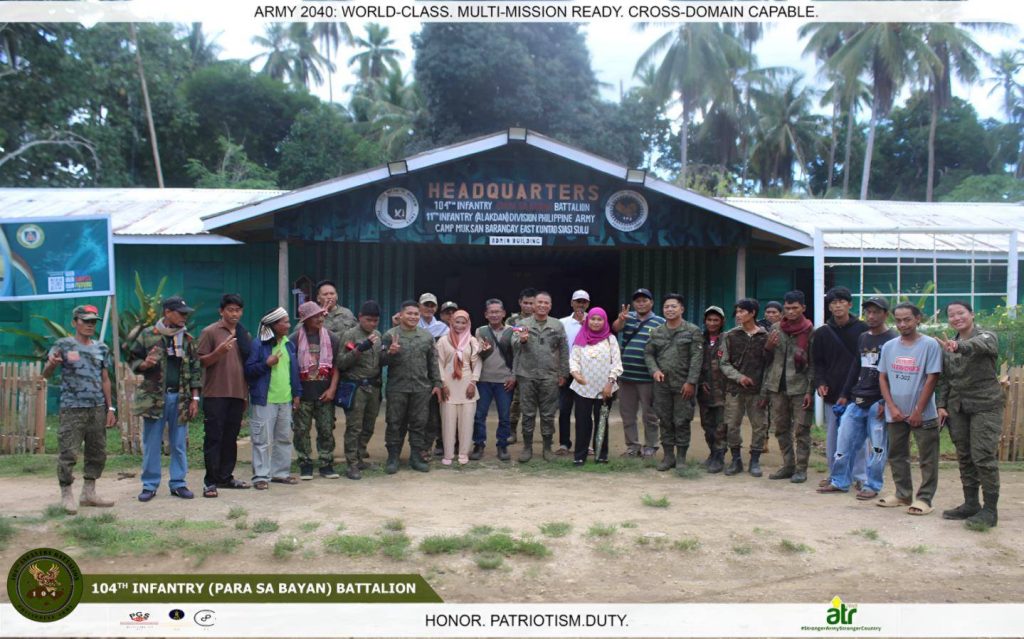
The 104th Infantry (Para sa Bayan) Battalion of the Philippine Army, under the 11th Infantry Division, led a peace-focused briefing and fellowship with MNLF leaders from the island municipalities of Siasi and Pandami. The initiative reflects a growing shift toward community-based peacebuilding in Sulu, where decades of armed struggle have gradually given way to dialogue and cooperation.
At the center of the engagement was Lt. Col. Roy R Dalumpines, Commanding Officer of the 104th Infantry Battalion, joined by Civil-Military Operations Officer 1Lt. Roylando C Garcia.
Rather than a one-sided briefing, the activity evolved into an open forum—an intentional space where long-standing grievances, misunderstandings, and local concerns could be aired directly. For both soldiers and former combatants, the dialogue marked a rare opportunity to engage beyond the boundaries of rank and affiliation.
Participants raised issues affecting their communities, while military officials clarified policies and ongoing initiatives. The exchange, according to organizers, aimed to bridge gaps that often fuel mistrust and hinder peace efforts at the grassroots level.
“The path to peace is not the responsibility of the Armed Forces alone,” Dalumpines said during the gathering. “It requires the shared commitment of communities, leaders, and all stakeholders working together.”
A highlight of the engagement was the renewed push for a “Rido-Free, Gun-Free, and Peace-Centered Community” (RFGPCC)—a localized framework that seeks to address clan feuds, reduce the proliferation of firearms, and promote a culture of non-violence. In Sulu, where rido or clan-based conflicts have historically contributed to instability, the initiative underscores the importance of community-led solutions alongside security operations.
The day concluded not with formalities, but with a boodle fight—a communal meal shared by soldiers and MNLF members. Spread across banana leaves, the simple act of eating together carried symbolic weight, reflecting a shared desire to move forward from a past defined by division.
While challenges remain in sustaining long-term peace in Sulu, engagements like this signal a broader transformation: from armed encounters to inclusive dialogue, from suspicion to cooperation.
For the 104th Infantry Battalion, the effort is part of an ongoing strategy to deepen partnerships with local stakeholders. For community leaders, it represents a chance to shape peace not as a distant policy, but as a lived reality within their own villages.
As Siasi and Pandami continue to navigate the complexities of post-conflict recovery, the message from both sides is clear—lasting peace will not be imposed, but built together.