
The declaration of a national energy emergency under Executive Order No. 110 is not just a policy move—it is an admission. An admission that beneath months of official reassurances lies a fragile, reactive system now scrambling to catch up with a crisis it long denied. While Malacañang frames the decision as a necessary response to escalating tensions in the Middle East, the deeper truth is far more unsettling: this crisis did not arrive overnight. It was foreseeable, predictable—and yet, it appears, insufficiently prepared for.
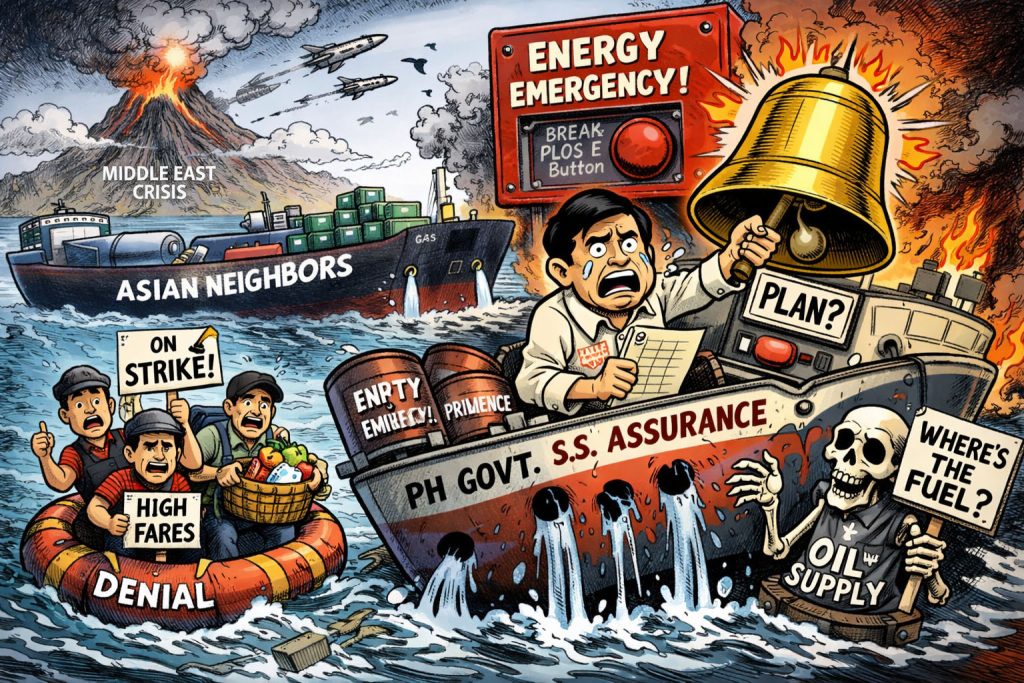
From Assurances to Alarm Bells
For weeks, even as geopolitical tensions escalated globally, the Filipino public was told there was no cause for panic. No shortage. No crisis. No immediate impact on fuel or commodities. These assurances now ring hollow.
The first week of conflict proved otherwise. Fuel prices surged almost instantly. Transport costs followed. Basic goods—food, logistics, daily necessities—began climbing in price. On paper, the government resisted acknowledging the severity. On the ground, ordinary Filipinos were already absorbing the shock.
This disconnect between official narrative and lived reality is perhaps the most dangerous aspect of this unfolding crisis. Trust, once eroded, is harder to restore than any disrupted fuel supply chain.
A Region Prepared, A Nation Exposed
Across Southeast Asia, the same global pressures were felt—but not equally. Neighboring countries, while not immune to rising oil prices, were far better cushioned. Why? Because they prepared.
Diversified energy sources, stronger fuel reserves, and more strategic foreign policies allowed them to absorb the blow. Their price increases, while real, were measured—not the sharp, immediate spikes seen in the Philippines.
In contrast, the Philippines’ heavy dependence on imported fuel has once again exposed a long-standing vulnerability. The government’s own data reveals a sobering reality:
- LPG supply: 23.51 days
- Jet fuel: 38.62 days
- Diesel: 45.82 days
- Gasoline: 53.14 days
These are not comforting figures in the face of a prolonged global disruption. These are warning signs.
Policy Whiplash and Public Frustration
Nothing illustrates the government’s reactive posture more than the handling of transport fares.
The Department of Transportation approved fare increases—₱1 for jeepneys, higher adjustments for buses—acknowledging the burden on drivers and operators. Yet, within a day, the President reversed the decision.
The result? Confusion. Frustration. Anger.
Transport groups, already reeling from rising fuel costs, saw the move as indecisive and disconnected. Strikes are now beginning to ripple through the streets—not merely as economic protest, but as a manifestation of policy inconsistency.
In times of crisis, clarity is currency. The government is spending it poorly.
An Emergency Declared Too Late?
Executive Order No. 110 outlines sweeping measures—fuel procurement, anti-hoarding enforcement, subsidies, conservation programs, and the creation of the UPLIFT Committee. On paper, it is comprehensive. Ambitious, even.
But it also raises a critical question: why only now?
The global situation did not deteriorate overnight. The risks surrounding the Strait of Hormuz, the volatility of oil markets, and the Philippines’ import dependence have long been known. The mechanisms being activated today could have been prepared, simulated, or even partially implemented months ago.
Instead, the response appears triggered not by foresight—but by pressure.
The Illusion of Control
The Department of Energy continues to assure the public that fuel shipments are coming. That supply will stabilize. That measures are in place.
But the question many Filipinos are now asking is simple: Where is this supply, and will it be enough?
Assurances without transparency only deepen uncertainty. Without clear sourcing, timelines, and contingency plans, these statements risk sounding like echoes of the same premature confidence that preceded this crisis.
A Government on the Defensive
The declaration of an energy emergency should project strength—a government taking decisive control of a difficult situation. Instead, it feels like a government on the defensive, reacting to events rather than shaping outcomes.
The creation of committees, the mobilization of agencies, the invocation of emergency powers—these are necessary steps. But they are also belated ones.
Meanwhile, the burden shifts, as it often does, to the public:
- Commuters facing unstable fares
- Drivers absorbing fuel hikes
- Farmers dealing with rising input costs
- Consumers watching prices climb daily
What This Crisis Truly Reveals
At its core, this is not just an energy crisis. It is a governance test.
It tests whether long-term planning exists beyond press briefings.
It tests whether policy consistency can withstand political pressure.
It tests whether leadership can move from reassurance to readiness before a crisis hits—not after.
The Filipino people are not asking for perfection. They are asking for preparedness. For honesty. For decisions that reflect the reality they experience—not narratives crafted to delay panic.
Beyond Emergency Declarations
Declaring a national energy emergency is easy. Governing through one is not.
What happens next will define more than just the country’s energy stability. It will define public trust in institutions already strained by contradiction and delay.
If this moment leads to genuine reform—diversified energy sourcing, stronger reserves, coherent policies—then the crisis may yet serve a purpose.
But if it becomes another cycle of reaction, reassurance, and reversal, then the cost will not just be economic.
It will be the further erosion of confidence in a government that saw the storm coming—and chose to say the skies were clear.