
GENERAL SANTOS CITY/KORONADAL CITY, Philippines — A widening controversy surrounding the proposed joint venture between South Cotabato II Electric Cooperative, Inc. (SOCOTECO II) and Ignite Power and Energy Holdings Inc. has reached the Department of Education, with three church leaders formally filing an administrative complaint against several DepEd officials and personnel over their alleged involvement in the conduct of the cooperative’s plebiscite.
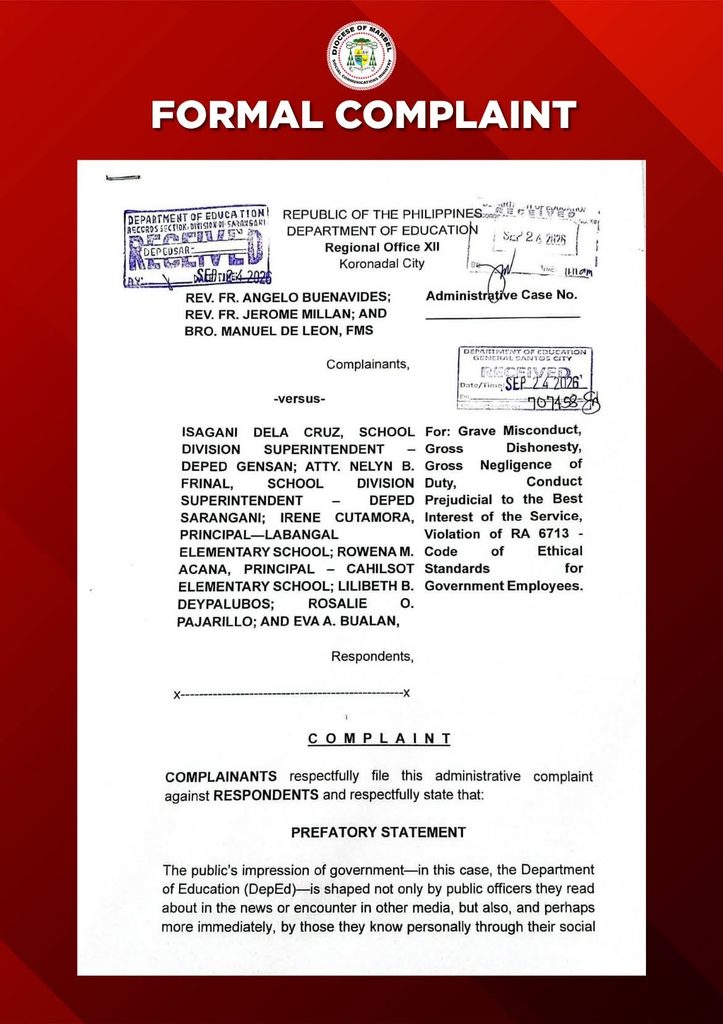
The administrative complaint was received by the Department of Education Regional Office XII in Koronadal City, as well as the DepEd Schools Divisions of General Santos City and Sarangani, on September 24, 2026.
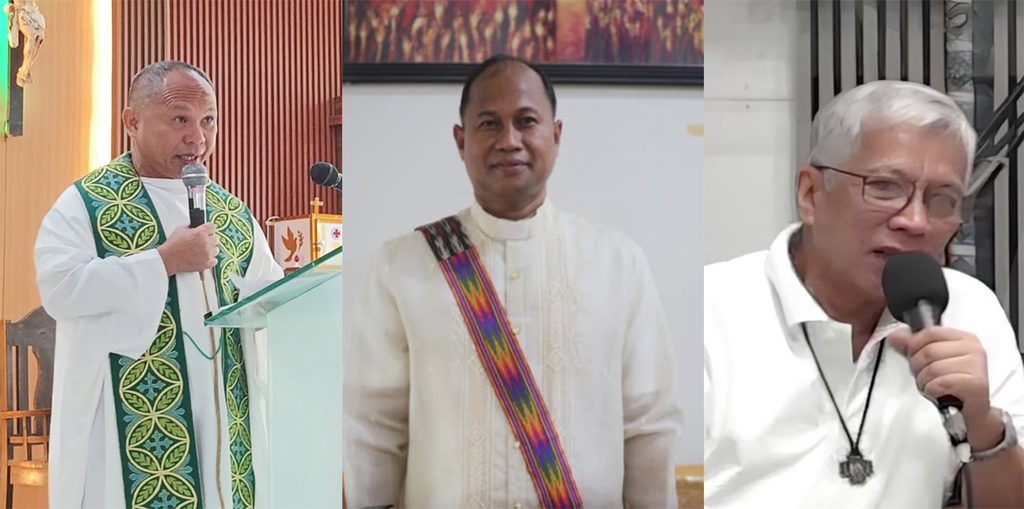
The complainants are Rev. Fr. Angelo Buenavides, Rev. Fr. Jerome Millan and Bro. Manuel De Leon, FMS.
Named respondents include General Santos City Schools Division Superintendent Isagani S. Dela Cruz; Sarangani Schools Division Superintendent Atty. Nelyn B. Frinal; Labangal Elementary School Principal Irene Cutamora; Cahilsot Elementary School Principal Rowena M. Acana; and Lilibeth B. Deypalubos, Rosalie O. Pajarillo and Eva A. Bualan.
The complaint accuses the respondents of grave misconduct, gross dishonesty, gross negligence of duty, conduct prejudicial to the best interest of the service, and violations of Republic Act No. 6713, or the Code of Ethical Standards for Public Officials and Employees.
The allegations remain unproven. The respondents are entitled to due process and the presumption of innocence, and the administrative case remains subject to investigation and appropriate proceedings.
Complaint focuses on DepEd participation in the plebiscite
At the center of the controversy is the participation of public-school personnel and the use of public-school facilities in the SOCOTECO II plebiscite on the proposed Conditional Joint Venture Agreement with Ignite Power.
SOCOTECO II announced that its member-consumer-owners would vote on the proposed partnership during a series of September voting dates. The cooperative initially scheduled voting for September 5–6, 12–13, 19–20 and 26–27, 2026.
The proposed transaction is significant because it concerns the future operation and distribution assets of the electric cooperative serving General Santos City, Sarangani and portions of South Cotabato.
Under the proposed arrangement, SOCOTECO II would transfer its distribution assets to a new distribution company, with approximately 70% of the consideration to be paid in cash and the remaining 30% converted into an equity stake for the cooperative. Ignite Power has also proposed a modernization program and a reduction in the system-loss charge recoverable from consumers from the current 8.25% cap to 5.5%.
The proposed venture involves Ignite Power, a partnership between Razon-led Primelectric Holdings and MP Holdings associated with Manny Pacquiao.
SOCOTECO II has said the partnership is intended to provide capital for the rehabilitation and modernization of aging distribution facilities. The cooperative has also reported substantial financial and operational difficulties, including accumulated losses of about ₱2.1 billion as of December 2025 and system losses that had reached 14%, according to reports citing the cooperative.
DepEd-Sarangani MOU authorized schools and compensated personnel
Documents obtained by the Diocese show that DepEd-Sarangani entered into a Memorandum of Understanding with SOCOTECO II in August 2026.
The agreement provided for the use of designated public-school classrooms and facilities as voting precincts and verification rooms during the plebiscite.
It also authorized qualified teachers to serve as election officers, subject to the terms of the agreement.
The MOU specified daily honoraria of ₱3,000 for a chairperson and ₱2,500 each for the secretary, member and school head. SOCOTECO II was likewise required to provide meals and snacks and reimburse electricity and water expenses associated with the use of school facilities.
The document further provided for an orientation for participating teachers, including a ₱500 orientation honorarium and fare reimbursement.
One provision described the teacher orientation as compulsory for participating personnel.
The agreement was signed by Fr. Nelyn B. Frinal, Schools Division Superintendent of Sarangani, and Jessie F. Alaban, SOCOTECO II’s overall plebiscite committee chairperson.
DepEd-Sarangani subsequently furnished the Diocese of Marbel a copy of the MOU after Fr. Buenavides requested the document in a September 3 letter. In its September 4 transmittal, DepEd emphasized that any personal or sensitive information contained in the document remained subject to the Data Privacy Act of 2012.
General Santos DepEd later terminated its division-level MOA
The situation in General Santos followed a different course.
In a September 18 letter to SOCOTECO II, Schools Division Superintendent Isagani Dela Cruz said the division-level Memorandum of Agreement concerning the use of public-school facilities would no longer govern the arrangements for the plebiscite.
Dela Cruz cited the 2010 Educational Facilities Manual, particularly its provision allowing school buildings, grounds and facilities to be used for appropriate civic and educational activities, subject to existing laws, regulations and DepEd policies.
The letter stated that requests for school facilities could instead be coordinated directly with individual school heads, who would evaluate such requests under applicable policies and in consideration of the school’s best interests.
The division-level MOA was therefore declared terminated and superseded in its entirety, without prejudice to school heads’ authority to evaluate requests under existing DepEd rules.
The General Santos division also reiterated that no DepEd teaching or non-teaching personnel could be construed as being authorized, directed or required to participate in the plebiscite.
Any participation, the letter said, must remain strictly voluntary.
DepEd Region XII had earlier reminded its Schools Division Offices that participation by teaching and non-teaching personnel in activities connected with the plebiscite must be strictly voluntary and compliant with existing laws, regulations and Department issuances.
Why the DepEd role became a point of contention
The church-led complaint places particular attention on the involvement of government employees in an activity concerning a controversial corporate and cooperative transaction.
The complainants’ broader concern is not simply whether schools may legally be used for civic activities, but whether public personnel and public resources were used in a manner that could compromise neutrality, independence or the free exercise of the voting rights of SOCOTECO II’s member-consumer-owners.
The complaint itself does not establish that any respondent committed the offenses alleged. Those questions will have to be determined through the administrative process.
DepEd’s own documents, meanwhile, show that the department recognized a distinction between permissible civic use of school facilities and compulsory or directed participation by its personnel.
Diocese also seeks DILG fact-finding over alleged political activity
The administrative case against DepEd officials is only one component of the Diocese of Marbel’s broader intervention in the SOCOTECO II dispute.
Earlier, the Diocese’s Coalition of Priests, Laity and Sectoral Representatives, through the Protect SOCOTECO II Coalition, asked the Department of the Interior and Local Government Regional Office XII to conduct a fact-finding investigation into alleged partisan and illegal activities involving elected officials and local government employees during the plebiscite.
In a September 7 letter received by DILG XII on September 9, the coalition raised allegations including the distribution of rice allegedly linked to support for the proposed JVA, alleged harvesting of proxy votes, and alleged use of public offices, personnel and resources to influence the plebiscite.
These are allegations contained in the coalition’s complaint and have not been established as facts.
The coalition asked DILG XII to remind local officials of their political neutrality obligations, issue appropriate directives against partisan activity connected with the plebiscite, and pursue administrative cases against officials found to have violated applicable rules.
The coalition said it was acting on behalf of SOCOTECO II member-consumer-owners, whom it described as the cooperative’s owners.
Church opposition has expanded beyond the Diocese’s social action groups
The Diocese of Marbel’s concerns have also moved beyond the administrative complaint.
Bishop Cerilo Casicas of the Diocese of Marbel and Bishop Gerardo Alminaza of the Diocese of San Carlos, president of Caritas Philippines, earlier asked Ombudsman Jesus Crispin Remulla to consider the preventive suspension of SOCOTECO II board members facing complaints related to the proposed JVA. The bishops cited alleged procedural irregularities and concerns over the integrity of the process.
The Diocese had also previously called for greater transparency, an independent examination of SOCOTECO II’s operations and the deferment of the plebiscite.
The church’s position has itself become part of the public debate.
Some Muslim leaders in South Cotabato have questioned whether the Diocese can speak for all SOCOTECO II member-consumer-owners, emphasizing that the cooperative’s consumers come from different religious and community backgrounds. Those leaders have argued that individual MCOs should be free to form their own positions on the proposed partnership.
That debate underscores the central issue facing the plebiscite: the decision ultimately concerns the cooperative’s qualified member-consumer-owners, rather than any single religious, political or civic organization.
Plebiscite itself has faced repeated court intervention
The controversy has also been shaped by a series of court orders.
A Polomolok regional trial court initially issued a 72-hour TRO on September 4, preventing the September 5–6 voting from proceeding. The order was later extended while the court considered an application for a preliminary injunction.
On September 11, another RTC resolution lifted the TRO and denied the application for a preliminary injunction filed by member-consumer-owner Eugenio Mangilaya. The court said the claims questioning transparency had not established sufficient grounds for the requested injunction, while emphasizing that the JVA remained conditional.
That ruling cleared the way for voting on September 19–20 and September 26–27.
SOCOTECO II subsequently posted partial and official results for the September 19–20 voting and a notice concerning rescheduled plebiscite dates on September 24.
However, another legal challenge emerged, with a new court order reportedly halting the remaining voting schedule on September 24. The latest challenge questions whether members were provided sufficient information about the proposed transaction before voting. Those allegations likewise remain subject to judicial proceedings.
The larger issue: public trust, electricity and the right to informed choice
The dispute has therefore expanded beyond a question of whether SOCOTECO II should enter into a joint venture with Ignite Power.
It now involves questions about corporate governance, disclosure of information, the use of public facilities, the participation of government employees, political neutrality, alleged influence over voters, and the ability of member-consumer-owners to make an informed decision.
For DepEd, the administrative complaint puts the department’s personnel and use of public facilities under scrutiny.
For local governments, the Diocese’s DILG complaint raises questions about whether public officials and government resources were used appropriately during the voting process.
For SOCOTECO II, the controversy comes at a critical point in its effort to secure capital for a major modernization program while addressing financial and operational problems.
And for the cooperative’s member-consumer-owners, the proposed transaction concerns an institution they collectively own and a power-distribution system that directly affects households, businesses and communities across the SOCSARGEN area.
The administrative complaint filed against DepEd officials does not determine liability. Neither do the Diocese’s allegations against local officials establish that violations occurred.
Those questions now rest with the appropriate investigating and adjudicating bodies.
What is already clear, however, is that the SOCOTECO II–Ignite Power proposal has become one of the region’s most consequential governance and energy disputes, with its eventual outcome dependent not only on the plebiscite but also on the continuing legal, regulatory and administrative processes surrounding it.