
DAVAO ORIENTAL — The Mount Hamiguitan Range Wildlife Sanctuary has imposed a permanent ban on the entry, use, and disposal of wet wipes and single-use plastic materials inside the protected area, tightening environmental safeguards in one of Mindanao’s most ecologically significant mountain ecosystems.
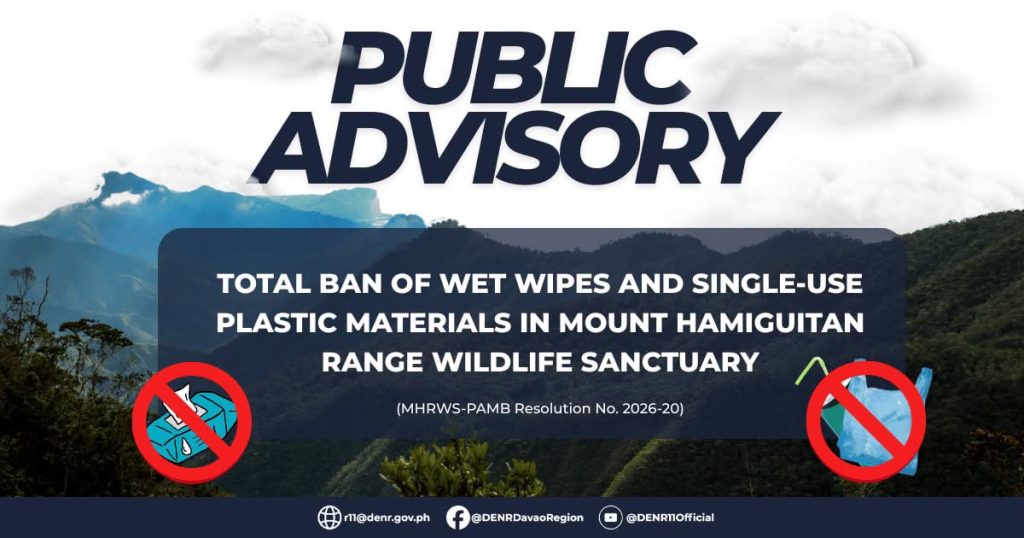
The prohibition is being implemented pursuant to Mount Hamiguitan Range Wildlife Sanctuary Protected Area Management Board (MHRWS-PAMB) Resolution No. 2026-20, following repeated findings from the Protected Area Management Office (PAMO) during its periodic monitoring of ecotourism activities in the sanctuary.
Under the new policy, trekkers, researchers, tourists, guides, porters and other visitors will no longer be allowed to bring or use wet wipes and single-use plastic materials within the protected area.
The move reflects growing concerns over the accumulation of materials that can persist in the environment and potentially threaten the sanctuary’s forests, wildlife and water sources.
Wet wipes raise environmental concerns
Authorities specifically identified wet wipes as a major concern because many commercial wet wipes contain plastic-based fibers and chemical resins that do not readily break down in natural environments.


Unlike ordinary biodegradable paper products, discarded wet wipes can remain in forests for extended periods, increasing the risk of litter accumulation and contamination of sensitive ecosystems.
The sanctuary also cited the broader environmental impact of single-use plastics, including polyethylene terephthalate (PET) bottles, sachets and disposable utensils.
When improperly discarded, these materials can accumulate along trails, campsites and waterways, potentially degrading habitats and threatening the ecological integrity of the protected area.
For Mount Hamiguitan, the concern extends beyond visible litter.
The sanctuary is home to highly diverse plant and animal species, including wildlife found nowhere else in the world. Its forest ecosystems also serve as important sources of water, making waste management a critical component of long-term conservation.
A collective decision by the sanctuary management
Dr. Roy Ponce, president of Davao Oriental State University, a mountaineer and an advocate for the protection of Mount Hamiguitan, said the prohibition was the result of a collective decision involving the mountain sanctuary’s management stakeholders.
According to Ponce, the policy was deliberated by the Mount Hamiguitan Management Technical Working Group (TWG) before being approved by the Protected Area Management Board.
“Collective decision ni sa Mt Hamiguitan Mgt TWG and approved by PAMB. I believe deliberated ni siya,” Ponce said.
Ponce acknowledged that the ban could create additional inconvenience for some experienced and environmentally conscious climbers, particularly those who are already accustomed to practicing responsible waste management during expeditions.
However, he said stricter rules may be necessary because not all visitors demonstrate the same level of discipline when entering sensitive natural areas.
“Personally, hassle for educated climbers but needed sa mga undisciplined,” he said.
His assessment highlights one of the central challenges facing protected areas: ensuring that conservation policies are effective not only on paper but also in actual field implementation.
Stricter controls at entry points
To ensure the ban is effectively implemented, the Protected Area Management Office will integrate the new policy into the mandatory pre-climb orientation for all trekkers, researchers and visitors.
Everyone entering the sanctuary will be informed of the prohibited materials and the environmental reasons behind the policy before proceeding with their activities.
Authorities will also conduct strict baggage inspections before visitors are allowed to enter the protected area.
The inspections are intended to prevent prohibited materials from being carried into the sanctuary in the first place rather than relying solely on enforcement after violations occur.
Accredited porters and guides will also play a key role in enforcing the policy.
They will serve as the sanctuary’s on-trail counterparts, helping monitor visitors and ensuring that prohibited materials are not used or discarded during treks.
The involvement of guides and porters is expected to strengthen enforcement in areas where conventional monitoring may be difficult because of the sanctuary’s rugged terrain and extensive forest environment.
Implementation seen as the real test
While Ponce expressed support for the conservation objective behind the ban, he pointed to implementation as the policy’s biggest challenge.
A permanent prohibition can only achieve its intended environmental benefits if visitors understand the rules, enforcement is consistent, and the system can be implemented effectively across the sanctuary’s access points and trekking routes.
“The real challenge here is the system of implementation,” Ponce said.
He also suggested that authorities should eventually assess the policy based on actual results rather than relying solely on its initial intent.
Ponce said the sanctuary management could evaluate the measure after a period of implementation to determine whether it is producing the desired environmental outcomes, while also considering the experiences and concerns of visitors.
“Maybe we can evaluate after a period of implementation to see its effectiveness and impact and also to get visitors’ feedback,” he said.
Such an evaluation could provide management authorities with evidence on whether the total ban is reducing waste inside the protected area, whether enforcement mechanisms are working as intended, and whether adjustments may be necessary to improve implementation.
Violators face penalties
The PAMO warned that violations of the policy will be dealt with under existing environmental laws.
Penalties may be imposed pursuant to Republic Act No. 9003, or the Ecological Solid Waste Management Act of 2000, and Republic Act No. 11038, or the Expanded National Integrated Protected Areas System Act of 2018.
The enforcement approach underscores that the ban is not merely a tourism regulation but part of the sanctuary’s broader obligation to protect its ecosystems from activities and materials that could cause long-term environmental damage.
The policy also places greater responsibility on visitors, requiring them to make deliberate choices before and during their journey into the mountain sanctuary.
Protecting a globally important ecosystem
Mount Hamiguitan Range Wildlife Sanctuary, a UNESCO World Heritage Site, is recognized for its exceptional biodiversity and unique mountain ecosystem.
Its protection requires more than preventing major destructive activities. Even seemingly small sources of pollution, such as discarded plastic packaging and wet wipes, can become significant when repeated across thousands of visitors and activities over time.
The total ban therefore represents a shift toward a more preventive approach to ecotourism—one that seeks to minimize waste before it enters the protected area.
For the sanctuary’s management authorities, conservation ultimately depends not only on regulations and enforcement but also on the cooperation of every person who enters the protected landscape.
Ponce’s comments likewise point to the importance of balancing strict conservation measures with practical implementation, monitoring and feedback from the people who use and help protect the mountain.
As the new policy takes effect, its long-term success will ultimately depend on whether the rules can translate into measurable improvements in the sanctuary’s environmental condition.
For Mount Hamiguitan, the objective remains clear: keeping human activities from leaving behind a lasting footprint in an ecosystem whose value extends far beyond the visitors who come to experience it.