
DAVAO ORIENTAL, Philippines — The Davao Oriental Provincial Medical Center (DOPMC) has released its first official response to concerns raised by the parents of a newborn boy who died following delivery, saying its preliminary review indicates that the fetal death may have occurred before or during the mother’s labor and could have been linked to complications involving the umbilical cord.
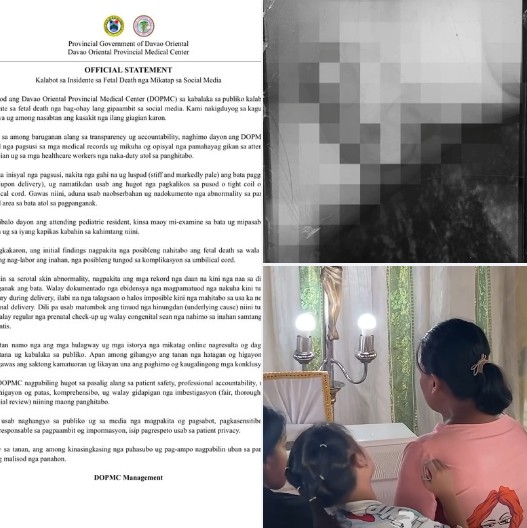
The hospital’s statement comes after the grieving parents, Wilbert and Bonita Anogot, sought answers over the death of their son and raised concerns after they allegedly discovered what they described as a large wound in the infant’s scrotal area.
The incident, which has since circulated on social media, prompted public questions over the circumstances surrounding the newborn’s death and whether the visible condition found in the scrotal area was connected to the delivery or to the child’s death.
In its official statement, the DOPMC expressed condolences to the family and said it understood the pain and concerns surrounding the incident.
The hospital said it immediately conducted an initial review of the relevant medical records and obtained official statements from the attending physician and healthcare workers who were on duty at the time.
According to the DOPMC’s preliminary findings, the baby was already described as stiff and markedly pale upon delivery. Medical personnel also reportedly observed a tight coil of the umbilical cord.
The hospital said an abnormality involving the skin in the infant’s scrotal area was likewise observed and documented at the time of delivery.
An attending pediatric resident was immediately informed and examined the newborn, according to the hospital. The pediatric resident also reportedly explained the child’s condition to the mother and her partner.
Based on the initial review, the DOPMC said the available findings suggest that the fetal death may have occurred before or during labor, possibly due to an umbilical cord complication.
The hospital, however, emphasized that its findings remain preliminary as it continues its review of the incident.
On the scrotal abnormality that prompted the parents’ concerns, the DOPMC said its medical records indicate that the condition was already present when the baby was delivered.
It said there was no documented evidence showing that the abnormality was caused by an injury sustained during delivery. The hospital further maintained that such an injury would be rare or nearly impossible to occur during a normal vaginal delivery.
The underlying cause of the scrotal skin abnormality has not yet been definitively identified, the DOPMC said.
According to the hospital, determining the possible underlying cause has also been complicated by the absence of regular prenatal check-ups and the lack of a congenital scan during the mother’s pregnancy.
The hospital’s explanation directly addresses the central concern raised by the Anogot family: whether the condition observed in their newborn’s scrotal area occurred during the delivery or was connected to the circumstances that led to his death.
Before the DOPMC released its statement, the parents had said they were seeking a clear and medically supported explanation after being informed that their child’s death was associated with an umbilical cord complication and later noticing what they described as a large wound in the scrotal area.
The parents’ account and the hospital’s preliminary findings present differing interpretations of the condition observed after delivery. While the family described what they saw as a wound and questioned how it occurred, the DOPMC said its records documented a skin abnormality that was already present upon delivery and found no evidence, based on its initial review, that it resulted from an injury during delivery.
The DOPMC said it recognizes that the images and accounts circulating online have generated significant public concern but appealed to the public not to draw conclusions before the facts are fully established.
The hospital said it remains committed to patient safety, professional accountability and a fair, thorough and impartial review of the incident.
It also appealed to the public and members of the media to exercise sensitivity and responsibility in sharing information, citing the need to respect patient privacy.
The case remains emotionally devastating for the family, whose loss has been compounded by questions surrounding the circumstances of their child’s death and the condition observed after delivery.
The DOPMC’s statement provides the hospital’s first detailed public account of the incident, but its conclusions are based on an initial internal review. Whether further medical examination, an independent assessment or another formal investigation will be pursued has not been established in the information currently available.
For now, the central questions surrounding the case remain focused on establishing a complete medical timeline, determining the precise cause and timing of the fetal death, and identifying the underlying cause of the abnormality observed in the newborn’s scrotal area.
The DOPMC said it would continue to uphold transparency and accountability while conducting its review, while the family continues to seek what it has described as a clear, credible and medically supported explanation of what happened to their newborn son.