
MUNAI, Lanao del Norte — In a symbolic and significant gesture of renewed government commitment to the Bangsamoro peace process, Presidential Adviser on Peace, Reconciliation, and Unity Secretary Mel Senen S. Sarmiento paid his first official visit to the Moro Islamic Liberation Front (MILF)’s Camp Bilal on July 3, assuring former combatants and community leaders that the national government remains steadfast in fulfilling its commitments under the Comprehensive Agreement on the Bangsamoro (CAB).
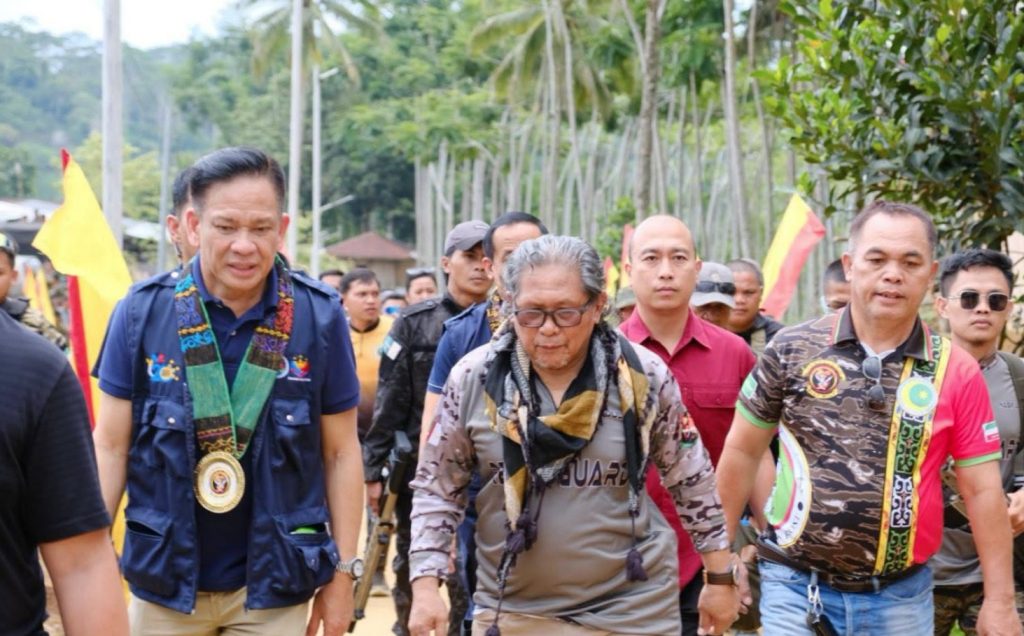
The visit, held during the monthly assembly of the MILF-Bangsamoro Islamic Armed Forces (BIAF) Northwestern Front, underscored the administration’s determination to accelerate the implementation of the peace agreement and its Normalization Program—an essential pillar in transforming former conflict areas into peaceful and productive communities.
Addressing MILF commanders, local officials, religious leaders, and community stakeholders, Sarmiento emphasized that his leadership is anchored on action rather than promises.
“Sinanay akong huwag mangako ng aking magulang… pero nakikinig ako’t may utak, may puso tayo,” Sarmiento said, assuring participants that the government is committed to addressing long-standing concerns through concrete programs and sustained engagement.
Peace dividends through development
The visit highlighted the government’s strategy of translating peace agreements into tangible improvements in people’s lives through infrastructure, housing, agriculture, healthcare, and governance.
Munai Mayor Rahma D. Andamama welcomed the peace adviser and described his visit as an encouraging sign of stronger collaboration between the national government and Bangsamoro communities.
She expressed hope that continued cooperation among government agencies, local governments, and the MILF would accelerate development not only in Munai but throughout the country.
Bangsamoro Member of Parliament Abdullah G. Macapaar, who also serves as Front Commander of the MILF-BIAF Northwestern Front, acknowledged the government’s development initiatives, citing the newly improved access road leading to Camp Bilal as one of the clearest examples of the peace process delivering real benefits to residents.
According to Macapaar, the road has significantly improved mobility, making government services more accessible while opening new economic opportunities for surrounding communities.
He likewise reaffirmed the Northwestern Front’s unwavering commitment to the peace process and called for the faithful implementation of all signed agreements between the government and the MILF.
Development, security and peace must move together
Musa Mohamad Sanguila, Country Accompanier of the United Religious Initiative, Inc., stressed that Sarmiento’s presence inside the former MILF stronghold symbolizes how peace has evolved from armed struggle toward sustainable community development.
He noted that infrastructure projects, livelihood programs, and government services are no longer simply development initiatives but are now visible “fruits of peace” made possible through years of negotiations and confidence-building.
Sanguila urged all stakeholders to safeguard the gains already achieved under the Bangsamoro peace process, emphasizing that protecting mutual trust and honoring commitments under the Comprehensive Agreement on the Bangsamoro remain crucial for lasting peace.
Housing program advances
Responding directly to concerns raised by local leaders, Sarmiento provided an important update on the government’s housing program intended for MILF members residing in Camp Bilal.
He announced that the Presidential Proclamation covering the land identified for the housing project has already been forwarded to Malacañang and is currently awaiting the designation of an administrator before it can be formally signed.
The development was welcomed by camp residents who have long awaited permanent housing as part of the government’s normalization commitments.
Agriculture reform seen as key to lasting peace
Beyond infrastructure projects, Sarmiento presented what he described as a holistic strategy for poverty reduction centered on modernizing agriculture.
He argued that fragmented farming systems continue to prevent rural communities from maximizing their economic potential and stressed the need for large-scale production planning.
According to Sarmiento, each former camp or community should focus on strategic agricultural products instead of operating independently, enabling farmers to produce at commercial scale and become more competitive.
He also linked agricultural modernization to broader economic stability, saying increased domestic production and stronger exports could lessen the country’s dependence on imported goods while helping stabilize the Philippine economy.
To improve farmers’ incomes, Sarmiento proposed eliminating middlemen by establishing direct market linkages between agricultural producers and large corporations.
Using the coconut industry as a model, he said the government aims to facilitate arrangements where major companies purchase products directly from farmers, ensuring better earnings and more sustainable livelihoods.
Bringing healthcare to remote communities
Sarmiento likewise outlined initiatives to modernize public services in geographically isolated and conflict-affected communities.
Among the most notable proposals is expanding satellite-based internet connectivity through a partnership between Globe and Starlink, allowing healthcare workers in remote areas to access telemedicine services.
He explained that reliable internet connectivity would enable rural health personnel to consult specialists regardless of location, significantly improving healthcare delivery in previously underserved communities.
According to Sarmiento, strengthening healthcare systems forms an essential component of long-term reconciliation and nation-building.
He emphasized that peace is not sustained solely through signed agreements but by ensuring that communities experience better public services, stronger institutions, and expanded economic opportunities.
Addressing justice and security concerns
Local commanders also raised concerns regarding uncoordinated law enforcement operations that have occasionally created tensions within former conflict areas.
In response, Sarmiento disclosed that his office has already initiated discussions with the Supreme Court and the Department of Justice to streamline legal processes, particularly in the issuance of clearances, while promoting greater cultural sensitivity during law enforcement operations in Bangsamoro communities.
He further announced plans to engage the leadership of the Philippine National Police and the national security sector to improve coordination and prevent future uncoordinated operations that could undermine confidence in the peace process.
Renewing confidence in the peace process
Sarmiento’s inaugural visit to Camp Bilal represents more than a ceremonial engagement. It signals the government’s continuing resolve to honor its obligations under the Comprehensive Agreement on the Bangsamoro while strengthening partnerships with former combatants and local communities.
As the Bangsamoro peace process enters another critical stage of normalization and development, government officials and MILF leaders alike emphasized that sustainable peace will depend not only on fulfilling signed agreements but also on delivering meaningful improvements in governance, economic opportunities, healthcare, justice, and infrastructure.
For communities that once stood at the center of armed conflict, the visit reinforced a shared message: the success of the Bangsamoro peace process will ultimately be measured not only by the absence of war, but by the presence of inclusive development, responsive governance, and lasting reconciliation.