
DAVAO CITY – A 34-year-old woman was arrested by operatives of the Criminal Investigation and Detection Group (CIDG) after allegedly posing as a Pag-IBIG Fund employee and defrauding a homebuyer of ₱1 million through a fake housing acquisition scheme involving foreclosed properties in Davao City.
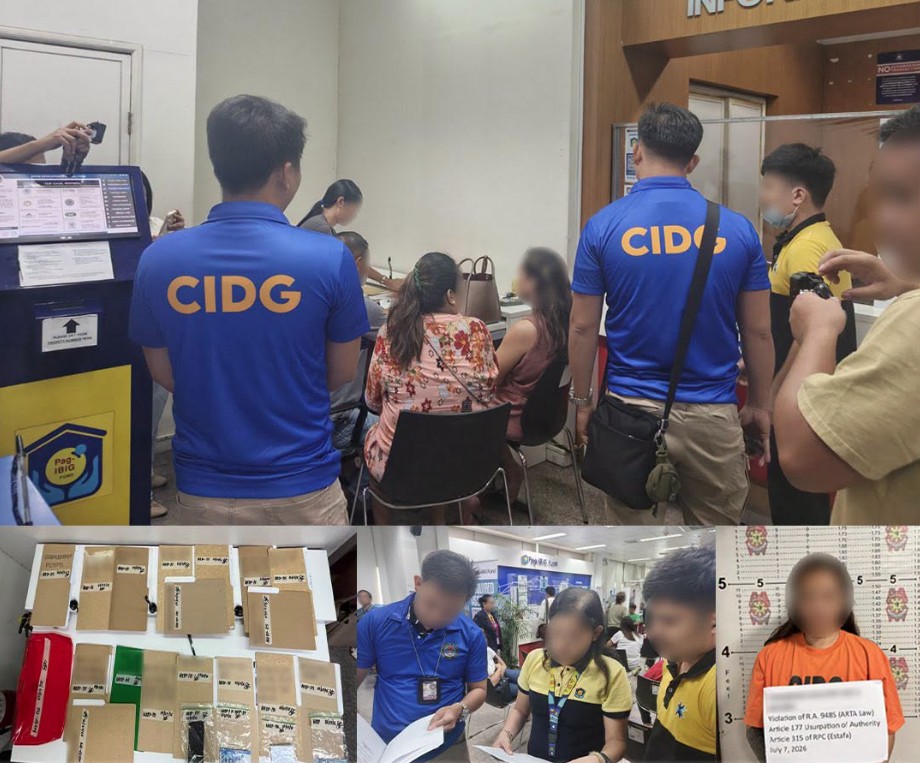
The arrest was carried out on July 7, 2026, at around 1:57 p.m. inside the Pag-IBIG Fund Office at Pryce Tower along J.P. Laurel Avenue, Bajada, Davao City, during a joint law enforcement operation conducted by the CIDG Davao City Field Unit and representatives of the Pag-IBIG Fund Davao City.
Authorities identified the suspect only by her alias “Lyza,” a 34-year-old single woman and resident of Bangkal, Talomo, Davao City.
According to a report submitted to CIDG Director PMGEN Robert A.A. Morico II, the suspect was caught while processing documents related to a Pag-IBIG housing application and receiving money from a complainant despite having no official authority, license, or affiliation with the Pag-IBIG Fund.
She now faces charges for alleged violations of:
- Republic Act No. 9485 or the Anti-Red Tape Act of 2007;
- Article 177 of the Revised Penal Code (Usurpation of Authority or Official Functions); and
- Article 315 of the Revised Penal Code (Estafa).
Alleged Housing Scam
Investigation revealed that the fraudulent scheme allegedly began in April 2026, when the suspect introduced herself to the victim as a legitimate Pag-IBIG Fund agent.
She allegedly offered several Pag-IBIG-acquired properties, also known as Real and Other Properties Acquired (ROPA), claiming she had the authority to facilitate and fast-track the processing and approval of the transactions.
To further convince the complainant, the suspect allegedly claimed that she had legally acquired the properties by fully paying their previous owners.
Believing these representations to be genuine, the victim paid a total of ₱1,000,000 for the supposed purchase of:
- 16 housing units in Deca Homes, Talomo, Davao City;
- One housing unit in Emily Homes, Cabantian, Davao City; and
- One housing unit in Portville Subdivision, Panacan, Davao City.
Fake Documents Discovered
Suspicions arose when the promised transactions failed to materialize.
On July 3, 2026, the complainant personally visited the Pag-IBIG Fund Office in Davao City to verify the status of the housing applications and authenticate the documents issued by the suspect.
The verification reportedly revealed that the submitted documents were spurious and had never been issued by Pag-IBIG Fund.
Agency officials also confirmed that the suspect was neither an employee nor an authorized representative of the government housing agency.
Despite already receiving ₱1 million, the suspect allegedly demanded an additional ₱120,000 from the complainant as the supposed remaining balance before the transactions could be completed.
Instead of paying the additional amount, the victim sought assistance from the CIDG, which immediately organized an entrapment and law enforcement operation that resulted in the suspect’s arrest.
CIDG Commends Operatives
The CIDG lauded the efforts of PLTCOL Ariel T. Huesca, Acting Regional Chief of CIDG Regional Field Unit 11, and the CIDG Davao City Field Unit headed by PMAJ Winnie T. Lampuyas for the successful operation.
Authorities said the arrest effectively halted the suspect’s alleged fraudulent activities and prevented more individuals from becoming victims of the scheme.
The CIDG emphasized that the operation reflects the agency’s continuing commitment to combating fraud, swindling, and other forms of criminality across the country.
Public Urged to Verify Transactions
Following the arrest, the CIDG reminded the public to exercise caution when dealing with individuals claiming to represent government agencies, especially in transactions involving housing, real estate, and financial services.
“We urge our kababayans to remain vigilant, verify the legitimacy of their transactions, and deal exclusively with authorized representatives of government agencies and private institutions before entrusting their hard-earned money,” the CIDG said in a statement.
Authorities also encouraged prospective homebuyers to verify the authenticity of property listings, documents, and representatives directly with the appropriate government offices before making any payments to avoid falling victim to similar scams.