
TAWI-TAWI, Philippines — The Provincial Government of Tawi-Tawi has appealed to fisherfolk, coastal communities, local government units, tourism stakeholders, and the general public to unite in protecting the province’s world-renowned coral reefs following the latest Philippine Coral Bleaching Watch update, which indicates that much of the province’s surrounding waters remain under Bleaching Watch, while several nearby reef systems have already reached Bleaching Alert Levels 1 and 2.
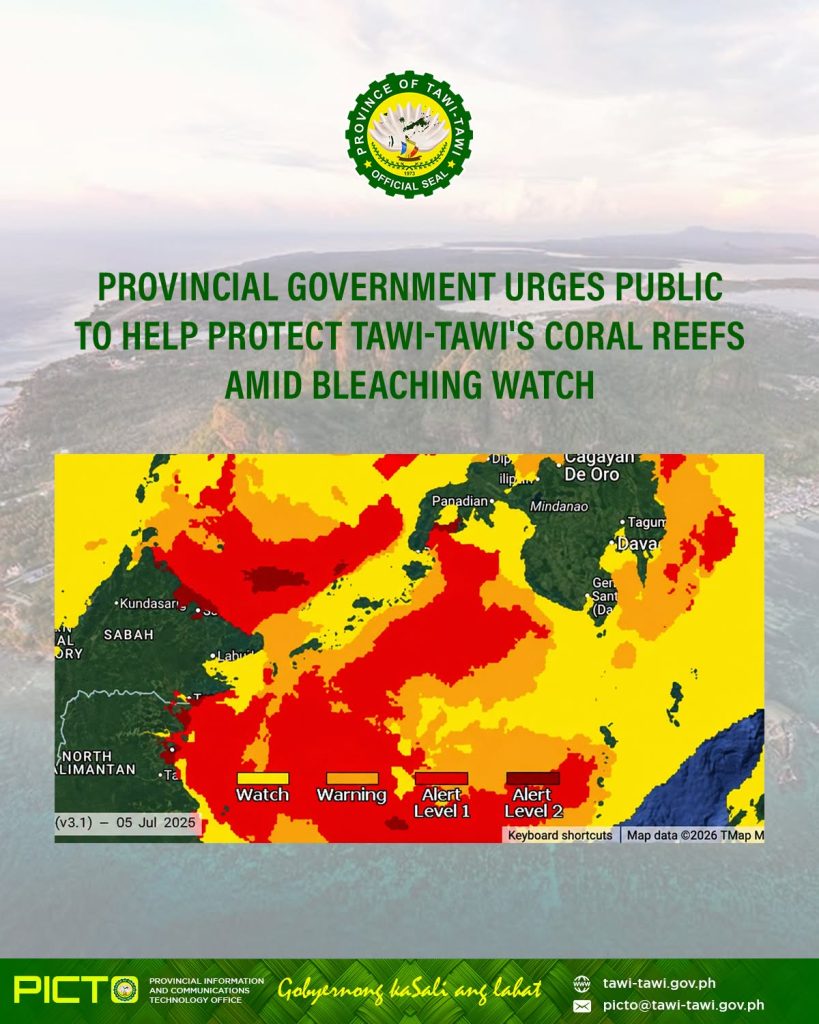
The advisory, issued through the Provincial Planning and Development Office (PPDO), comes after the 08 July 2026 monitoring report showed that prolonged high sea surface temperatures are creating conditions that could trigger—or have already begun causing—coral bleaching across parts of the province’s marine ecosystems.
A Growing Environmental Concern
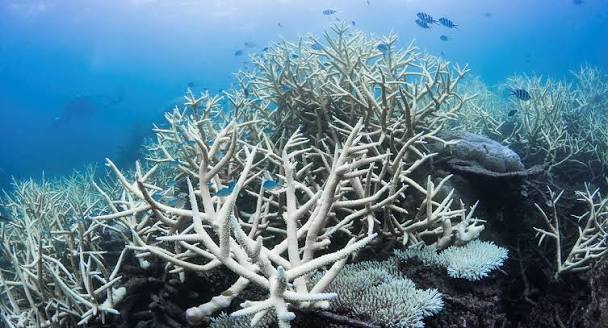
Coral bleaching occurs when ocean temperatures remain unusually warm for extended periods, causing corals to expel the microscopic algae (zooxanthellae) that live within their tissues. These algae provide corals with food through photosynthesis and give reefs their vibrant colors.
Without these algae, corals turn white or pale, becoming weakened and more susceptible to disease and mortality. While bleached corals are not immediately dead, prolonged heat stress significantly reduces their chances of survival if sea temperatures fail to return to normal.
Environmental experts warn that repeated bleaching events can have devastating consequences for marine biodiversity, fisheries, and coastal communities that depend heavily on healthy reef ecosystems.
Vital Lifeline for Tawi-Tawi
Recognized as one of the Philippines’ richest centers of marine biodiversity and an important part of the globally significant Coral Triangle, Tawi-Tawi’s coral reefs serve as critical habitats for countless marine species.
Beyond their ecological value, the reefs support fisheries that provide food and income for thousands of families, strengthen the province’s eco-tourism industry, shield islands from coastal erosion and storm surges, and sustain the livelihoods of generations of Sama, Tausug, Jama Mapun, Badjao, and other coastal communities.
Provincial Governor Yshmael I. Sali underscored the importance of collective responsibility in safeguarding these marine resources.
“Our coral reefs are among Tawi-Tawi’s greatest natural treasures. They feed our people, protect our islands, and sustain our economy. We call upon every fisherfolk, every coastal resident, and every visitor to help protect our reefs during this period of environmental stress. Small actions by each one of us can make a significant difference,” Governor Sali said.
An Early Warning, Not a Cause for Panic
The PPDO emphasized that the current Bleaching Watch should be viewed as an early warning rather than a reason for public alarm.
Officials noted that many coral reefs are still capable of recovering naturally if sea temperatures normalize and additional human-induced stress is minimized.
The provincial government stressed that timely conservation efforts can significantly improve the resilience of reef ecosystems during periods of elevated ocean temperatures.
Guidelines for Fisherfolk
To reduce pressure on already vulnerable reefs, the Provincial Government urged fisherfolk to adopt environmentally responsible fishing practices, including:
- Avoid dropping anchors directly onto coral reefs and instead anchor only on sandy or open-bottom areas whenever possible.
- Refrain from stepping, walking, or standing on corals while fishing or harvesting marine resources.
- Avoid destructive fishing methods that can further damage fragile reef ecosystems.
- Immediately report sightings of widespread white or pale corals to the Municipal Agriculture Office, Municipal Environment and Natural Resources Office (MENRO), or other environmental authorities.
- Continue practicing sustainable fishing to allow marine ecosystems sufficient time to recover.
Public Encouraged to Help Protect Marine Ecosystems
Residents, tourists, divers, snorkelers, and other marine recreation enthusiasts were likewise reminded to do their part by:
- Never collecting or breaking corals for souvenirs.
- Properly disposing of garbage and preventing waste from entering rivers and coastal waters.
- Practicing responsible snorkeling and diving by avoiding direct contact with corals.
- Respecting Marine Protected Areas (MPAs) and complying with local environmental regulations.
- Participating in coastal clean-up drives and community-led marine conservation initiatives.
Continuous Monitoring Underway
The PPDO said it will continue monitoring developments through the Philippine Coral Bleaching Watch while closely coordinating with the Ministry of Environment, Natural Resources and Energy (MENRE), the Ministry of Agriculture, Fisheries, and Agrarian Reform (MAFAR), municipal governments, and national partner agencies to assess reef conditions and implement appropriate conservation measures when necessary.
Officials emphasized that protecting coral reefs today is essential to preserving Tawi-Tawi’s fisheries, food security, biodiversity, tourism industry, and the cultural heritage of its coastal communities for future generations.
In its appeal to the province’s ra’iyyat (citizens), the Provincial Government called on every resident to become a steward of Tawi-Tawi’s marine heritage.
“Together, let us protect the reefs that protect us,” the provincial government said, reaffirming that safeguarding the province’s coral ecosystems is a shared responsibility that will determine the long-term health and sustainability of one of the country’s most valuable marine environments.