
LUUK, Sulu — A total of five loose firearms were voluntarily surrendered across multiple municipalities in Sulu from April 18 to 22, 2026, signaling sustained progress in the government’s campaign to dismantle armed threats and foster long-term peace in conflict-affected communities.
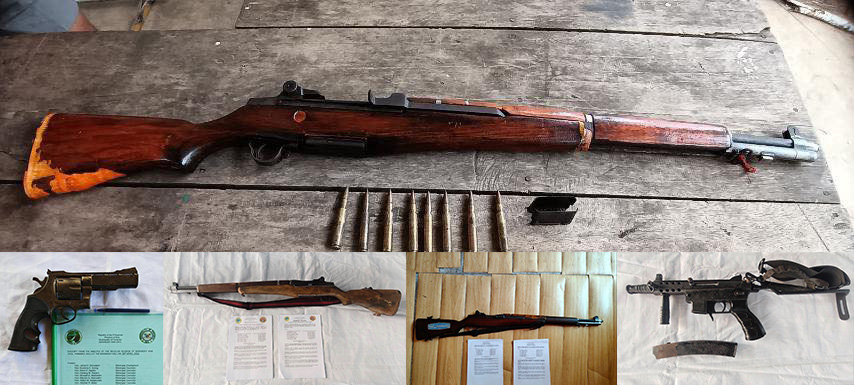
The series of surrenders, recorded in the towns of Pata, Banguingui, Panamao, and Siasi, forms part of the intensified implementation of the Rido-Free, Gun-Free, and Peace-Centered Community (RFGFPCC) campaign—a joint initiative of local government units, the Philippine Army, and the Philippine National Police (PNP).
Lieutenant Colonel Roy R. Dalumpines, Commanding Officer of the 104th Infantry “Para sa Bayan” Battalion, reported that the first turnover took place on April 18 in Barangay Timuddas, Pata. A civilian, through the facilitation of barangay officials led by Chairman Ben-Azher Sahibaddin, surrendered one Caliber .30 M1 Garand rifle. The effort was supported by troops from Charlie Company under 1st Lt. Robert Mantac Jr., in coordination with the 2nd Civil-Military Operations Company and the Pata Municipal Police Station.
The following day, April 19, another firearm—a KG9 with one magazine—was turned over in the same barangay, again through coordinated efforts between military personnel, police forces, and local leaders. Authorities emphasized the crucial role of barangay officials in encouraging residents to participate in the disarmament campaign.
Also on April 19, a separate turnover was conducted in Barangay Tinutungan, Banguingui, where one M1 Garand rifle was surrendered during an Information and Education Campaign (IEC). The activity, spearheaded by the 101st Infantry “Sajahitra” Battalion under Lt. Col. Dante Mantes, brought together representatives from the PNP, Philippine Coast Guard, Department of Social Welfare and Development (DSWD), and local government units. The IEC aimed to raise awareness on the dangers of loose firearms and promote the declaration of peaceful and conflict-free communities.
On April 20, in Barangay Kan-Ukol, Panamao, troops from the 21st Infantry “Invincible” Battalion facilitated the surrender of a .357 revolver. The turnover, led by 1st Lt. Tom Troy B. Tanzo and supported by the Panamao Municipal Police Station, was made possible through the intervention of Barangay Chairman Jamal H. Abdusalim.
The latest surrender was recorded on April 22 in Barangay Tulling, Siasi, where a civilian handed over a Caliber .30 M1 Garand rifle along with a clip containing eight rounds of ammunition. The firearm was presented by Barangay Chairman Ramil Ipa Ismail and received by troops from Alpha Company of the 104th Infantry Battalion, led by 1st Lt. Carl Lorenz Ebon, in coordination with the Siasi Municipal Police Station.
Brigadier General Alaric Avelino Delos Santos, Commander of the 1102nd Infantry “Ganarul” Brigade, described the consecutive surrenders as a “strong indicator of increasing public trust” in government efforts to restore peace and order in the province.
“The growing number of voluntary firearm surrenders reflects the community’s support for peace initiatives and their willingness to move away from a culture of violence,” Delos Santos said.
Security officials underscored that the RFGFPCC campaign not only targets the reduction of illegal firearms but also addresses long-standing clan feuds, or “rido,” which have historically fueled violence in parts of Mindanao. By combining security operations with community engagement and education, authorities aim to create safer environments conducive to development.
The military and police vowed to sustain intensified coordination with local leaders and stakeholders to encourage more residents to surrender unlicensed weapons and embrace peaceful conflict resolution.
Authorities reiterated that voluntary surrender programs remain open and assured the public that individuals who turn over loose firearms will be assisted through proper documentation and community reintegration efforts.
The recent developments in Sulu highlight a gradual but significant shift toward stability, as grassroots cooperation continues to play a pivotal role in achieving lasting peace in the region.