
Seven Years Later, the Questions Remain
Seven years after the establishment of the Bangsamoro Autonomous Region in Muslim Mindanao (BARMM), one would expect that the transition from the former Autonomous Region in Muslim Mindanao (ARMM) had already been completed, especially in a sector as vital as education. Instead, the recent joint committee hearing of the Bangsamoro Parliament exposed a troubling reality: thousands of teachers remain trapped in bureaucratic uncertainty, payroll records appear riddled with inconsistencies, and ministry officials struggle to provide answers to basic questions about personnel management.
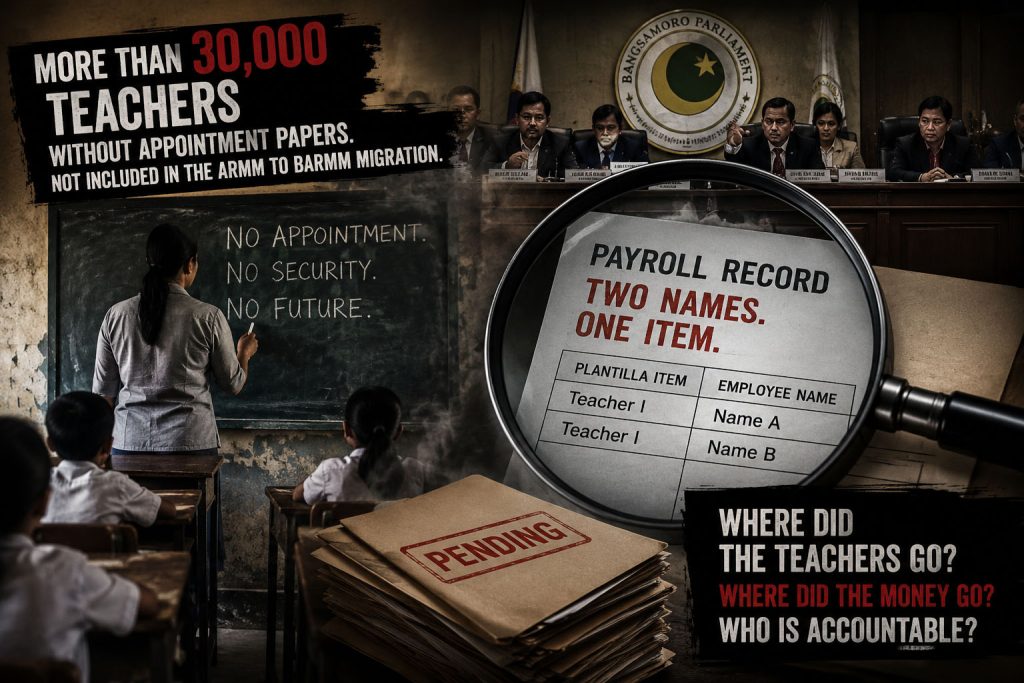
What emerged from the hearing was not merely a technical discussion about plantilla positions and migration processes. It was a portrait of an institution grappling with systemic weaknesses that have persisted for years without resolution. The revelations raised legitimate concerns about transparency, accountability, and the government’s commitment to protecting the welfare of educators who form the backbone of the region’s educational system.
The Alarming Case of “Item Sharing”
Among the most shocking disclosures was the alleged case of two teachers sharing a single plantilla position. In government service, a plantilla item represents an officially funded position authorized under the government’s personnel structure. It is intended to be occupied by one employee, not two.
The idea that two individuals could be attached to a single plantilla item immediately raises serious questions. Was it a simple administrative error? Was it a temporary arrangement that was poorly documented? Or does it point to deeper flaws in personnel management and payroll monitoring?
The inability of ministry officials to provide clear and immediate explanations only intensified suspicions. Public trust is built on transparency, and when officials responsible for managing public resources cannot account for irregularities in their own records, confidence in the institution inevitably erodes.
Thirty Thousand Teachers Left in Limbo
Equally disturbing is the claim that more than 30,000 teachers in BARMM allegedly lack appointment papers or were not properly included in the migration process from ARMM to BARMM.
If accurate, this figure represents more than a bureaucratic oversight. It represents tens of thousands of educators whose employment status remains uncertain despite years of service. These are individuals responsible for educating the next generation of Bangsamoro youth, yet many continue to operate without the security and clarity that should accompany government employment.
The fact that this issue remains unresolved seven years into the transition raises fundamental questions about institutional capacity and administrative effectiveness. A transition period is meant to be temporary. When unresolved personnel issues continue for nearly a decade, the problem can no longer be attributed solely to the complexities of transition. It becomes a question of governance.
Payroll Mysteries and Missing Accountability
The hearing also revealed reports of teachers with plantilla positions who allegedly do not appear on payroll records, particularly in areas such as Basilan. Such findings naturally lead to uncomfortable questions. If legitimate employees are missing from payroll records, where are the funds allocated for their salaries going? If names exist in the payroll system without corresponding personnel records, who is benefiting from those entries?
These are not minor accounting concerns. They involve public funds entrusted to government agencies for the delivery of essential services. Every peso allocated to education carries the expectation that it will support teachers, classrooms, and students—not disappear into a maze of administrative confusion.
The concern expressed by members of Parliament regarding possible negligence or misconduct is therefore justified. Whether these irregularities stem from incompetence, weak internal controls, or deliberate manipulation, the public deserves answers grounded in facts rather than speculation.
Beyond the Search for a “Mafia”
One of the most dramatic moments of the hearing came when lawmakers openly questioned whether a “mafia” operates within the ministry. While such statements reflect the frustration felt by legislators, the more important issue is not whether a shadowy group exists but whether the systems designed to prevent abuse are functioning effectively.
Corruption flourishes where accountability is weak. Even without an organized network, poor record-keeping, inadequate oversight, and weak internal controls can produce the same harmful outcomes. The focus should therefore remain on strengthening institutions rather than merely identifying individuals to blame.
An effective government agency should be capable of tracking every employee, every plantilla item, and every salary disbursement with precision. If lawmakers themselves cannot obtain clear answers regarding these basic matters, then the problem is larger than any single official.
The Real Victims Are Teachers and Students
Lost amid the controversy are the people most affected by these failures: teachers and students.
Every unresolved appointment, delayed migration, or questionable payroll entry creates uncertainty for educators who are simply trying to perform their duties. Teachers cannot focus fully on improving educational outcomes when they remain unsure about their employment status, benefits, or future within the system.
More importantly, administrative dysfunction inevitably affects classroom performance. Resources diverted toward resolving preventable bureaucratic problems are resources that could have been invested in improving learning outcomes, teacher development, school facilities, and student support services.
The longer these issues persist, the greater the risk that educational quality in the region will suffer.
Transparency Must Lead the Way Forward
The Bangsamoro Parliament deserves credit for aggressively pursuing answers through its oversight functions. Public hearings are designed precisely for moments like this—to expose weaknesses, demand accountability, and compel government agencies to correct their shortcomings.
However, hearings alone will not solve the problem. What is needed now is a comprehensive audit of personnel records, plantilla positions, payroll systems, and migration documents within the MBHTE. The ministry must fully cooperate with legislative inquiries and provide complete, accurate, and verifiable records.
More importantly, the public must be informed of the results. Transparency should not end when the hearing adjourns. It must continue until every teacher’s status is clarified, every payroll discrepancy is resolved, and every questionable transaction is accounted for.
A Test of BARMM’s Institutions
The controversy surrounding MBHTE is ultimately about more than payroll records or plantilla positions. It is a test of whether BARMM’s institutions can uphold the principles of good governance that were central to the region’s creation.
The Bangsamoro people were promised a government that would be more responsive, more transparent, and more accountable than the structures it replaced. That promise cannot be fulfilled if basic questions about teachers, salaries, and personnel records remain unanswered after seven years.
The path forward requires courage from public officials, vigilance from lawmakers, and honesty from the institutions involved. The goal should not merely be to identify who made mistakes, but to ensure that such failures never happen again.
For the thousands of teachers waiting for certainty and the millions of students depending on a functioning education system, the stakes could not be higher. The future of Bangsamoro education depends not only on what was revealed during the hearing, but on what leaders choose to do next.