
DAVAO CITY – National and regional government agencies have rallied behind the Mindanao Development Authority’s (MinDA) plan to establish a state-of-the-art disaster response hub in Mindanao, underscoring a shared commitment to stronger disaster preparedness and inter-agency coordination across the island.
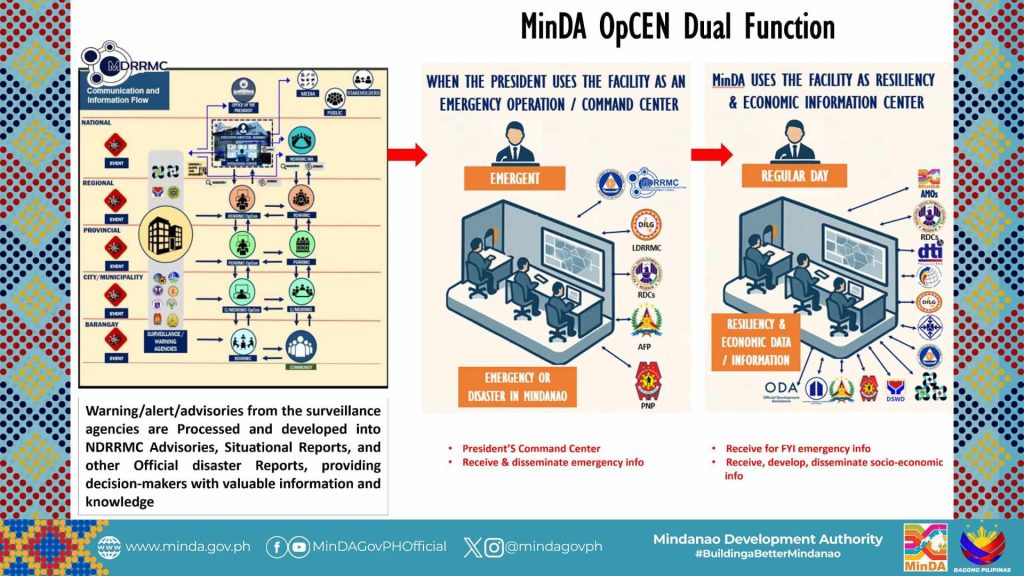
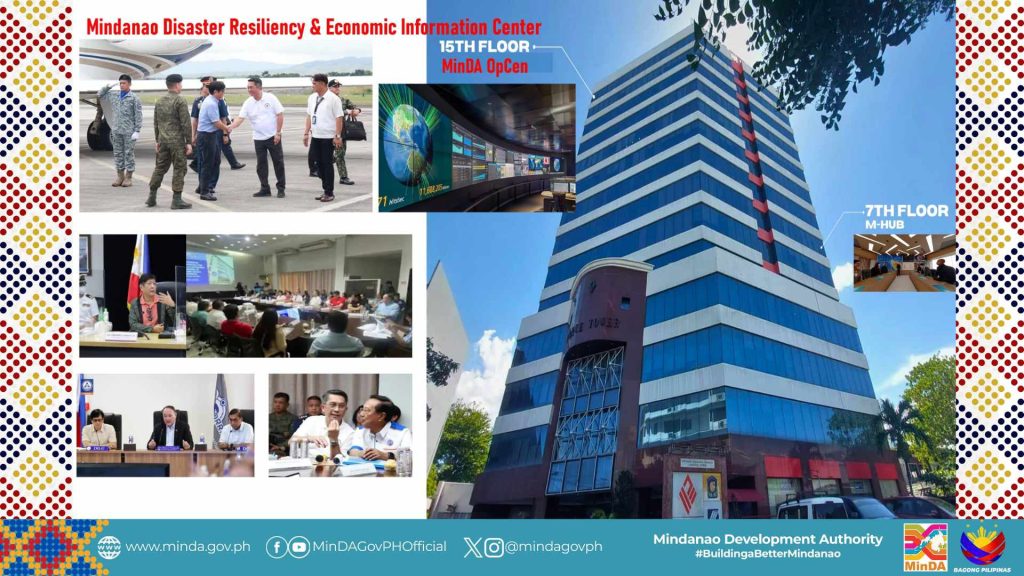
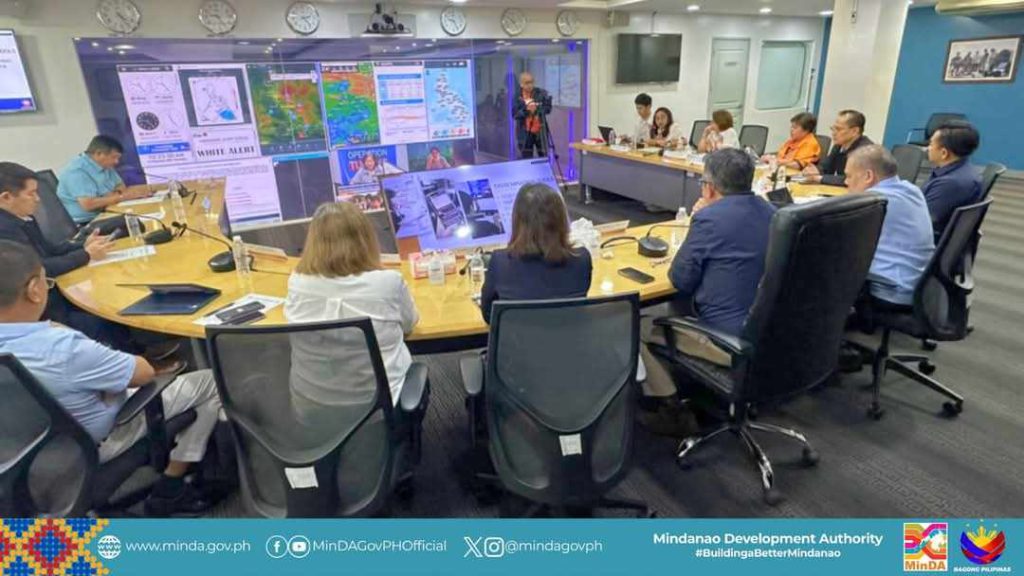
The proposed Mindanao Disaster Resiliency and Economic Information Center, also referred to as the Mindanao Operations Center (MinDA OpCen), was presented by MinDA Chairperson Secretary Leo Tereso Magno during an Inter-Agency Convergence Focus Group Discussion held on June 3, 2025, at the 10th BIMP-EAGA Hall in Davao City.
The MinDA OpCen is envisioned as a cutting-edge facility that mirrors Japan’s advanced disaster prevention systems and serves as Mindanao’s counterpart to the National Disaster Risk Reduction and Management Council (NDRRMC) centers in Luzon and the Visayas. It will serve as the main facility for disaster preparedness, mitigation, response, recovery, and coordination—providing a centralized location for real-time monitoring and high-level decision-making.
“It will be an economic information center and, at the same time, serve as an Operations Center for the President, providing a strategic command facility for Mindanao. It will enable real-time coordination, data-driven decision-making, and high-level engagements during major disasters or emergency situations in the region,” said Secretary Magno.
Originally conceptualized as the ₱2-billion Mindanao Disaster Resiliency and Resources Center (MDRRC), the project was refined through consultations with agencies including the Office of Civil Defense (OCD), Department of Social Welfare and Development (DSWD), and Department of Environment and Natural Resources (DENR). To avoid duplication with existing infrastructure and pending proposals, MinDA recalibrated the plan and adopted a more focused, phased approach—beginning with the establishment of the MinDA OpCen.
“From our previous discussions, I gathered valuable insights that prompted us to adjust our plan,” Magno shared. “While we continue to aspire to our original vision, we are taking an important interim step with the MinDA OpCen.”
Initially, the center will be housed on the 15th floor of Pryce Tower in Davao City, where it will function under the NDRRMC framework and also serve as a repository for economic and disaster-related data. This dual-function approach aims to provide validated, actionable information to national leaders, including the President, and facilitate swift inter-agency coordination during crises.
Regional support for the project has been overwhelming. DILG XI Regional Director Abdullah Matalam called the MinDA OpCen a concrete manifestation of convergence between the national and local governments. “We welcome this project. Ito ang convergence ng national government sa local. We already have one in Luzon and one in the Visayas, and this will surely help the people of Mindanao,” he said.
Meanwhile, OCD XI Regional Director Ednar Dayanghirang emphasized the project’s broader impact: “This will enable more efficient disaster response and resilience, not just for Davao but for the entire Mindanao. It also provides a larger space for training and coordination.”
Magno stressed that the OpCen is not intended to replace or override the functions of any existing agency. “Most importantly, this initiative is not a duplication or an assumption of your functions,” he told the inter-agency gathering. “It is a collaborative effort with your respective agencies.”
The initiative aligns with the Mindanao Development Agenda 2023–2028, which prioritizes building resilience to natural and human-induced hazards. It also complements President Ferdinand R. Marcos Jr.’s broader push for disaster resiliency through institutional reforms, including the proposed creation of a Department of Disaster Resilience.
With solid support from national and regional stakeholders, the MinDA OpCen stands as a strategic step toward realizing the vision of a safer and more disaster-resilient Mindanao. Stakeholders also expressed hope that this kind of initiative will be sustained beyond the current administration, ensuring that future generations benefit from improved disaster governance and resilience mechanisms.