
The Liaoning carrier group’s passage through Western Mindanao and the escalating dispute over Chinese Ambassador Jing Quan expose a common challenge for Manila: how to protect national sovereignty, demand diplomatic respect, and strengthen maritime security without allowing confrontation to dictate national policy.
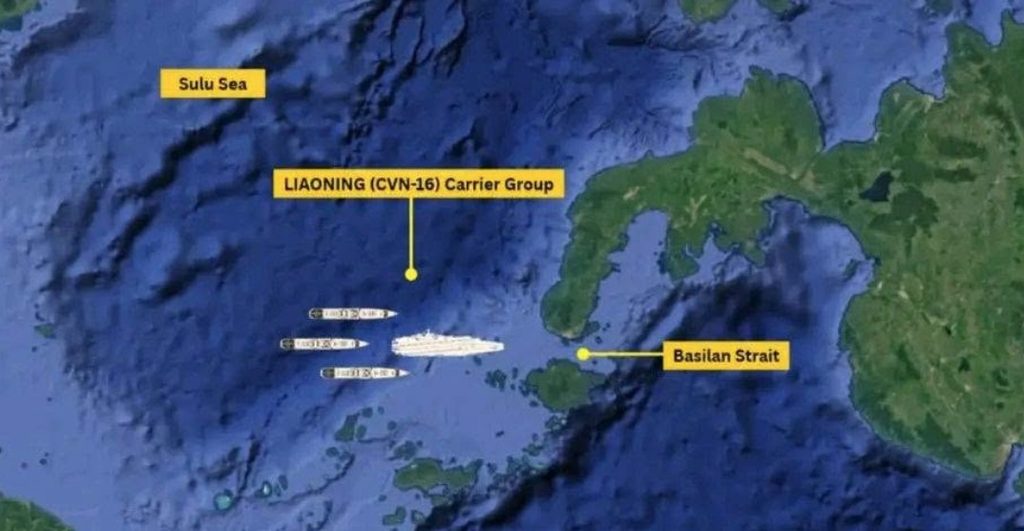
The passage of China’s aircraft carrier Liaoning and its accompanying warships through waters off Western Mindanao has raised questions that extend far beyond the movement of a foreign naval formation. At a time when relations between Manila and Beijing are already strained by competing maritime claims, disagreements over regional security, and increasingly hostile public exchanges, the incident presents the Philippines with a difficult test of sovereignty, military preparedness, diplomatic discipline, and political judgment.
The timing is particularly significant. The Chinese naval formation was monitored moving through the waters around Palawan and Western Mindanao in late October 2026, while the Philippine government was confronting a separate but increasingly bitter dispute with Chinese Ambassador Jing Quan. His October 15 remarks that China could “easily win” if it chose to use force against the Philippines, followed by a series of confrontational statements from the Chinese Embassy in Manila, prompted Philippine officials and lawmakers to demand stronger diplomatic action.
The Department of Foreign Affairs summoned Jing on October 19 to convey Manila’s serious concern and objection to his remarks. Several lawmakers subsequently urged President Ferdinand Marcos Jr. to declare the ambassador persona non grata or request his recall. The Chinese Embassy responded with further public challenges, while the Philippine government reiterated that diplomatic engagement must be conducted with restraint and mutual respect.
These developments have intensified a question that has long confronted Philippine foreign policy: How should a smaller country respond when a much more powerful neighbor combines military capability, disputed maritime claims, and increasingly confrontational diplomatic messaging?
The answer cannot be reduced to choosing between confrontation and accommodation. Nor should it depend on which side produces the most forceful statement, deploys the largest vessel, or generates the strongest public reaction.
The Philippines must be firm about its rights, precise about the facts, and disciplined about the consequences of its decisions. That is not weakness. It is the difference between reacting to a crisis and managing one.
A carrier group in Western Mindanao is a security issue, not merely a spectacle
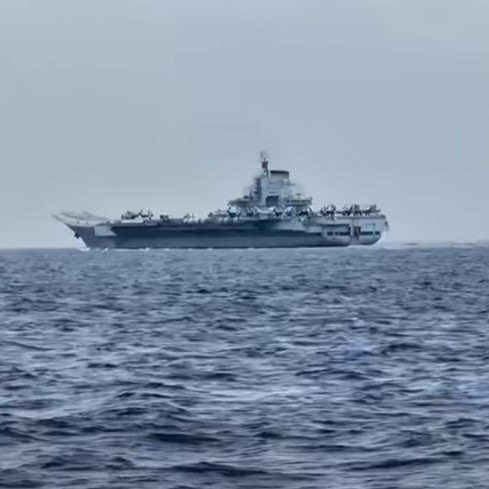
According to information reported by Philippine maritime authorities and accounts of the October 22–23 transit, the Liaoning was accompanied by three major surface combatants: the Type 055 destroyers Anshan and Wuxi, and the Type 052D destroyer Huainan. Philippine naval and coast guard assets monitored the formation as it moved through waters off the Zamboanga Peninsula and the Basilan Strait toward the Celebes Sea.
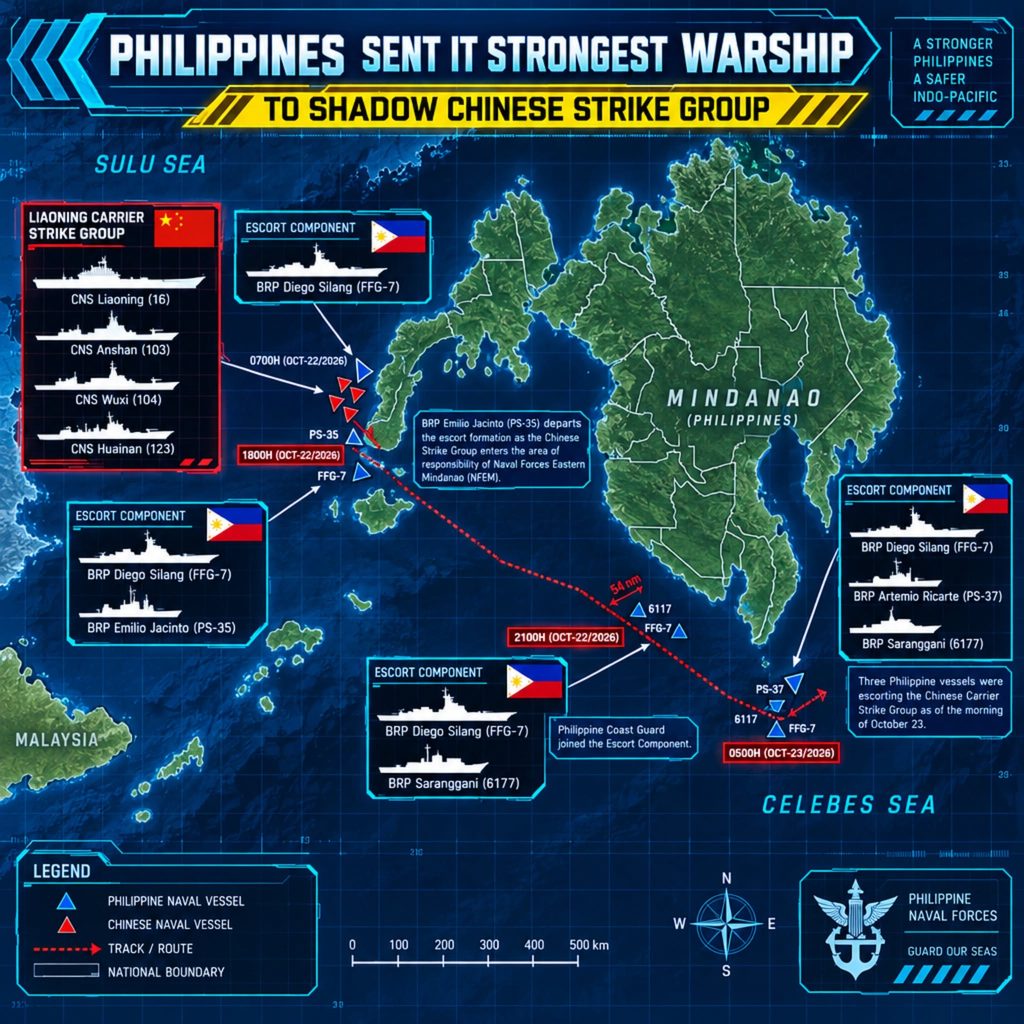
The reported Philippine response involved the deployment of the frigate BRP Diego Silang, other naval and coast guard vessels, and Philippine Air Force aircraft supporting maritime monitoring. Philippine authorities also reported that the Chinese vessels were not responding to radio challenges and had switched off their Automatic Identification System, or AIS, transmissions.
These details deserve serious attention. However, the significance of the incident should be assessed through evidence and operational context rather than the size of the carrier alone.
An aircraft carrier is a major military asset. It can support aircraft operations, extend a navy’s reach, and serve as the center of a formation capable of operating over considerable distances. Its accompanying warships provide additional defensive and operational capabilities. A formation of this kind represents a substantially greater military capability than a training ship or an ordinary naval vessel.
For the Philippines, the presence of such a formation near its southern maritime approaches highlights the importance of knowing what is moving through surrounding waters, how those movements relate to regional military activity, and whether Philippine authorities can maintain reliable surveillance and communication.
But the appearance of a powerful foreign warship does not, by itself, establish hostile intent.
A carrier group may be conducting training, moving between operational areas, exercising navigation rights, or carrying out a broader military deployment. These possibilities are not mutually exclusive, and the available information does not conclusively establish the specific strategic purpose of the Liaoning group’s route through Western Mindanao.
It would therefore be premature to declare the transit an attempted invasion, an imminent attack, or a deliberate provocation directed specifically at the Philippines without further evidence.
The opposite conclusion would be equally premature. The fact that a naval formation is transiting rather than attacking does not mean its presence is strategically insignificant. Military movements provide information about capabilities, operating patterns, readiness, and the geographic areas in which a navy can function.
The appropriate response is neither alarmism nor indifference. It is sustained monitoring, careful assessment, and an honest explanation to the public of what authorities know, what they do not know, and what they are doing to address the implications.
For communities in Zamboanga Peninsula, Basilan, Sulu, and Sarangani, these are not abstract questions about great-power competition. They concern the security of the maritime environment surrounding their homes, fishing grounds, transport routes, and coastal communities.
Yet these communities also deserve protection from exaggerated claims that can create unnecessary fear. National security reporting must inform the public without converting every foreign military movement into an impending military emergency.
The question of maritime rights must be answered through law
One of the most important aspects of the Liaoning transit is the legal character of the waters through which the formation passed.
Public discussions frequently use the terms Philippine waters, territorial waters, exclusive economic zone, and international waters as though they were interchangeable. They are not. Each has a distinct legal meaning, and those distinctions matter when assessing the rights and obligations of foreign military vessels.
The Philippines is an archipelagic state under the United Nations Convention on the Law of the Sea. Its archipelagic waters, territorial sea, exclusive economic zone, and other maritime areas are governed by different provisions of international law.
The territorial sea extends up to 12 nautical miles from the applicable baselines, subject to the Convention’s provisions. Within it, the coastal state exercises sovereignty, while foreign ships retain the right of innocent passage under the relevant rules.
Archipelagic waters are subject to the special legal regime applicable to archipelagic states. That regime includes rights of innocent passage and, where the Convention’s requirements apply, archipelagic sea lanes passage. Transit passage also applies to qualifying international straits under the Convention, but it is not a universal legal label for every narrow waterway.
An exclusive economic zone, meanwhile, is not equivalent to territorial waters. The coastal state has sovereign rights over specified natural resources and certain jurisdictional rights, while other states retain particular freedoms, including navigation and overflight, subject to the Convention and the rights and duties it establishes.
These distinctions are essential to evaluating the Liaoning group’s passage through the Basilan Strait and surrounding waters.
The precise legal assessment depends on the location of the vessels, the relevant maritime boundaries and baselines, the geographic and legal status of the waterway, and the circumstances of the passage. It cannot be settled simply by declaring that every foreign warship in Philippine-administered waters is acting illegally.
Nor does the general principle of freedom of navigation give foreign military vessels unrestricted permission to disregard applicable international law.
The Philippines should establish the facts and identify the specific legal provisions governing the incident. If a violation occurred, Manila should document it, state the applicable legal basis, and pursue the appropriate diplomatic or operational response.
If the transit was lawful, the government should be equally prepared to say so, even if the movement remains strategically concerning.
A state strengthens its international position when it applies the law consistently, including when the facts do not support its preferred political narrative.
This is especially important for the Philippines because its arguments in maritime disputes depend not only on its military capabilities but also on the credibility of its legal position. A government that insists on international law must demonstrate that it understands and applies that law accurately.
The AIS issue and unanswered radio calls deserve scrutiny
The reported failure of the Chinese formation to respond to radio challenges, together with the absence of publicly broadcast AIS information, raises legitimate questions about maritime awareness and operational transparency.
AIS is a navigational information system designed to transmit information such as vessel identity, position, course, and speed. It can assist in identifying and tracking maritime traffic, but it is not a complete surveillance system, nor is it a substitute for military monitoring.
Military vessels may operate under different AIS practices from commercial ships. The legal obligations governing AIS use must also be distinguished from the obligations to navigate safely, communicate when required, and comply with the applicable rules of passage.
Consequently, switching off AIS should not automatically be described as proof of illegal activity. Equally, the absence of publicly available AIS information should not be treated as a reason for Philippine authorities to accept uncertainty about the movement of a major foreign naval formation.
The reported failure to respond to radio calls is a separate issue. Its significance depends on the nature of the calls, the communications procedures involved, the location and circumstances of the vessels, and the applicable rules. Those details should be established before the incident is assigned a definitive legal meaning.
Nevertheless, the practical implications are clear. A country with extensive maritime approaches cannot rely solely on commercial tracking applications or on the expectation that foreign military vessels will make themselves easy to identify.
It needs multiple, overlapping sources of information: coastal and maritime radar, surface patrols, aerial surveillance, satellite-based information where available, reliable communications, intelligence-sharing arrangements, and trained personnel able to integrate the information into a coherent operational picture.
The Philippines’ response to the Liaoning formation demonstrates the value of coordinating the Navy, Coast Guard, and Air Force. It also exposes the broader challenge of sustaining that coordination across an archipelago with numerous straits and extensive coastlines.
Deploying vessels after a foreign formation has been detected is necessary. Knowing where it is before it reaches a sensitive maritime approach, maintaining contact throughout its movement, and preserving an accurate record of its conduct are equally important.
The government should therefore use this incident as an opportunity to evaluate surveillance coverage, communications procedures, response times, and interagency coordination. Any resulting capability gaps should be identified openly enough to support public accountability, without disclosing sensitive operational information.
The objective should not be to promise that the Philippines can monitor every vessel at every moment. No maritime state can eliminate uncertainty entirely. The objective should be to reduce that uncertainty, detect important developments earlier, and make sound decisions from reliable information.
A powerful neighbor does not automatically have hostile intentions, but power deserves attention
There is a temptation in security debates to interpret every action by a rival state as evidence of a single, predetermined strategy. This can produce a misleading picture of events.
The Liaoning group’s route has prompted speculation about whether its movement was connected to regional exercises, changing operational requirements, weather conditions, or an intention to signal Beijing’s military reach. Its reported movements near Taiwan and through the Philippine maritime region, alongside the timing of multinational military activities in the broader region, provide context for these questions.
They do not, by themselves, answer them.
A route that differs from an observer’s expectations is not sufficient proof of a deliberate message. Naval formations change course for many reasons, and the publicly available information may not reveal the full operational circumstances.
At the same time, military planners routinely consider the movements and capabilities of other states. A Chinese carrier group’s presence near Philippine maritime approaches can therefore have strategic significance regardless of whether Beijing intended to communicate a specific political message.
The Philippine government should assess the event through intelligence and operational analysis rather than public speculation. It should examine the formation’s previous movements, the geography of its route, the activities of other regional forces, and any relevant changes in its behavior.
It should also distinguish between an assessment of capability and an assessment of intent.
China possesses substantial military capabilities. The Philippines has legitimate reasons to monitor those capabilities, particularly in light of its maritime disputes with Beijing and the broader regional security environment. But a capability to threaten another state does not prove that a particular movement was undertaken with an immediate intention to do so.
This distinction matters because misreading intent can be dangerous. Underestimating a genuine threat can leave a country unprepared. Overestimating one can lead to unnecessary escalation, distort spending priorities, and narrow the space for diplomacy.
A credible security policy must guard against both errors.
The diplomatic confrontation is a related warning, not proof of a naval conspiracy
The Liaoning transit occurred against the backdrop of a public dispute between the Chinese Embassy in Manila and Philippine officials. The timing inevitably invites questions about whether the naval movement and the diplomatic confrontation are part of a coordinated Chinese strategy.
Such questions are legitimate subjects for intelligence assessment. But a connection should not be asserted as fact without evidence.
The diplomatic dispute has its own identifiable chronology.
On October 15, Ambassador Jing Quan said that if China wanted to use force, it could “easily win,” while adding that China would not do so because it favored peace. The remark came in response to criticism from Philippine Defense Secretary Gilberto Teodoro Jr., who had characterized China as a regional troublemaker.
The statement was not made in a vacuum. It came amid long-running tensions over the West Philippine Sea, Philippine security cooperation with other countries, and disagreements over Beijing’s regional policies.
The ambassador’s additional assurance that China would not use force is relevant to a fair reading of his remarks. It would be inaccurate to omit that part of the statement when assessing its meaning.
Nevertheless, the reference to China’s ability to win through force was reasonably open to criticism, particularly given the disparity in military capabilities and the sensitivity of the bilateral relationship. Even when a diplomat intends to emphasize deterrence or military superiority rather than announce a threat, the wording can communicate intimidation or contempt.
President Marcos himself said the remarks sounded like a threat and were not diplomatic. The Department of Foreign Affairs subsequently summoned Jing on October 19, conveying Manila’s serious concern and strong objection.
The dispute intensified when the Chinese Embassy challenged lawmakers calling for the ambassador’s removal. Its public posts included the demand that Philippine officials “STOP BLUFFING,” the statement that if the Philippines did not welcome Chinese diplomats, China would not welcome them either, and a warning directed at lawmakers who supported diplomatic action.
The embassy also publicly criticized Philippine officials who had challenged China’s position on maritime and security matters.
The Philippine government, for its part, described the embassy’s latest social media statements as escalatory and undiplomatic, arguing that they undermined efforts to stabilize relations. It reiterated the expectation that foreign diplomats exercise restraint and responsibility in their public statements.
These exchanges are relevant because diplomacy depends on more than formal meetings and official notes. The language used by ambassadors and foreign missions can affect public perceptions, shape political choices, and either preserve or reduce room for negotiation.
But it is important to distinguish the ambassador’s original remark from the subsequent statements issued by the embassy, as well as from the separate conduct of Chinese naval forces.
The ambassador’s words can be assessed as diplomatic conduct. The embassy’s posts can be assessed as public diplomacy. The naval formation’s movements must be assessed through maritime law and military evidence.
Treating these as distinct questions does not mean ignoring their broader relationship. It means avoiding the mistake of allowing one controversial development to serve as unproven evidence for another.
A careful government can recognize a pattern of deteriorating relations without claiming that every incident is part of a single, centrally coordinated operation.
Persona non grata: a legitimate option, but not a substitute for strategy
The calls to declare Ambassador Jing persona non grata have become a focal point of the dispute. They reflect anger over his remarks and the embassy’s subsequent public challenges, as well as a broader concern that Chinese representatives are treating Philippine officials with insufficient respect.
Those concerns should not be dismissed as mere political theatrics.
An ambassador represents a foreign government. The position carries responsibilities that go beyond defending the sending state’s interests. Diplomats are expected to communicate firmly when necessary, but also to preserve channels through which disagreements can be addressed without escalating into broader confrontations.
Publicly challenging a host country’s elected officials, particularly through language that can be interpreted as taunting or coercive, risks undermining that function.
The Chinese Embassy has defended its statements as a response to what it considers hostile or misleading claims about China. Beijing is entitled to defend its position and challenge statements it believes are inaccurate. Philippine officials are likewise entitled to criticize Chinese policies, defend the country’s maritime rights, and debate the appropriate response to diplomatic conduct.
But the existence of a legitimate right to respond does not make every response prudent or appropriate.
The same standard should apply to both sides: criticism should be supported by facts, and official communication should avoid language that unnecessarily undermines the possibility of constructive engagement.
The question is whether Jing’s conduct has crossed a threshold at which the Philippine government should take the more serious step of declaring him persona non grata or requesting his recall.
Under Article 9 of the Vienna Convention on Diplomatic Relations, a receiving state may notify the sending state at any time, without having to explain its decision, that a head of mission or another member of the diplomatic staff is persona non grata. The sending state must then recall the person concerned or terminate that person’s functions. If it fails to do so within a reasonable period, the receiving state may refuse to recognize the individual as a member of the mission.
This is a recognized diplomatic mechanism, not an unlawful act in itself. The Philippines does not need China’s permission to exercise its rights under the Convention.
However, the legality of the action and the wisdom of taking it are different questions.
Expelling an ambassador would send a clear signal that Manila considers the conduct unacceptable. It could reinforce the principle that foreign representatives should not attempt to intimidate Philippine officials or use public taunts as a substitute for diplomacy.
It could also trigger reciprocal measures, including the possible removal of a Philippine ambassador or restrictions affecting other diplomatic personnel. It might complicate negotiations on maritime incidents, fisheries, trade, consular matters, and the welfare of Filipinos living or working in China.
These consequences are not reasons to avoid action at all costs. They are reasons to evaluate the action carefully.
The government should ask what it expects the declaration to achieve. Would it deter similar conduct? Would it create pressure for a more restrained Chinese diplomatic approach? Would it protect the credibility of Philippine institutions? Could the same objectives be achieved through a formal protest, a demand for clarification or correction, restrictions consistent with applicable law, or a coordinated diplomatic response?
It should also consider what happens after the decision. If Jing is removed, who assumes responsibility for managing the relationship? What communication channels remain available? What safeguards would protect Filipino interests from avoidable retaliation? How would Manila respond if Beijing took reciprocal action?
These are not questions of timidity. They are questions of statecraft.
As of the public developments reported through October 23, the Philippine government had summoned Jing, issued further criticism of the embassy’s statements, and reserved the right to take additional diplomatic action. Lawmakers had filed resolutions seeking his removal or recall, while Malacañang had urged caution and indicated that the President was not inclined to declare a diplomat persona non grata at that stage.
The distinction matters. Calls for the ambassador’s removal, resolutions urging action, and the government’s actual decision are not the same thing. The diplomatic row had intensified, but the public record available at that point did not establish that President Marcos had formally declared Jing persona non grata.
The strongest argument for removing the ambassador would be that his conduct had become incompatible with the responsibilities of his position and that allowing it to continue would weaken the Philippines’ ability to insist on reciprocal diplomatic respect.
The strongest argument against immediate removal would be that the measure could narrow communication channels and produce consequences disproportionate to its practical benefits, particularly if more targeted measures remained available.
Neither argument should be dismissed without examination.
Ultimately, the decision belongs to the appropriate executive authorities. The President must weigh national dignity alongside national interest, and the government should explain its decision in terms of objectives, consequences, and the standards it expects foreign representatives to observe.
What it must not do is confuse the appearance of toughness with the achievement of a strategic objective.
Beijing must also consider the costs of its diplomatic approach
A balanced analysis cannot focus exclusively on the decisions Manila must make. Beijing also bears responsibility for the direction of the relationship.
China has legitimate interests in regional security, freedom of navigation, economic cooperation, and its diplomatic relations with neighboring countries. It is entitled to defend its policies and dispute interpretations that it considers incorrect.
But a policy of responding to criticism with public taunts, warnings, or language suggesting that a smaller neighbor could be easily defeated through force carries risks of its own.
It can strengthen the very political forces in the Philippines that advocate a harder line against China. It can make compromise appear politically costly for Philippine officials. It can increase public suspicion of Chinese intentions and reinforce support for deeper security cooperation with other countries.
In that sense, confrontational public diplomacy may be counterproductive even from Beijing’s perspective.
The Philippines is not likely to abandon its maritime claims simply because a Chinese representative emphasizes China’s military superiority. Nor does public pressure necessarily produce greater willingness to accommodate Beijing.
Instead, it may encourage Manila to strengthen its maritime surveillance, deepen defense cooperation with partners, and become more determined to document and publicize disputed encounters.
China may view these responses as unfriendly or provocative. The Philippines may view them as necessary measures to protect its sovereignty and reduce its vulnerability. Each side’s response can then reinforce the other’s concerns, creating a cycle in which actions described as defensive by one government are interpreted as hostile by the other.
This is a familiar security dilemma, and it is one reason diplomatic restraint matters.
Beijing can defend its interests without belittling Philippine officials. It can dispute allegations through evidence, formal diplomatic channels, and consistent explanations of its legal position. It can also recognize that the Philippines has its own security concerns and constitutional responsibilities.
If China expects its diplomats to defend Chinese sovereignty and dignity, it should also understand that Philippine officials face public and institutional pressure to defend Philippine sovereignty and dignity.
Respect cannot mean that one side may speak forcefully while the other is expected to remain silent.
Nor should it mean that every criticism of China is treated as an insult that requires retaliation. In a relationship between unequal powers, restraint by the stronger party can help reduce the risk that a dispute escalates beyond either side’s original intentions.
Manila must not allow public anger to replace a coherent China policy
The Philippine government faces a difficult political environment. A perceived failure to respond firmly to Chinese actions can invite accusations of weakness. An excessively confrontational response can expose the country to unnecessary diplomatic and economic costs.
This tension is real, but it should not dictate policy through competing demands for the most dramatic response.
The government needs a clear set of objectives that remains consistent across maritime incidents and diplomatic disputes.
First, it must protect Philippine rights and jurisdiction under international law. That includes documenting relevant maritime encounters, maintaining effective surveillance, and pursuing appropriate diplomatic or legal remedies when violations occur.
Second, it must preserve the ability to communicate with China, particularly during incidents that could produce misunderstandings or operational risks. Diplomatic channels are most valuable when relations are strained, not merely when both sides agree.
Third, it must improve the country’s capacity to monitor its maritime approaches and respond proportionately to developments. That requires sustained investment, interagency coordination, training, maintenance, and realistic assessments of what Philippine forces can accomplish.
Fourth, it must communicate with the public honestly. Officials should distinguish verified information from assessments and speculation. They should explain legal distinctions rather than rely on broad claims about territorial waters. They should also avoid exaggerating the significance of individual incidents to satisfy short-term political demands.
Finally, it must ensure that its response to China is based on Philippine interests rather than on the need to win each exchange of public statements.
The same principle applies to the persona non grata controversy. If the President decides that Jing’s conduct warrants removal, the decision should form part of a considered diplomatic policy, supported by a clear explanation of the standards at issue and the steps Manila will take afterward.
If the government decides against removal, that decision should not amount to silence or acquiescence. It should be accompanied by clear expectations for diplomatic conduct and a willingness to impose proportionate consequences if those expectations are repeatedly disregarded.
Either course can be defended if it is grounded in national interest, consistency, and a credible plan.
What would be difficult to defend is a policy that alternates between threats of expulsion and indefinite hesitation, with each new public exchange forcing the government to reconsider its position without a clear set of criteria.
Consistency is essential because credibility depends not only on what a government says but also on whether its actions match its stated objectives.
The Philippines needs maritime capability, not just maritime rhetoric
The Liaoning incident brings the discussion back to a more fundamental question: What practical steps can the Philippines take to reduce its vulnerability?
The deployment of the BRP Diego Silang and supporting assets demonstrated that the country could organize a response to the carrier group’s movement. That is important. But a successful monitoring operation should not be mistaken for proof that all surveillance and response requirements have been met.
The Philippines has an enormous maritime area to monitor relative to the resources available to its security agencies. Its geography creates both an advantage and a challenge. Numerous islands and straits are strategically important, but their number and distribution make persistent surveillance difficult.
The solution cannot be limited to buying additional warships, although capable and adequately maintained vessels are important. Nor can it depend solely on acquiring sophisticated aircraft or surveillance equipment.
The country needs a system in which maritime information can be collected, assessed, shared, and acted upon efficiently.
That means strengthening coastal radar networks, improving maritime domain awareness, investing in communications and data integration, maintaining reliable patrol schedules, and developing the capacity to track vessels across the different agencies responsible for maritime security.
It also means supporting the personnel who operate these systems. Equipment that cannot be maintained, communications that fail to connect agencies, and surveillance information that cannot be integrated into timely decisions will not deliver the promised security.
The Coast Guard’s civilian maritime law-enforcement role and the Navy’s defense responsibilities must remain clear, while cooperation between them should be strengthened. The Air Force can contribute surveillance and reconnaissance capabilities, and diplomatic and intelligence channels can help provide context for movements that might otherwise be difficult to interpret.
The government should also make a serious assessment of how regional cooperation can support Philippine maritime awareness without creating unnecessary dependence on external partners.
Cooperation with allies and other regional states can improve information-sharing, training, interoperability, and deterrence. It can also introduce complications if regional competition intensifies. Manila should therefore pursue such partnerships with a clear understanding of its own interests, obligations, and operational priorities.
A credible defense policy is not one that promises to match China’s military power vessel for vessel. Such a goal would be unrealistic. It is one that makes the Philippines more capable of detecting activity, protecting its rights, responding to incidents, and increasing the costs of unlawful or coercive behavior.
The government should be able to explain how each major investment contributes to those objectives and how progress will be measured.
The Liaoning transit offers a concrete case through which to evaluate that performance.
Western Mindanao must not become an afterthought in national security
The incident also underscores the importance of the southern Philippines in the country’s wider maritime security architecture.
National debate about China’s activities often centers on the West Philippine Sea and the waters around the Spratly Islands. That focus is understandable, given the long-running disputes and repeated encounters there. But the country’s maritime security concerns do not end at Palawan or the western approaches to Luzon.
The Basilan Strait and the surrounding waters connect important maritime areas, including the Sulu Sea and Celebes Sea. Their geography makes them relevant to commercial navigation, local fishing, transport, and regional security.
A foreign naval formation moving through this area deserves the same careful legal and operational assessment that would be applied to a comparable formation near another Philippine coastline.
The government should not treat Western Mindanao as a peripheral theater that receives attention only when an unusually large foreign vessel appears.
Maritime surveillance and security planning must account for the entire archipelago. The capabilities available in one region should be considered alongside those required in another, and the government should identify where its surveillance coverage is weakest.
For coastal communities, national security is not only about great-power rivalry. It also concerns the safety of maritime transport, the protection of fishing grounds, the prevention of smuggling and other unlawful activities, and the ability of authorities to respond to emergencies.
A stronger maritime security system can serve all these objectives, provided it is designed around the country’s actual needs rather than only around the most visible international disputes.
The presence of the Liaoning group should therefore prompt more than a temporary increase in attention. It should encourage a sustained assessment of the security of the country’s southern approaches and the resources required to monitor them effectively.
Diplomacy is not weakness, and firmness is not hostility
One of the most damaging assumptions in public debate is that diplomacy and firmness are opposites.
They are not.
Diplomacy without credible capacity can leave a country unable to protect its interests. Military strength without diplomatic judgment can increase the risk of conflict. Public anger without a clear strategy can pressure leaders into decisions whose consequences have not been adequately considered.
The Philippines needs all three elements of statecraft: the capacity to protect its rights, the willingness to insist on respect, and the judgment to choose its responses carefully.
The same standard should govern the government’s treatment of the Chinese ambassador.
It is reasonable for Philippine officials to object to language they consider threatening. It is reasonable for lawmakers to debate whether the ambassador’s conduct warrants stronger action. It is also reasonable for the President to consider the consequences of expulsion before making a decision.
These positions are not inherently contradictory. They reflect different responsibilities within a democratic system.
Lawmakers may voice public concern and urge action. The Department of Foreign Affairs must manage diplomatic relations and assess available measures. The President must make decisions that account for national security, international obligations, and the broader consequences for Filipinos.
The public has every right to demand accountability from all three.
But accountability should not mean requiring the government to choose the most dramatic option simply to demonstrate resolve. It should mean demanding clear objectives, consistent standards, and evidence that the chosen policy serves the national interest.
Similarly, the Chinese Embassy cannot reasonably expect Philippine officials to refrain from criticizing its conduct while reserving for itself the freedom to publicly disparage those officials. Mutual respect requires restraint on both sides.
If Beijing believes Philippine statements are inaccurate, it can respond with evidence and formal diplomatic arguments. If Manila believes Chinese statements are unacceptable, it can protest, seek clarification, or pursue stronger measures through the appropriate channels.
Neither side benefits when public exchanges become contests of humiliation.
The real test is whether the Philippines can turn this crisis into a durable policy
The passage of the Liaoning carrier group and the confrontation over Jing Quan’s remarks may eventually recede from the headlines. The underlying challenges, however, will remain.
China will continue to possess substantial military capabilities. The Philippines will continue to have maritime interests that it must protect. The two countries will continue to face disagreements over sovereignty, navigation, regional security, and their respective relationships with other powers.
These realities require a policy that can endure beyond any single incident or administration.
The government should establish clear procedures for monitoring foreign naval movements, evaluating the legal status of maritime incidents, communicating with foreign vessels where appropriate, and publicly explaining the findings once operational considerations permit.
It should also maintain consistent standards for diplomatic conduct. Foreign representatives should be free to defend their governments’ positions, but they should not be encouraged to turn bilateral disputes into public campaigns of personal ridicule or intimidation.
Where diplomatic misconduct occurs, Manila should respond proportionately and consistently. Where legal violations occur at sea, it should document them and pursue the appropriate remedies. Where the evidence does not support a claim of wrongdoing, it should resist the pressure to make one.
That discipline would strengthen the Philippines’ credibility at home and abroad.
It would also make the country less vulnerable to being drawn into an escalating cycle of reaction, in which each military movement generates a political accusation, each accusation prompts a diplomatic counterattack, and each counterattack makes a measured response appear insufficient.
The country cannot control every decision made in Beijing. It can control the quality of its own assessments, the credibility of its institutions, the preparedness of its maritime forces, and the discipline with which it responds.
That is where national resilience begins.
A principled response must be stronger than a public-relations victory
The Liaoning’s passage through Western Mindanao is a reminder that geography, military capability, and international law intersect in ways that cannot be managed through rhetoric alone. The dispute with Ambassador Jing Quan is a reminder that diplomatic language can either help manage those tensions or make them more difficult to contain.
Neither development should be dismissed. Neither should be used as an excuse to abandon careful judgment.
The Philippines is entitled to defend its sovereignty, protect its maritime rights, demand respect from foreign representatives, and strengthen its security partnerships. It is equally responsible for ensuring that its claims are accurate, its actions proportionate, and its decisions grounded in law and national interest.
China, for its part, must recognize that military superiority does not confer a general right to dictate the conduct of a smaller neighbor. Nor does the defense of Chinese interests justify a diplomatic approach that needlessly alienates the very country with which Beijing must continue to engage.
The question of whether Jing Quan should be declared persona non grata should therefore be treated neither as a test of patriotism nor as a choice between defiance and submission. It should be assessed according to the ambassador’s conduct, the applicable diplomatic framework, the objectives Manila seeks to achieve, and the foreseeable consequences of the decision.
If removal becomes necessary, it should be carried out with clarity and preparation. If the government chooses another course, that decision should be accompanied by firm expectations and credible consequences for further misconduct.
Likewise, the Chinese carrier group’s passage should be investigated and assessed according to the applicable maritime rules and the evidence of its conduct. The government should neither exaggerate the incident into an established act of aggression nor minimize its significance as a matter of maritime security.
The Philippines does not need to prove its strength by matching China’s rhetoric. It needs to demonstrate strength through preparedness, legal consistency, diplomatic competence, and the ability to protect its interests without being governed by provocation.
That is the standard by which the government’s handling of both the naval transit and the diplomatic dispute should ultimately be judged.
A sovereign country must know when to protest, when to prepare, when to negotiate, and when to impose consequences. Its strength lies not in choosing only one of these responses, but in knowing which response the facts and the national interest require.