
Tagum City, Davao del Norte – June 19, 2026
In a continued push to strengthen coastal resilience and marine biodiversity, the Local Government Unit (LGU) of Tagum City installed 15 new pickleball-inspired Artificial Coral Reef (ACR) structures inside the Marine Protected Area of Barangay Liboganon on Thursday, June 19, 2026.
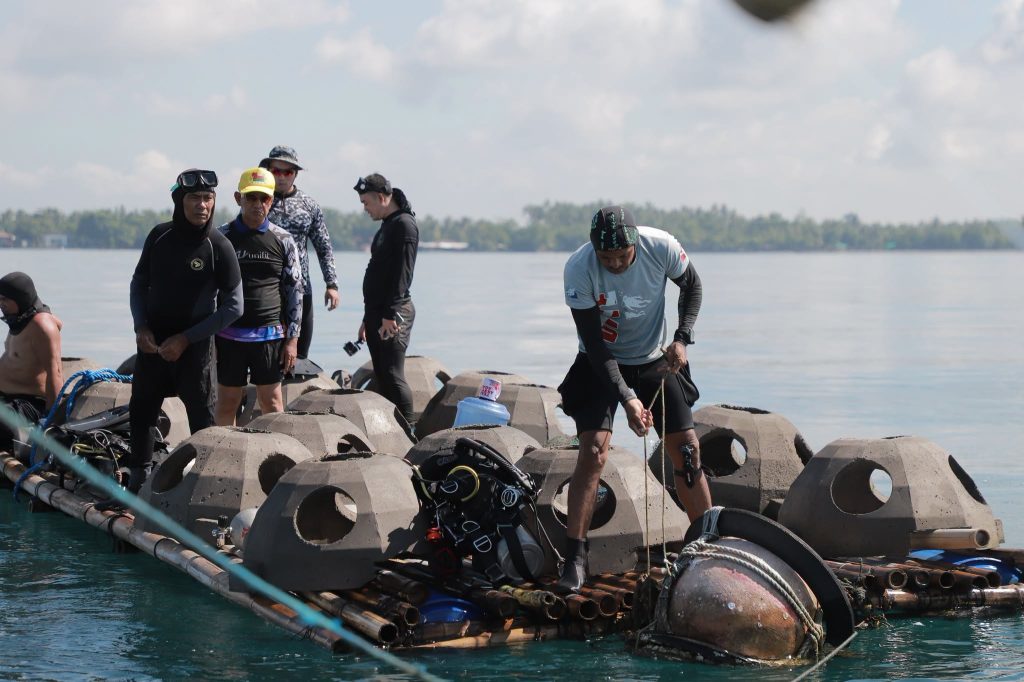
The initiative, led by the LGU through its City Agriculture Office in coordination with the Bantay Dagat Task Force and the Bureau of Jail Management and Penology (BJMP) Tagum–Male Dormitory, reflects an evolving blend of innovation, environmental stewardship, and community participation in coastal resource management.
Innovation meets marine conservation
What sets the latest deployment apart is its unique design inspiration—from the rapidly growing sport of pickleball. The geometric, grid-like structure of the reef modules is intended not only to optimize underwater stability but also to increase surface area for coral attachment and fish habitat formation.
Local officials said the design symbolizes Tagum City’s creative approach to environmental challenges, merging modern concepts with ecological restoration efforts.
“This is not just about installing structures underwater. This is about building life beneath the sea, strengthening our fisheries, and ensuring that future generations still benefit from our marine resources,” a city agriculture representative said.
A two-decade commitment to the sea
The installation marks another milestone in a long-running conservation program that began in 2007, following the implementation of City Ordinance No. 249, also known as the Comprehensive Fisheries Code of Tagum. The ordinance paved the way for the establishment of the Tagum City Fish Sanctuary and the systematic deployment of artificial reefs.
Over the years, the program has steadily expanded. As of this latest installation, more than six hectares of artificial coral reef structures have already been deployed within the city’s Marine Protected Area.
City officials emphasized that this sustained effort demonstrates Tagum’s long-term commitment to marine protection rather than short-term interventions.
Toward a fully restored marine protected area
Under the leadership of Mayor Rey T. Uy, the city government has set an ambitious long-term goal: to fully populate the entire 22-hectare Marine Protected Area with a combination of artificial reefs and naturally regenerating coral ecosystems.
Officials believe that the integration of man-made reef structures will accelerate natural coral growth by providing stable substrates where marine organisms can thrive and reproduce.
“The vision is a fully functioning marine ecosystem where artificial structures eventually become living reefs,” a Bantay Dagat officer explained.
Boosting fish populations and livelihoods
Beyond environmental restoration, the ACR project is also seen as a direct investment in food security and local livelihoods. By increasing coral cover and creating new fish habitats, the reefs are expected to attract a wider variety of marine species back into the protected zone.
Fisherfolk communities in Barangay Liboganon and nearby coastal areas are among the primary beneficiaries of the initiative. Many rely heavily on municipal waters for their daily catch and household income.
Local authorities expressed hope that as marine biodiversity improves, fish stocks will recover, eventually leading to more stable and sustainable fisheries.
Community-led protection efforts
The participation of the Bantay Dagat and BJMP Tagum–Male highlights the city’s whole-of-community approach to marine conservation. Law enforcement personnel, local fisherfolk, and government workers continue to collaborate in protecting the sanctuary from illegal fishing and other destructive practices.
Officials stressed that conservation success depends not only on infrastructure but also on strict enforcement and community ownership of marine resources.
A growing model for coastal cities
Tagum City’s expanding artificial reef program is increasingly being viewed as a model for integrated coastal management in Mindanao. By combining science-based interventions, local legislation, and community engagement, the city aims to balance ecological restoration with economic sustainability.
As the 15 new pickleball-inspired structures settle beneath the waters of Liboganon, they represent more than just artificial installations—they symbolize a long-term investment in life beneath the sea and the resilience of communities that depend on it.