
DAVAO ORIENTAL, Philippines — Deep within the high-altitude, old-growth forests of Tarragona, a quiet yet extraordinary natural event has unfolded: the discovery of 30 individuals of Rafflesia mira, one of the Philippines’ most elusive and endangered flowering plants.
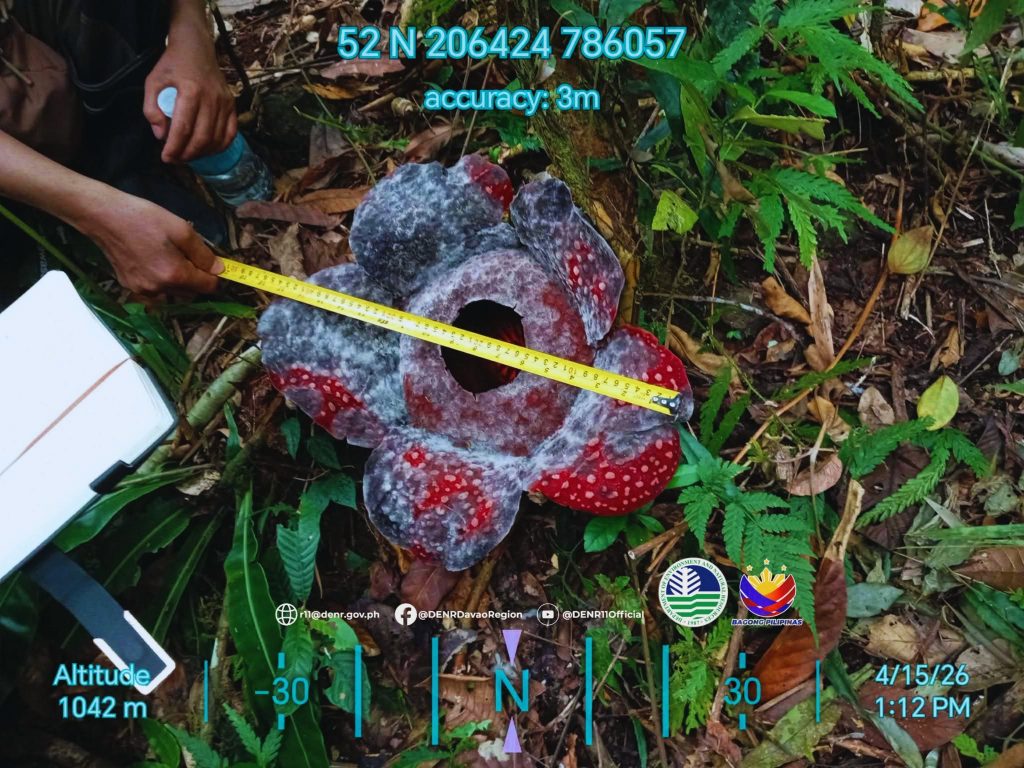
The finding, documented earlier this month by a joint team from the LAWIN Forest and Biodiversity Protection System and the Community Environment and Natural Resources Office (CENRO) in Mati, marks a significant breakthrough for conservationists and scientists working to protect the country’s fragile biodiversity.
Spread across a compact, roughly one-hectare patch of rugged terrain at an elevation of about 1,053 meters above sea level, the cluster represents one of the most concentrated sightings of the species in recent years. The discovery was prompted by initial reports from the field, which led to a rapid biodiversity assessment in the remote forest area.
What the team found exceeded expectations.
Of the 30 recorded individuals, 10 were in full bloom—known as the anthesis stage—displaying the species’ iconic, massive reddish petals marked with pale spots. Another 13 were in the budding phase, not yet opened but promising future blooms, while seven were already in decline, naturally wilting after completing their brief life cycle.
The presence of the plant across multiple growth stages offers rare insight into the reproductive cycle of Rafflesia mira, also known synonymously as Rafflesia magnifica. Unlike most plants, Rafflesia has no leaves, stems, or roots and lives as a parasite inside its host vine, making its sudden emergence as a giant flower both dramatic and fleeting. Each bloom lasts only a few days before decaying, making sightings especially rare and scientifically valuable.
Researchers noted that only a portion of the forested area was surveyed, raising the possibility that more individuals remain undiscovered deeper within the mountainous landscape.
The implications of the discovery go beyond scientific curiosity. According to the Department of Environment and Natural Resources’ Updated National List of Threatened Philippine Plants, Rafflesia mira is classified as an endangered species—meaning its survival in the wild is at serious risk if threats such as habitat destruction, climate change, and human disturbance persist.
Yet the relatively high density of the species within this small forest patch offers a glimmer of hope.
Environmental experts say the Tarragona site could serve as a critical refuge for the species and a baseline for long-term ecological monitoring. It also underscores the importance of sustained forest protection efforts, particularly in Mindanao, where biodiversity hotspots remain under pressure from development and land-use change.
Beyond its ecological significance, the discovery highlights the enduring mystery and richness of the Philippines’ natural heritage. Often dubbed the “corpse flower” due to its pungent odor, Rafflesia continues to captivate scientists and nature enthusiasts alike—not only for its size and rarity, but for what it represents: a delicate balance within ecosystems that are still largely unexplored.
Each bloom of Rafflesia mira is more than a botanical curiosity. It is a fleeting signal of life thriving under precise conditions—conditions that demand urgent protection.
As conservationists push for stronger safeguards in Tarragona and similar forest ecosystems, the recent discovery serves as both a celebration and a warning: that even the rarest wonders of nature can persist, but only if the forests that sustain them are allowed to endure.