
ARAKAN, Cotabato — A Philippine Eagle, the country’s critically endangered national bird, was found dead after reportedly being electrocuted by a power line in Barangay Libertad, Arakan, Cotabato, on October 4, with a subsequent necropsy also revealing that the bird had recently been shot with an air gun.
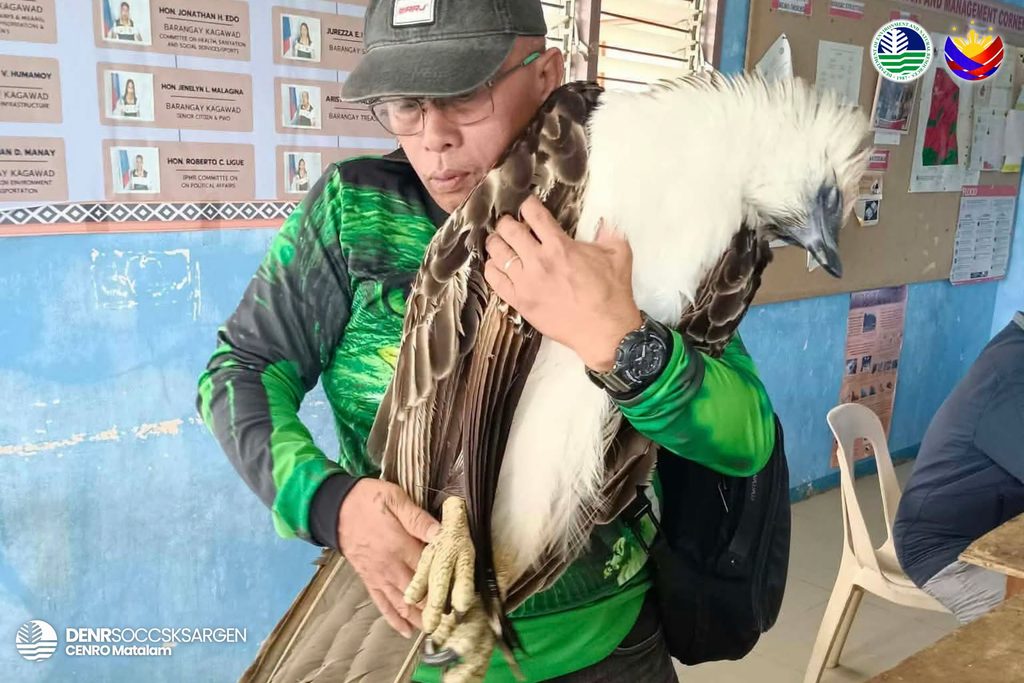
The eagle was reportedly found at around 10 a.m. after it came into contact with a power line in the area. The Department of Environment and Natural Resources–Community Environment and Natural Resources Office (DENR-CENRO) Matalam immediately responded to the report in coordination with the Municipal Environment and Natural Resources Office (MENRO) of Arakan.
The responding team confirmed that the dead bird was a Philippine Eagle.
Initial examination showed electrical burn marks on the eagle’s left wing and on two digits of its right talon, providing physical evidence consistent with electrocution.
The carcass was subsequently turned over directly to the Philippine Eagle Foundation (PEF) for a necropsy to determine the circumstances surrounding its death.
Necropsy confirms electrocution
The necropsy confirmed that electrocution was the cause of the eagle’s death.
However, the examination also uncovered another disturbing finding: two air-gun bullets were recovered from the eagle’s body.
One of the bullets, found in the left wing, was associated with a recent wound that was estimated to have been sustained only a few days before the eagle died.
The findings indicate that the eagle had been shot or hunted shortly before its death, adding another layer to the threats confronting the already critically endangered species.
The discovery is particularly alarming because the bird survived the shooting long enough to suffer another fatal encounter with a power line.
The incident demonstrates how multiple human-related threats—including shooting, hunting and unsafe electrical infrastructure—can place additional pressure on wildlife populations already struggling for survival.
DENR urges public to help protect ‘Haring Ibon’
DENR-12 OIC Regional Executive Director Maria Elvira V. Lumayag expressed sadness over the death and called on communities to actively participate in efforts to protect the Philippine Eagle and other endangered wildlife.
“The department is saddened by the recent death of the Philippine Eagle. Our team through CENRO Matalam has already conducted an investigation in coordination with the Philippine Eagle Foundation for the proper proceedings of its death,” Lumayag said.
She also urged the public to help safeguard the country’s national bird and other threatened wildlife species.
“In light of this unfortunate event, we urge the public to assist us in protecting not only our beloved ‘Haring Ibon’ but also all wildlife species that are critically endangered in the country,” Lumayag said.
Another Philippine Eagle shot in North Cotabato
The latest death comes only days after another Philippine Eagle was rescued in North Cotabato.
On September 27, a five-year-old Philippine Eagle was rescued in Magpet, North Cotabato, after it was shot with air-gun pellets.
The rescued eagle remains under the custody of the Philippine Eagle Foundation and is currently undergoing close clinical monitoring and observation at Doc Bayani’s Wellness Clinic in Davao City.
The two incidents in North Cotabato within a matter of days underscore the continuing dangers faced by the country’s national bird, particularly from human activities.
While the Arakan eagle ultimately died from electrocution, the presence of recent air-gun wounds shows that the bird had also been exposed to direct human-inflicted harm before its death.
Public reporting crucial to wildlife protection
The incidents highlight the need for stronger wildlife protection measures, sustained community awareness and faster response mechanisms for animals in distress.
The Philippine Eagle is classified as critically endangered, making every individual bird important to the survival and recovery of the species. Protecting remaining eagles requires not only government enforcement but also the cooperation of communities living near their habitats.
Authorities are reminding the public to immediately report injured, distressed or dead wildlife to the DENR, local government authorities or appropriate wildlife responders.
Prompt reporting can allow trained responders to rescue injured animals, secure affected areas, document evidence, investigate possible wildlife crimes and undertake appropriate conservation measures.
The death of the Arakan eagle serves as another warning that protecting the Philippine Eagle cannot end with the preservation of forests alone. Preventing illegal shooting and hunting, addressing dangerous encounters with power infrastructure and ensuring rapid intervention when wildlife is found in distress are equally critical.
For a species with an already fragile population, the loss of every individual is a serious blow—and the circumstances surrounding this eagle’s death reinforce the urgent need for communities and authorities to work together to keep the “Haring Ibon” flying in the wild.