
ZAMBOANGA CITY, Philippines — The Philippine Navy has strengthened its maritime security posture in Western Mindanao with the arrival of BRP Emilio Jacinto (PS-35) at Ensign Majini Pier, Naval Station Romulo Espaldon, on October 4, 2026, adding another surface asset to the Naval Command Western Mindanao’s (NCWM) growing capability for External Security Operations.
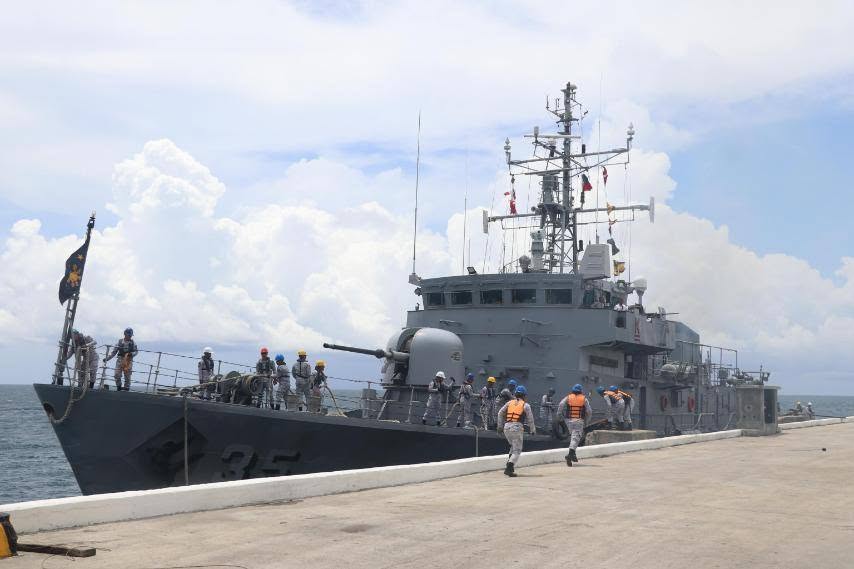
The Jacinto-class patrol corvette and its officers and crew were formally welcomed during an arrival ceremony at the naval station, marking the ship’s deployment to an area where the Philippine Navy maintains a continuing maritime security presence across strategically important waters.
For NCWM, the arrival of PS-35 is more than a routine movement of a naval vessel. It represents an effort to expand the command’s operational reach, sustain a more persistent presence at sea, and improve its ability to monitor and respond to developments across Western Mindanao’s maritime domain.
Expanding maritime reach
As a patrol corvette, BRP Emilio Jacinto provides the Navy with a platform capable of supporting a range of maritime operations, including patrols, surveillance, maritime domain awareness and monitoring of sea lanes and maritime approaches.
Its deployment gives NCWM an additional platform that can operate alongside other Philippine Navy vessels, joint forces and government agencies involved in maritime security.
The Navy said PS-35 will contribute to the protection of strategic maritime areas, safeguarding of sea lines of communication and monitoring of maritime approaches while supporting operations aimed at protecting the country’s sovereignty and territorial integrity.
The presence of a capable surface vessel is particularly significant in Western Mindanao, a maritime area that connects the country to important domestic and international sea routes and includes waters where maritime security concerns can quickly have implications for communities, commerce, transportation and national security.
A stronger posture for external security operations
The deployment also comes as the Philippine Navy continues its broader transition toward a stronger focus on External Security Operations (ESO)—operations intended to address threats and challenges involving the country’s maritime territory, approaches and national interests beyond traditional internal security missions.
Under this evolving posture, naval vessels serve not only as platforms for routine maritime patrols but also as instruments for maintaining presence, gathering maritime information, supporting joint operations and responding to emerging security situations.
The arrival of PS-35 therefore gives NCWM greater flexibility in distributing naval assets across its area of responsibility.
A persistent maritime presence can also strengthen the country’s ability to maintain awareness of activities at sea, particularly in areas where commercial shipping, fishing, transportation and other maritime activities intersect with strategic national interests.
Presence as a form of deterrence
Beyond its operational functions, the deployment of BRP Emilio Jacinto carries a broader strategic message: that the Philippines intends to maintain a visible and sustained presence in its maritime domain.
For a maritime nation such as the Philippines, naval presence can serve several purposes at the same time. It can support surveillance, provide a platform for coordinated responses, reassure maritime communities and contribute to deterrence by demonstrating that government forces are capable of monitoring and responding to developments at sea.
In Western Mindanao, where maritime routes connect numerous coastal communities and islands, the ability to maintain ships at sea for extended periods is particularly important.
PS-35 can therefore become part of a wider network of naval, military, law enforcement and civilian agencies working to maintain maritime security.
Part of a broader maritime security network
The Navy emphasized that BRP Emilio Jacinto will not operate in isolation.
The vessel is expected to work alongside other naval and joint forces as well as inter-agency partners, contributing to maritime domain awareness and coordinated maritime security operations.
Such cooperation is increasingly important as maritime security involves concerns that can range from protection of sea lanes and strategic waters to responses to emerging security incidents.
The Navy’s approach recognizes that maintaining maritime security requires more than individual ships or isolated patrols. It depends on the ability of different forces and government agencies to share information, maintain communication and deploy appropriate capabilities when necessary.
The arrival of PS-35 adds another operational layer to that system.
More than another ship
The NCWM described the arrival of BRP Emilio Jacinto as a strengthening of the command itself—an indication of a Western Mindanao naval force seeking greater capacity to address changing external security challenges.
The ship’s arrival does not, by itself, transform the region’s maritime security environment. But it provides NCWM with another capable platform that can extend its reach and give commanders additional options when conducting patrols, surveillance and other maritime operations.
For the Philippine Navy, that additional flexibility is increasingly important as the country places greater emphasis on protecting its sovereignty, territorial integrity and maritime interests.
As PS-35 settles into its new operational environment, its presence is expected to become part of NCWM’s continuing effort to maintain a stronger and more persistent maritime posture in Western Mindanao.
The message from the naval command is clear: greater capability must translate into stronger maritime presence—and stronger maritime presence must support the Philippines’ readiness to defend its national interests at sea.