
Authorities seize tanker truck, four drums of diesel in joint operation in Bunawan District
DAVAO CITY, Philippines — Two individuals were apprehended, while a tanker truck and four drums of diesel fuel were confiscated during a joint government operation targeting alleged illegal petroleum trading activities in Budbud, Bunawan District, Davao City, the Department of Energy (DOE) reported.
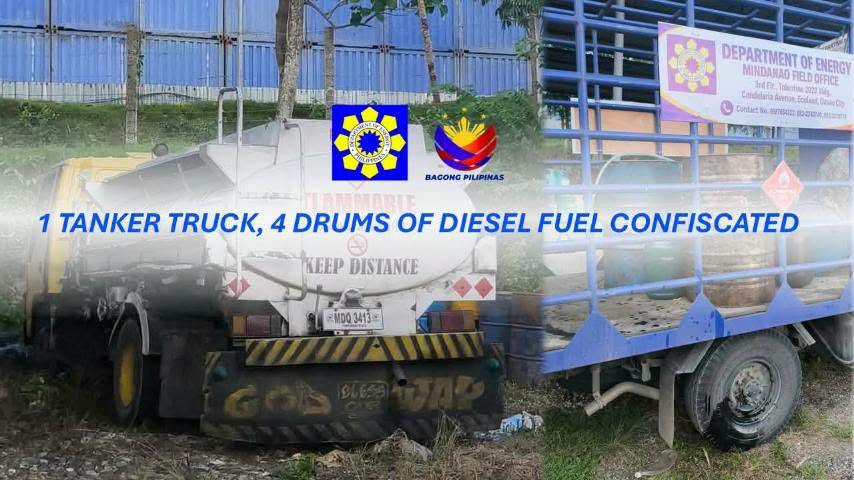
The operation, conducted by the DOE in coordination with the Philippine National Police Regional Maritime Unit XI (PNP-RMU XI), targeted alleged violations involving unauthorized fuel transfers, commonly known as “paihi,” illegal retailing, and the hauling and distribution of petroleum products without the required government authorization.
Authorities said the operation was carried out pursuant to DOE Department Circular No. 2017-11-0011 and Batas Pambansa Blg. 33, as amended by Presidential Decree No. 1865, which provide the legal and regulatory framework for addressing prohibited activities involving petroleum products.
The two individuals were apprehended over their alleged involvement in the activities under investigation. Authorities also confiscated and impounded one tanker truck and four drums of diesel fuel believed to be connected to the operation.
The DOE said the apprehended individuals were linked to alleged violations involving the unauthorized sale, transportation, and distribution of petroleum products. However, the allegations remain subject to the appropriate legal and regulatory proceedings.
Four Alleged Regulatory Violations Documented
According to the DOE, the joint operation documented several violations involving the handling and sale of petroleum products.
These included retailing petroleum products without a valid DOE Certificate of Compliance (COC), as well as selling fuel through unauthorized “paihi” or “bote-bote” arrangements.
The authorities also documented the alleged hauling and distribution of petroleum products without the required DOE accreditation and non-compliance with prescribed safety, operational, and regulatory requirements.
Unauthorized “paihi” operations generally involve the transfer of fuel from one container or vehicle to another outside authorized procedures. Meanwhile, “bote-bote” refers to the sale of fuel in bottles or other small containers, potentially outside the regulatory requirements applicable to petroleum retailers.
Such activities may expose consumers and surrounding communities to risks when fuel is transferred, stored, transported, or sold without appropriate safeguards and regulatory oversight.
The DOE has yet to provide further details on the identities of the two individuals, the specific charges to be pursued, or the exact quantity of diesel contained in the four confiscated drums.
Confiscated Fuel and Tanker Secured Pending Proceedings
Following the operation, the confiscated tanker truck and petroleum products were secured at a DOE storage facility while the appropriate legal and regulatory proceedings are being pursued.
The agency did not specify when the next proceedings would take place or whether formal charges had already been filed against the two individuals.
The case highlights the government’s continuing efforts to enforce petroleum regulations and address unauthorized fuel trading activities that may undermine safety standards and fair competition in the downstream oil industry.
DOE Warns of Fire, Spill and Environmental Hazards
The DOE emphasized that illicit petroleum activities can endanger lives, livelihoods, businesses, and the environment, particularly when fuel is handled, transported, stored, or distributed without proper safeguards.
Petroleum products are flammable, and improper fuel transfers or storage can increase the risk of fires, spills, and other potentially dangerous incidents. Such incidents may cause property damage, disrupt business operations, threaten nearby residents, and contaminate surrounding land or waterways.
Beyond public safety, unauthorized fuel trading may also place legitimate businesses at a disadvantage when operators fail to comply with the permits, accreditation, and safety requirements imposed on lawful industry participants.
The DOE reiterated its commitment to enforcing energy regulations, promoting safe petroleum operations, protecting consumers, and maintaining fair competition in the fuel industry.
Industry participants were reminded to comply with all applicable laws, rules, and regulations and to secure the necessary government permits, certificates, and accreditation before engaging in petroleum-related activities.
Consumers Urged to Buy Fuel From Authorized Establishments
The DOE also called on consumers to purchase petroleum products only from legitimate and duly authorized establishments.
The public was encouraged to report suspected illegal fuel trading and other petroleum-related violations to the agency so that appropriate verification and enforcement action could be undertaken.
The operation in Bunawan District serves as a reminder that petroleum regulation is not limited to monitoring fuel prices and supply. It also involves ensuring that fuel is handled and sold under conditions that protect consumers, workers, businesses, and communities.
Authorities have yet to disclose further details about the case. The two apprehended individuals are entitled to due process, and any determination of criminal liability must be made through the appropriate legal proceedings.
The DOE stressed that compliance with fuel safety and regulatory requirements is a shared responsibility among industry operators, government agencies, and consumers.