
KIDAPAWAN CITY, North Cotabato — Few encounters carry the weight of history quite like the meeting between a former feared militia leader and an Italian missionary whose fellow priest was killed in one of the darkest chapters of Central Mindanao’s conflict.
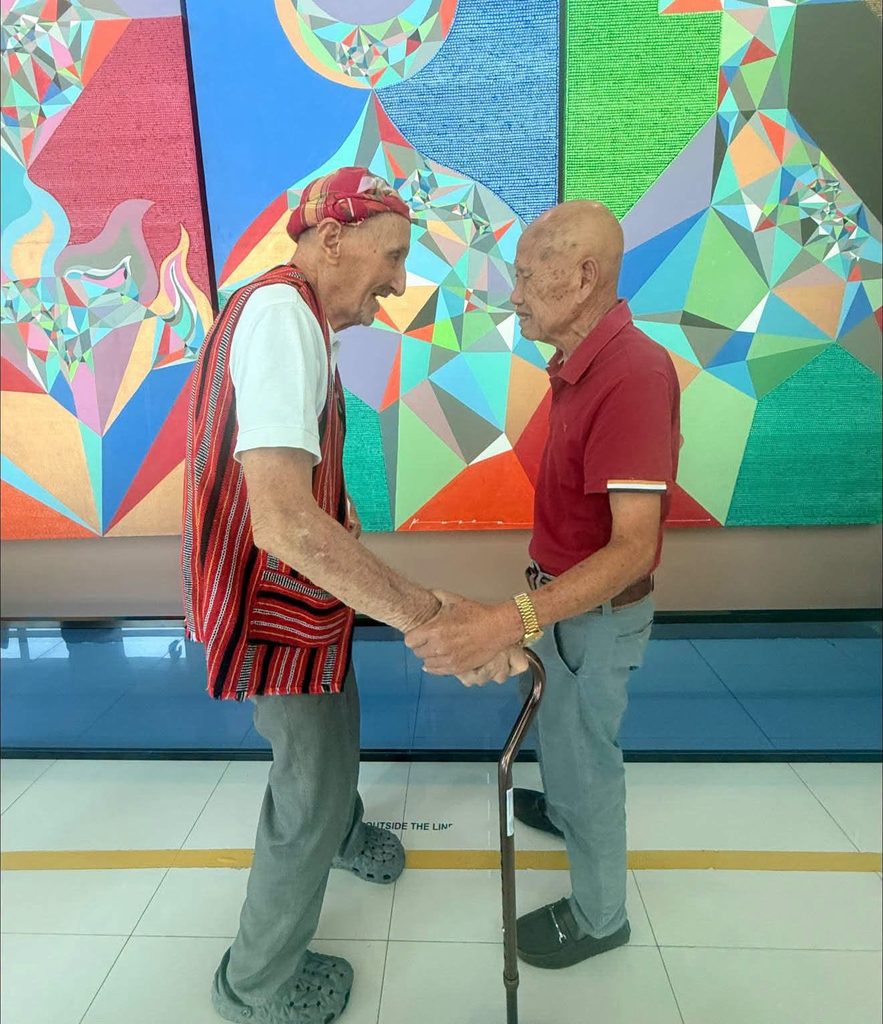
That rare and deeply symbolic moment unfolded on Saturday, August 29, at Museyo Kutawato inside the Cotabato Provincial Capitol in Kidapawan City, where Norberto “Kumander Bukay” Manero Jr. and Italian PIME missionary Father Peter Geremia crossed paths during an event held as part of the ongoing Kalivungan Festival.
For many who witnessed the encounter, it was more than a reunion between two elderly men. It was a meeting shaped by decades of conflict, loss, imprisonment, faith and, ultimately, the possibility of reconciliation.
Geremia, seated in a wheelchair, exchanged pleasantries with Manero, the bald former leader of the Ilaga vigilante movement whose name became synonymous with fear and violence in parts of Central Mindanao during the turbulent years of the 1970s and 1980s.
Their meeting was particularly poignant because Geremia and another Italian missionary, Father Tullio Favali, were contemporaries in their religious mission in Mindanao. Favali was killed in Tulunan, North Cotabato, in April 1985 in an incident that shocked the country and drew international attention to the violence engulfing the region.
Manero was convicted in connection with Favali’s killing and spent about 23 years in prison at the New Bilibid Prison in Muntinlupa before his release in January 2008.
Geremia, meanwhile, had reportedly been the original target of the plot that resulted in Favali’s death. Despite the dangers faced by missionaries and community workers during the period of armed conflict, Geremia remained in Mindanao and continued his work among Indigenous communities, farmers and marginalized sectors.
His decades of service through the Pontifical Institute for Foreign Missions, or PIME, placed him among the foreign missionaries who witnessed firsthand the social and political upheavals that transformed Central Mindanao.
The reunion therefore brought together two men whose lives had been profoundly shaped by the same violent period, but from opposite sides of its history.
The significance of the encounter was not lost on those attending the Museyo Kutawato event. Kalivungan, a term associated with gathering or coming together, provided an especially fitting backdrop for a meeting that demonstrated how people once separated by violence can find themselves sharing the same space decades later.
The encounter also came at a time when efforts to preserve and interpret Mindanao’s difficult past are increasingly being connected to the pursuit of peace and reconciliation.
Manero’s presence at the provincial museum had another purpose beyond the festival gathering. According to his confidant Crispin Berja-Pariolan, Manero was set to meet Cotabato Governor Lala Talino to turn over personal effects, amulets and other traditional talismans associated with himself and fellow members of the Ilaga movement for donation to the provincial museum.
The planned donation gives the encounter an additional historical dimension. Objects once associated with a controversial armed movement would become part of a museum collection, potentially allowing future generations to examine the realities of a conflict that shaped communities across Cotabato and neighboring areas.
The Ilaga movement emerged in the late 1960s amid escalating tensions involving Christian settlers, Moro communities and communist insurgents. Historical accounts have described the group as a predominantly Christian vigilante organization that operated in parts of Mindanao during the period, with members becoming involved in violent confrontations with Moro groups and communist forces.
Among the personalities associated with the movement were Feliciano Luces, popularly known as “Commander Toothpick,” and Manero. Manero’s involvement would later become inseparable from the Favali case.
The period was marked by deep communal divisions, displacement and retaliatory violence. The conflict was not simply a confrontation between armed organizations; it affected ordinary families, villages, religious workers, Indigenous communities and settlers caught between competing armed forces and political interests.
Historical accounts have also described alleged support or tolerance for Ilaga activities from some local political authorities and elements of the Philippine Constabulary during the period. Such accounts remain part of the broader and contested history of the conflict in Central Mindanao.
Against that backdrop, Father Geremia’s continued work among vulnerable communities became increasingly significant.
A member of PIME, Geremia spent decades working in Mindanao, particularly in areas where poverty, land disputes, armed conflict and the marginalization of Indigenous peoples intersected. His advocacy for poor and Indigenous communities brought him into difficult situations during the years of martial law and armed conflict.
The April 11, 1985 killing of Father Favali became one of the most notorious incidents associated with the violence of that era. Favali was in Tulunan when he was attacked and killed. Members of the Manero family, including Norberto Manero Jr., were subsequently prosecuted, with Manero eventually convicted and imprisoned for his role in the killing.
For years, the Favali case remained a painful reminder of how political divisions, armed militias and communal tensions could produce devastating consequences.
Yet the passage of time has changed the circumstances surrounding the people who lived through those years.
Manero eventually completed decades behind bars before his release in 2008. In the years since, he has returned to community life and has been presented in some accounts as supporting peace-related initiatives and efforts to confront the past.
Geremia, for his part, remained committed to his missionary work and to dialogue among the Christian, Muslim and Indigenous communities of Mindanao.
Their paths finally converged again not in a courtroom, a prison or a conflict zone, but inside a museum during a provincial cultural celebration.
Photographs from the gathering show Geremia in his wheelchair exchanging greetings with Manero, with Pariolan also present. The images offer a striking contrast to the violence that once defined the historical circumstances surrounding their lives.
For a province whose history has been deeply marked by conflict, such an encounter carries a message larger than the two individuals involved.
It does not erase the suffering of the past, nor does reconciliation require forgetting what happened. Instead, the meeting serves as a reminder that acknowledging history can coexist with the pursuit of peace.
The planned transfer of Manero’s personal effects and Ilaga-related artifacts to Museyo Kutawato could likewise become part of that process. Museums do more than preserve objects; they preserve memories, including those that are difficult, painful and uncomfortable.
Placed in their proper historical context, such artifacts can help younger generations understand how fear, displacement, political divisions and armed conflict affected communities in Mindanao—and why peace remains an unfinished responsibility.
The reunion of Manero and Geremia thus became an unexpected highlight of the Kalivungan Festival.
What began as a gathering celebrating culture and community became a moment of historical reflection, bringing face-to-face two men whose lives had been touched by one of the most painful periods in Cotabato’s history.
Their meeting cannot change what happened in 1985. It cannot bring back Father Favali or erase the suffering experienced by countless families during the decades of conflict.
But it can show something else: that history does not have to end with hatred.
Inside Museyo Kutawato, surrounded by reminders of Cotabato’s past, the former militia commander and the Italian missionary offered a powerful image of how the passage of time, personal transformation and the willingness to meet can create space for healing.
In a region that has spent generations confronting the scars of war and division, their reunion stands as a quiet but compelling reminder that peace is not only negotiated in formal halls or signed in agreements.
Sometimes, it begins with two people from opposite sides of history meeting again—and choosing to stand in the same room.