
BAGANGA, Davao Oriental — In a quiet village once shaped by conflict, a new chapter is taking root—one defined not by armed struggle, but by opportunity, cooperation, and hope.
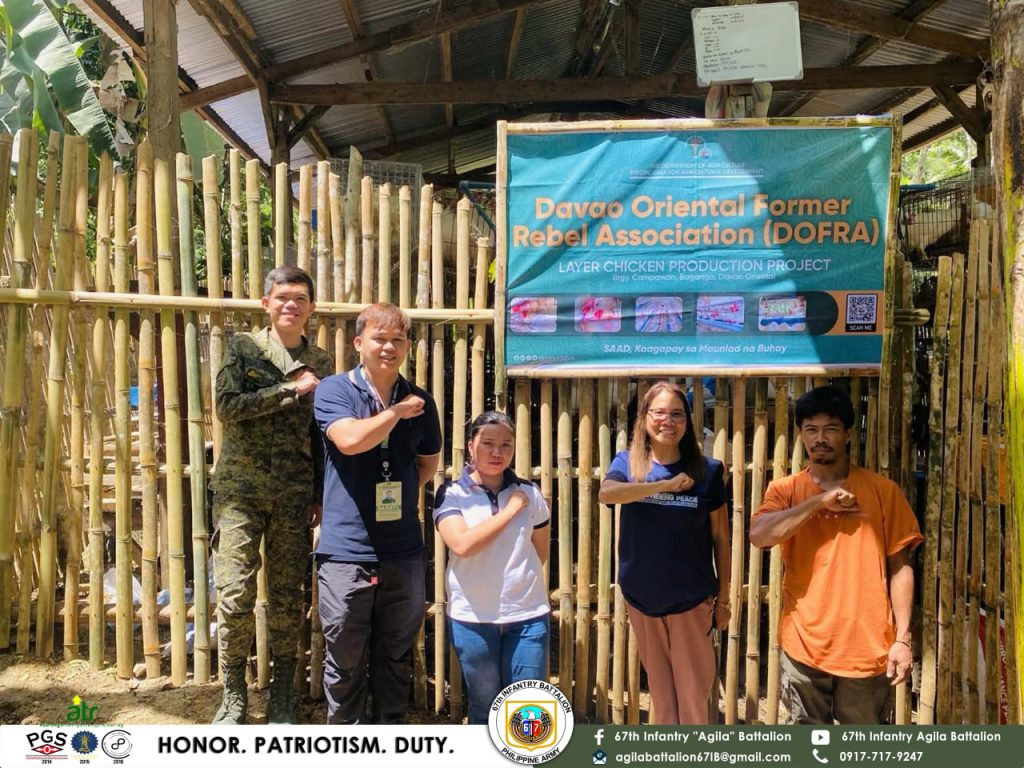
A total of 375 ready-to-lay (RTL) chickens were recently turned over to members of the Davao Oriental Former Rebels Association (DOFRA) in Barangay Campawan, marking a significant step in the reintegration of former rebels into civilian life. The initiative, supported by the Community Development Team (CDT) of the Philippine Army’s 67th Infantry “Agila” Battalion under the 10th Infantry Division, underscores a broader effort to transform lives through sustainable livelihood programs.
The poultry package, facilitated under the Department of Agriculture’s Special Area for Agricultural Development (DA-SAAD) Program, aims to equip beneficiaries with a stable source of income while fostering self-reliance among former insurgents who have chosen the path of peace.
For many of the recipients, the project represents more than just an economic opportunity—it is a tangible symbol of a second chance.
Local officials and development workers led the initiative, with Municipal Agriculturist Mary Ann Ambasan of the Municipal Agriculture and Fisheries Office (MAGRO) Baganga spearheading the distribution. She worked closely with Darryl Jay Medrano, Community Development Officer II of DA-SAAD Region, alongside other stakeholders committed to community-based development.
The Philippine Army, through its Community Development Team, played a vital role in ensuring the smooth delivery and turnover of the livestock, reinforcing its evolving role beyond security operations. In areas like Baganga, soldiers are increasingly becoming partners in peacebuilding—supporting initiatives that address the root causes of conflict such as poverty and lack of access to livelihood.
The DA-SAAD Program, which targets marginalized and conflict-affected communities, has been instrumental in bridging development gaps in remote areas. By providing agricultural inputs and technical support, the program helps beneficiaries transition into productive and sustainable livelihoods.
For DOFRA members, the chickens are expected to generate income through egg production, offering a steady and manageable enterprise that can support daily needs and, eventually, small-scale business expansion.
Community leaders emphasize that such initiatives are critical in preventing a return to armed struggle. By strengthening economic security and social inclusion, programs like this not only uplift individuals but also reinforce long-term peace and stability in conflict-prone areas.
The collaboration between the Philippine Army, the Department of Agriculture, and local government units reflects a whole-of-nation approach to peacebuilding—one that integrates security, development, and community engagement.
As the chickens begin to lay eggs in the coming weeks, so too does the promise of a more stable future for the former rebels of Baganga—one built not on conflict, but on cooperation, dignity, and renewed purpose.