
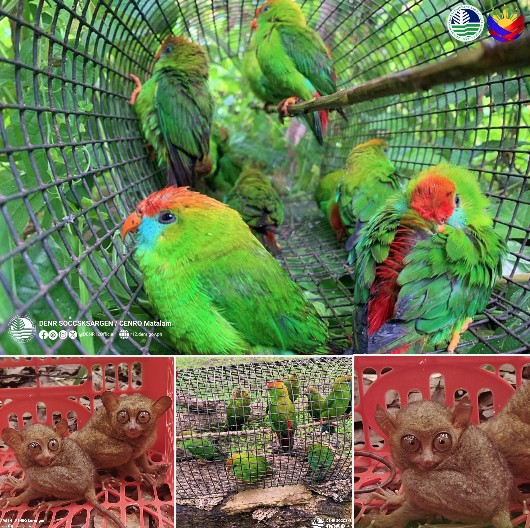
MINDANAO, Philippines — A total of 13 endemic wildlife animals, including three Philippine tarsiers and 10 critically endangered Philippine hanging parrots (kulasisi), have been successfully rescued and released back into their natural habitats in separate conservation efforts in Sarangani and Cotabato, highlighting the crucial role of public vigilance and swift government intervention in protecting the country’s unique biodiversity.
The back-to-back wildlife rescues, led by the Department of Environment and Natural Resources (DENR), underscore the growing importance of community participation in combating illegal wildlife trade and ensuring the survival of some of the Philippines’ most vulnerable species.
Three Philippine Tarsiers Rescued from Flood Threat in Sarangani
In Alabel, Sarangani Province, three Philippine Tarsiers (Carlito syrichta) were safely returned to the wild on July 14 after being rescued from possible danger caused by rising floodwaters.
According to the DENR Provincial Environment and Natural Resources Office (PENRO) of Sarangani, the tarsiers were discovered along a riverbank on July 13 by Jackyben Mangalon Jr. and Elizabeth Mangalon. Fearing that the tiny nocturnal primates could be swept away by the swollen river, the couple carefully secured the animals and temporarily cared for them before voluntarily surrendering them to DENR personnel the following day.
Wildlife specialists and a resident veterinarian examined the rescued animals and identified them as two adult males and one sub-adult male. The assessment found all three tarsiers to be in good physical condition, showing no visible injuries or signs of distress, making them suitable for immediate release.
Later that day, DENR personnel released the tarsiers into a suitable forest habitat, allowing them to safely return to the wild.
The Philippine tarsier, one of the country’s most iconic endemic mammals, is currently classified as Near Threatened by the International Union for Conservation of Nature (IUCN). Its population continues to decline due to habitat destruction, human disturbance, and illegal wildlife collection.
Ten Critically Endangered Kulasisi Saved from Alleged Illegal Wildlife Trade
In a separate operation in Matalam, Cotabato, 10 Philippine hanging parrots (Loriculus philippensis), locally known as kulasisi, were rescued from an alleged illegal wildlife trading operation and released back into their natural habitat.
The Community Environment and Natural Resources Office (CENRO) Matalam facilitated the release on July 9, one day after the parrots were confiscated during a wildlife enforcement operation in Barangay Pangao-an, Magpet, Cotabato.
The operation was launched after authorities received a report from a concerned citizen about the alleged illegal sale of the birds. According to CENRO Matalam, the rescued parrots were reportedly being offered for ₱1,000 each, illustrating the continuing threat posed by wildlife trafficking despite ongoing conservation campaigns.
Following immediate health assessments by wildlife personnel, all 10 birds were declared healthy and fit for release before being reintroduced into their natural forest habitat to maximize their chances of survival and contribute to the recovery of their dwindling population.
The Philippine hanging parrot, found only in the Philippines, is classified as Critically Endangered under DENR Administrative Order No. 2019-09 because of extensive habitat loss and relentless poaching driven by the illegal pet trade.
Community Vigilance Proves Vital
DENR emphasized that both successful operations demonstrate how ordinary citizens can make a significant contribution to wildlife conservation.
The voluntary turnover of the rescued tarsiers by the Mangalon couple and the report from a concerned citizen that led to the confiscation of the illegally traded kulasisi exemplify how public cooperation can help protect endangered species from harm and exploitation.
Authorities stressed that immediate reporting of rescued or illegally traded wildlife greatly increases the chances of successful rehabilitation and release.
Illegal Wildlife Trade Remains a Serious Threat
The DENR reiterated that the collection, hunting, possession, transport, sale, and trade of wildlife without the necessary permits are prohibited under Republic Act No. 9147, or the Wildlife Resources Conservation and Protection Act.
Violations involving protected and critically endangered wildlife species may result in imprisonment of up to four years and fines of up to ₱300,000, depending on the offense.
The agency also urged the public to refrain from purchasing wild animals, noting that consumer demand continues to fuel illegal wildlife trafficking across the country.
Instead, citizens are encouraged to immediately report wildlife sightings, rescued animals, or suspected wildlife-related offenses to the nearest DENR office to ensure proper rescue, rehabilitation, and conservation.
The successful rescue and release of the three Philippine tarsiers and 10 kulasisi serve as a reminder that safeguarding the Philippines’ rich biodiversity is a shared responsibility. Through community awareness, stronger law enforcement, and continued habitat protection, these remarkable endemic species stand a better chance of thriving in the forests they have called home for generations.