
A growing political crisis threatens to unravel the hard-won peace process in the Bangsamoro region, according to a joint statement released February 25 by the Climate Conflict Action (CCAA) and the Institute for Autonomy and Governance (IAG), which warned that trust between the government and Moro leaders is rapidly deteriorating.

In a strongly worded statement, the two organizations said the Bangsamoro political settlement is now “on the brink of collapse,” citing deepening divisions within the Moro Islamic Liberation Front (MILF), tensions in the peace implementation process, stalled normalization efforts, and mounting governance issues in the region.
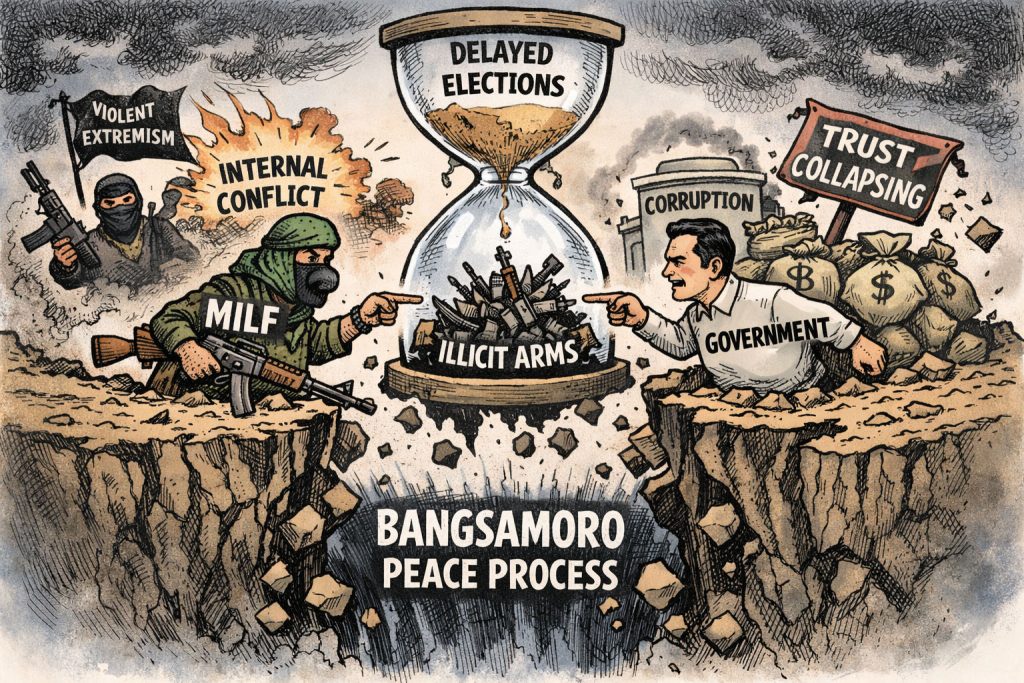
According to CCAA and IAG, the situation has deteriorated sharply over the past year, with the traditional divide between the State and non-state actors giving way to a more troubling rift within the MILF itself and between key players in the peace process. The groups warned that cooperation between government representatives and MILF counterparts at the implementation table is now giving way to confrontation, placing at risk the gains achieved over the past decade.
The two organizations said the crisis had been building for months. They noted that as early as August 2025, they had already raised alarms over expanding internal conflict among armed groups linked to the MILF, as well as the reemergence of violent extremism. These developments, they said, were fueled by the stalled decommissioning of combatants and weapons, the continued proliferation of illicit firearms, and what they described as a political transition trapped in gridlock.
Decommissioning process stalled
Central to the crisis, CCAA and IAG said, is the failure of the normalization process. The decommissioning of combatants and their weapons has effectively ground to a halt after the MILF unilaterally suspended the process while demanding that government efforts to dismantle private armies proceed simultaneously.
While acknowledging that the concern about private armed groups deserves attention, the organizations stressed that the peace agreement does not authorize a unilateral suspension of decommissioning. Allowing such a move, they warned, could delay the completion of the normalization process for another decade or more.
The consequences of this stalled process are already visible on the ground. The groups cited the recent armed attack on an elected town mayor involving a rifle-propelled grenade (RPG), a weapon that should have been among the first confiscated under the decommissioning program. The broad daylight attack, they said, highlighted how increasingly sophisticated weapons are circulating in the Bangsamoro region.
Concerns over delayed elections
Another major concern raised in the joint statement is what the organizations described as a growing push to suspend the Bangsamoro parliamentary elections once again.
CCAA and IAG warned that arguments about election timing and shortened governance periods are being used to justify another delay. They cautioned that prolonging unelected rule risks deepening the political crisis and eroding the legitimacy of the regional government in the Bangsamoro Autonomous Region in Muslim Mindanao.
The organizations pointed out that previous postponements of elections had already weakened democratic legitimacy, adding that consent for the MILF-led administration was further damaged when the State changed BARMM leadership without agreement from the MILF.
They described the move as an “organizational fix to a political problem” that undermined cooperation and trust—two elements they said are essential to sustaining peace in Mindanao and across the Philippines.
Corruption allegations deepen crisis
Compounding the political tensions, the statement also highlighted a corruption crisis within the BARMM government. CCAA and IAG said ongoing investigations have already produced substantiated findings of misuse of public funds and abuse of authority, with more cases still under review.
According to the organizations, corruption at this level does more than damage governance—it directly threatens the peace process by diverting resources meant to deliver tangible benefits to communities long affected by conflict. They warned that when public trust is already fragile, corruption can accelerate the collapse of confidence in institutions and the broader political settlement.
“The credibility of the political settlement cannot be separated from the credibility of the government tasked with implementing it,” the statement emphasized, stressing that accountability is fundamental to sustaining peace.
Urgent steps urged to save peace process
In light of the worsening situation, CCAA and IAG called for immediate action to restore trust among stakeholders and prevent the crisis from escalating further.
Among their key recommendations are the strict upholding of the peace agreements governing the Bangsamoro transition, ensuring a balance between executive authority and regional autonomy, and putting an end to any attempt to delay the parliamentary elections again.
They also urged both the MILF and the national government to complete normalization commitments as soon as possible, strengthen oversight mechanisms in the peace process, and address the growing problem of illicit weapons through stronger firearms registration and ballistic testing.
Finally, the organizations warned that emerging threats such as horizontal violence within armed groups and the resurgence of violent extremism must be addressed urgently, especially amid tensions within MILF leadership.
CCAA and IAG expressed hope that their recommendations would be considered in the spirit of Ramadan and the upcoming anniversary of the Comprehensive Agreement on the Bangsamoro, emphasizing that further erosion of trust could endanger the entire peace process.