
The signing of Executive Order No. 122 by President Ferdinand Marcos Jr., establishing a national policy framework for the development of the Philippines’ critical minerals industry, has been welcomed by government agencies and mining industry groups as a major opportunity to attract investments, expand mineral processing, create jobs and position the Philippines as a strategic supplier to the rapidly growing global clean-energy economy. Mindanao Development Authority Chairperson Leo Tereso A. Magno described the policy as a significant opportunity for mineral-rich regions to move beyond the traditional export of raw minerals and instead develop industries around refining, advanced materials, batteries, renewable-energy technologies and other downstream activities. The Philippine Nickel Industry Association likewise welcomed the measure, arguing that it could strengthen the country’s position in the global critical-minerals market. These objectives are understandable. The Philippines should indeed seek greater economic value from its natural resources rather than simply exporting raw materials while other countries capture the higher-value industries. But for Mindanao, the government’s enthusiasm must be accompanied by serious scrutiny because the region has heard the promise of mining-led prosperity many times before.
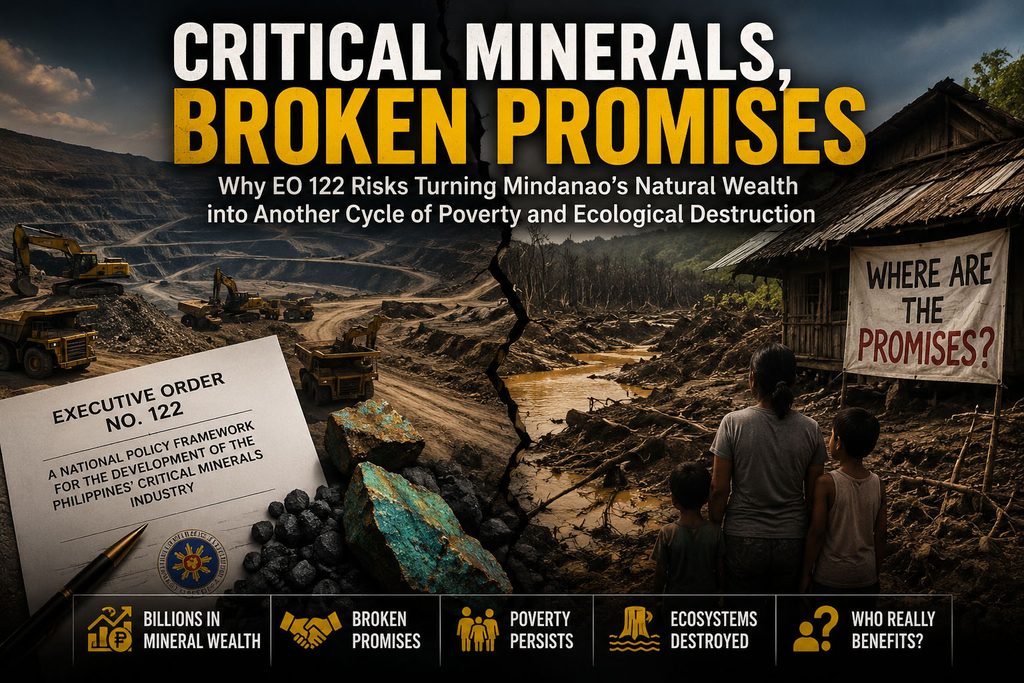
The central question surrounding EO 122 is therefore not whether the Philippines should participate in the global critical-minerals economy. It should. The more important question is whether this new policy will genuinely change the relationship between mineral extraction, economic development, environmental protection and the communities that live in mineral-rich areas, or whether it will simply accelerate the same extractive model that has allowed enormous mineral wealth to leave the region while many communities continue to struggle with poverty, insecure livelihoods, environmental degradation and displacement. The language of industrialization, clean energy and global competitiveness may be new, but the fundamental issue is not. Mindanao remains the place where much of the country’s mineral wealth is extracted, while the communities that host these operations continue to ask whether the benefits they receive are proportionate to the resources and ecosystems they surrender.
Mineral Wealth Does Not Automatically Mean Community Prosperity
The government’s economic argument begins with the enormous value of the country’s mineral resources. The Philippine Statistics Authority reported that the monetary value of the Philippines’ Class A gold, copper, nickel and chromite reserves reached ₱588.12 billion in 2025. Nickel and nickel products alone were valued at ₱94.23 billion, while copper production amounted to ₱27.24 billion. Mindanao is particularly significant to the national mining industry, accounting for a substantial share of the country’s nickel production and hosting some of the Philippines’ most important mineral deposits. These figures demonstrate the enormous economic value of what lies beneath the region’s soil, but they do not demonstrate that the people living above those deposits have achieved comparable prosperity.
That distinction is at the heart of the mining debate. A mineral deposit can be worth billions of pesos without the community surrounding it becoming wealthy. The value of the resource underground is not automatically transferred to the household struggling to pay for food, education, health care and basic necessities. Mining companies can generate substantial revenues, government can collect taxes and fees, and workers can receive relatively good salaries while the broader local economy remains vulnerable. This is particularly concerning in communities whose livelihoods depend on agriculture, fisheries, forests and other natural resources that can be affected by mining activities.
The country’s poverty statistics should therefore be examined alongside its mineral production figures. Several of the Philippines’ resource-rich regions have historically experienced significant poverty, and although some have recorded substantial improvements in recent years, it would be misleading to attribute those gains automatically to mining. Poverty reduction is influenced by agriculture, infrastructure, government programs, social protection, services, employment and other economic activities. The existence of mining does not establish that mining was responsible for the improvement. More importantly, the continued vulnerability of farmers, fisherfolk and Indigenous Peoples demonstrates that economic growth from natural-resource extraction does not necessarily translate into broad-based economic security.
This is the paradox government must confront before presenting another expansion of mining as a solution to poverty. The real measure of success should not be how much mineral wealth a region possesses or how much ore it exports. It should be whether ordinary households experience sustained improvements in income, livelihood security, access to services and quality of life. If mineral production rises while communities continue to struggle, then policymakers have an obligation to ask why the wealth being extracted is not producing the development being promised.
The Jobs Created Must Be Weighed Against the Livelihoods at Risk
Mining undeniably creates employment. Large operations require engineers, technicians, machine operators, drivers, security personnel, administrative workers and other employees. Mining companies also generate demand for contractors, suppliers, transportation services and other businesses. These economic benefits are real and should not be dismissed.
But employment statistics alone cannot provide a complete picture of mining’s economic contribution. Large-scale mining is highly capital-intensive and relies heavily on machinery, technology and specialized labor. A mine can generate enormous economic output without employing a workforce large enough to compensate for all the livelihoods potentially affected by the operation. The farmer whose land is acquired does not automatically become a mine employee. The fisher whose traditional fishing grounds are affected does not necessarily have an equivalent alternative livelihood. The Indigenous family whose ancestral territory is disrupted cannot replace generations of cultural, social and economic relationships with a short-term employment package.
Government must therefore examine mining’s employment benefits alongside the livelihoods that may be displaced. A proper assessment should consider not only how many jobs are created but also how many agricultural households are affected, how fishing communities may be impacted, what happens to small businesses that depend on local ecosystems and whether workers will have sustainable opportunities after the mine closes. A mining operation has a finite lifespan because the mineral deposit is finite. The community, however, will remain long after extraction ends. If a mining project produces temporary employment while leaving behind degraded land, damaged water resources and an economy dependent on a resource that has already been exhausted, then its contribution to long-term poverty reduction must be questioned.
The same principle applies to community development programs. Scholarships, health facilities, roads, livelihood projects and other benefits can provide important assistance, but they should not be used to obscure the larger economic question. A concrete road cannot compensate permanently for the loss of productive agricultural land. A scholarship cannot replace a destroyed fishing ground. A livelihood package cannot recreate an ancestral landscape. Community benefits should supplement development, not become a justification for environmental and social costs that communities are expected to absorb.
Faster Mining Permits Require Stronger, Not Weaker, Oversight
EO 122’s proposal to streamline mining permits and approvals through a Virtual One-Stop Shop is likely to be welcomed by investors because it promises faster, clearer and more predictable government processes. There is nothing inherently wrong with improving bureaucratic efficiency. Government agencies should eliminate unnecessary duplication, coordinate more effectively and make legitimate regulatory processes easier to navigate.
The danger arises when speed becomes the primary measure of regulatory success.
Environmental and social safeguards exist precisely because mining can create impacts that are difficult or impossible to reverse. Environmental impact assessments, water-quality requirements, rehabilitation obligations, protected-area restrictions and Indigenous Peoples’ rights are not bureaucratic obstacles that should simply be processed as quickly as possible. They are mechanisms intended to determine whether a project is environmentally and socially acceptable before irreversible decisions are made.
The Philippines already has extensive environmental laws. The persistent challenge has been enforcement, monitoring and institutional capacity. Environmental agencies and local governments often operate with limited resources, while mining companies can employ teams of engineers, lawyers, consultants and technical specialists. Communities affected by proposed projects frequently lack comparable resources to independently assess technical studies or challenge decisions. In such circumstances, accelerating the approval process without simultaneously strengthening oversight could increase rather than reduce the risks faced by communities.
The proper objective of EO 122 should therefore be efficient governance without sacrificing substantive scrutiny. Government can make permitting faster by improving coordination and eliminating unnecessary administrative delays, but it must never shorten the time necessary to investigate environmental risks, conduct meaningful consultations, evaluate cumulative impacts or verify compliance. A permit should be issued quickly only when government has sufficient evidence to conclude that the project can proceed safely and lawfully. Efficiency should improve regulation, not dilute it.
The Green-Energy Transition Must Not Create New Sacrifice Zones
The global demand for critical minerals presents the Philippines with a genuine economic opportunity, but it also creates a profound environmental and ethical challenge. Nickel, copper and other minerals are necessary for many technologies associated with electrification and the energy transition. Countries seeking to reduce dependence on fossil fuels are competing for reliable mineral supply chains, and the Philippines is well positioned to attract investment because of its substantial mineral resources.
But the fact that a mineral is essential to clean-energy technologies does not make every deposit environmentally acceptable to exploit. A nickel deposit may be critical to a battery manufacturer, but the forest covering that deposit may be critical to the survival of communities downstream. Copper may be essential to electrical infrastructure, while the watershed surrounding a copper deposit may be essential to agriculture and drinking water. A mineral may have enormous international economic value while the land containing it may have immeasurable cultural and spiritual importance to an Indigenous community.
The global clean-energy transition must therefore not become an excuse to transfer environmental destruction from wealthy consuming countries to poorer communities in mineral-producing regions. It would be deeply unjust if electric vehicles, batteries and renewable-energy technologies were promoted as solutions to climate change while the extraction of their raw materials destroyed forests, polluted rivers, displaced communities and increased climate vulnerability in places such as Mindanao.
A genuinely sustainable energy transition must account for the entire supply chain, from extraction to processing, manufacturing, use and eventual recycling. The environmental cost cannot simply disappear because the final product is labelled green.
Mindanao’s Environmental Vulnerability Makes the Stakes Higher
The environmental implications of expanding mining are particularly serious in Mindanao because the region is already highly vulnerable to climate and disaster risks. Communities across the island regularly experience flooding, landslides, extreme rainfall, drought and other hazards. Forests, watersheds, wetlands and other ecosystems provide natural protection against these threats by stabilizing soils, regulating water flows and supporting biodiversity and livelihoods.
Research in parts of Mindanao has documented environmental concerns associated with mining, including soil erosion, landslides, flash floods, biodiversity loss, soil degradation and water contamination. Studies involving nickel-mining areas in Caraga have also examined concerns related to sedimentation and water quality. These findings should not be interpreted as proof that every mining operation causes the same impacts, but they demonstrate why environmental monitoring and site-specific risk assessment must be treated as fundamental components of mining governance rather than secondary considerations.
Climate change makes these risks more consequential. A disturbed landscape may be more vulnerable to extreme rainfall than a healthy forested watershed. Sedimentation can become more serious during intense storms. Soil instability can become more dangerous when rainfall patterns become less predictable. Communities already exposed to climate hazards should not be placed under additional environmental pressure without extraordinary justification and strong safeguards.
It is difficult to claim that a development policy is strengthening climate resilience if it simultaneously permits activities that can weaken the ecosystems responsible for protecting communities from climate-related hazards. Climate adaptation cannot simply consist of building flood-control structures and disaster-response systems after ecosystems have been degraded. Protecting forests, watersheds and other natural defenses must be part of the adaptation strategy itself.
Indigenous Rights Must Remain Non-Negotiable
Mining in Mindanao also raises serious questions about Indigenous Peoples and ancestral domains. Some of the region’s mineral-rich areas overlap with territories where Indigenous communities have lived for generations. These lands are not simply parcels of property that can be assigned an economic value and transferred in exchange for compensation. They are places of history, culture, livelihood, identity and collective memory.
The Free, Prior and Informed Consent process is therefore essential. But consent must be more than a procedural requirement. Communities must receive complete and understandable information about proposed mining activities, including their potential environmental, economic and social consequences. They must have sufficient time to deliberate and must be able to seek independent advice. Most importantly, the process must be genuinely free from coercion, intimidation or manipulation.
Poverty itself can create an unequal negotiating environment. A community with limited access to employment, health services and infrastructure may understandably be attracted to promises of jobs, roads, scholarships and financial assistance. But consent obtained under conditions where people feel they have no realistic alternatives cannot be treated casually.
The government must ensure that Indigenous Peoples are not reduced to beneficiaries of mining projects that fundamentally alter their territories. Their rights must be protected because they are rights, not because recognition of them makes mining projects more acceptable.
Responsible Mining Must Be Proven, Not Merely Promised
Government and industry have repeatedly emphasized responsible mining, environmental safeguards and social standards. The mining industry has expressed its willingness to work with government and communities to ensure that the critical-minerals opportunity produces sustainable and inclusive growth. Those commitments should be welcomed, but they must also be tested against measurable outcomes.
Responsible mining should mean that environmental compliance records are transparent, monitoring results are accessible to affected communities and violations carry meaningful consequences. It should mean that companies provide adequate financial guarantees for rehabilitation and closure rather than leaving the public to shoulder costs when projects fail. It should mean that cumulative environmental impacts are assessed, particularly in areas where multiple mining operations affect the same watershed or ecosystem. It should mean that communities have meaningful mechanisms to raise complaints and obtain remedies when environmental or social commitments are violated.
Most importantly, responsible mining must acknowledge that some areas are simply too environmentally sensitive or socially important to mine. Not every mineral deposit must be exploited merely because it exists. Critical watersheds, protected ecosystems, highly productive agricultural areas, disaster-prone landscapes and culturally significant ancestral territories may require stronger protection precisely because their value cannot be replaced once destroyed.
That is the test of responsible governance: not whether government can find a way to permit every economically attractive project, but whether it has the courage to reject projects whose costs are unacceptable.
Value-Added Processing Should Create a Better Economy, Not a Larger Extractive Footprint
EO 122’s emphasis on downstream industries deserves serious consideration. The Philippines has long struggled with exporting raw materials while importing finished products. Developing refining, advanced materials, battery-related manufacturing and other industries could create greater economic value within the country and reduce dependence on exporting unprocessed resources.
But moving up the value chain should not mean moving deeper into extraction without addressing environmental limits.
The country should use mineral revenues and investments to diversify local economies rather than make communities permanently dependent on mining. Processing facilities should be subject to strict environmental standards. Workers should receive decent wages and opportunities for skills development. Local businesses should be integrated into supply chains wherever possible. Government revenues should be invested in education, infrastructure, agriculture, technology and other sectors that can continue generating economic activity after mineral deposits are exhausted.
The objective should be to use mineral wealth as a bridge toward a diversified economy, not as a permanent substitute for one.
If the country merely extracts more ore, processes more minerals and exports more products while communities continue to experience poverty and environmental degradation, then the economic model has changed only superficially.
The Question Nobody Should Ignore: What Happens After the Mine Closes?
Every mining project is temporary.
Mineral deposits are finite. Commodity prices fluctuate. Technologies evolve. Companies change their investment priorities. Eventually, mines close.
Communities do not.
That reality should be at the center of every mining policy.
Before a project is approved, government should be able to explain what the local economy will look like when extraction ends. Will agricultural lands remain productive? Will rivers remain safe? Will forests remain intact? Will workers possess skills that can be used in other industries? Will local businesses have diversified markets? Will Indigenous communities retain control over their ancestral territories? Will sufficient financial resources exist to rehabilitate the site properly?
These questions are more important than the number of investors attracted during the first years of a project.
A mining operation should not be considered a success simply because it produced billions of pesos while it was active. It should be judged by what it leaves behind when the ore is gone.
If what remains is a diversified economy, restored ecosystems, skilled workers and financially secure communities, then mining may have contributed to lasting development.
If what remains is poverty, environmental damage, economic dependence and unresolved social conflict, then the country must have the honesty to acknowledge that extraction failed to deliver the promised transformation.
Mindanao Needs Development, But It Must Not Be Forced to Choose Between Development and Survival
There is no question that Mindanao needs investment and economic opportunities. The region needs industries that can provide decent employment, improve household incomes and create opportunities for young people. It needs infrastructure, better connectivity, stronger public services and diversified local economies.
But mining cannot be allowed to become the default answer to every development challenge simply because the region happens to possess valuable minerals.
Mindanao also possesses enormous agricultural potential, fisheries, forests, renewable-energy resources, tourism assets, cultural diversity and a young workforce. These sectors can generate employment and economic activity without necessarily requiring the permanent destruction of natural ecosystems. Government policy should strengthen these sectors alongside responsible mineral development rather than allowing mining to crowd them out.
A farmer should not have to surrender productive land to obtain a mining job. A fisher should not have to accept environmental degradation in exchange for a livelihood program. An Indigenous community should not have to choose between protecting its ancestral territory and receiving basic infrastructure. Development should expand people’s choices, not reduce them.
The ultimate objective should be an economy in which communities have multiple sources of income and are not forced to depend on a single extractive industry for survival.
EO 122 Must Be Judged by What It Leaves Behind
The Marcos administration now has an opportunity to demonstrate that EO 122 represents a genuine departure from the country’s traditional extractive approach rather than simply an acceleration of it. That will require more than promoting investment and celebrating mineral reserves. It will require transparent governance, strong environmental enforcement, independent monitoring, meaningful community participation, strict protection of Indigenous Peoples’ rights, credible rehabilitation and mine-closure requirements, and clear protection for ecosystems that are too important to sacrifice.
Government should also broaden the way it measures the success of mining. Jobs created and taxes collected are important, but they are only part of the equation. The government must also account for agricultural and fishing livelihoods affected by mining, environmental rehabilitation costs, changes in water quality, biodiversity loss, displacement, community health, climate vulnerability and the long-term economic condition of host communities. A mining industry that generates billions in revenue while imposing billions in unaccounted environmental and social costs on the public cannot honestly be described as fully successful.
The country must also resist the temptation to treat every mineral-bearing area as an investment opportunity. Some forests must remain forests. Some watersheds must remain protected. Some agricultural landscapes must remain devoted to food production. Some ancestral domains must remain beyond the reach of extractive industries. Economic development requires choices, and responsible government must be capable of recognizing limits.
Mindanao’s Greatest Wealth Is Not Beneath the Ground
The most important mistake in the current critical-minerals debate is the tendency to define Mindanao’s wealth primarily in terms of what can be dug out of its mountains.
Mindanao’s wealth is also found in the forests that regulate its watersheds, the rivers that sustain communities, the farms that produce food, the seas that support fisherfolk, the biodiversity that strengthens ecosystems, and the ancestral territories that sustain Indigenous cultures. These resources may not appear as billions of pesos on a balance sheet, but their economic and social value is enormous. They protect communities, sustain livelihoods and provide the foundation for generations of future development.
Once a mineral is extracted, it is gone. Once a forest is destroyed, its recovery may take generations. Once a river is contaminated, restoring it can be extraordinarily difficult. Once an Indigenous community is displaced, the cultural consequences may never be fully reversed. Once a farming or fishing livelihood collapses, the resulting poverty can persist long after a mining operation has moved on.
That is why EO 122 should not be judged by how quickly the Philippines can extract more critical minerals or how many investors it can attract. It should be judged by whether the policy can generate genuine economic value while protecting the people and ecosystems that must continue to exist long after the minerals are gone.
Mindanao should not be treated as a mineral warehouse whose primary purpose is to supply the demands of the global economy. It should be treated as a living region whose people, communities and ecosystems have an equal claim to the country’s vision of progress. If critical minerals are truly essential to the Philippines’ future, then the government must demonstrate that developing them will not come at the expense of the forests, rivers, farms, fisheries and ancestral lands that are equally essential to Mindanao’s survival.
The Philippines can pursue industrialization without surrendering environmental responsibility. It can attract investment without weakening community rights. It can develop downstream industries without allowing extraction to run unchecked. It can participate in the global clean-energy economy without turning vulnerable communities into sacrifice zones.
But that will happen only if the government recognizes that natural wealth is not limited to what can be sold.
Mindanao’s forests have value. Its rivers have value. Its farms have value. Its fisheries have value. Its ancestral lands have value. And above all, its people have value.
The minerals beneath Mindanao may be finite, but the consequences of how they are extracted can last for generations. The true test of EO 122 will therefore not be how much wealth the Philippines can pull from the ground. It will be whether the country can transform that wealth into lasting prosperity without destroying the natural systems and communities that make prosperity possible in the first place.
Mindanao has given enough to the nation’s extractive economy. It must not now be asked to surrender its environmental future in the name of a new mining boom.