
From a deadly shooting in Tacloban to stabbings, weapons discoveries, online threats and another fatal school shooting in Zamboanga, the Philippines is being forced to confront a question it can no longer postpone: Are our schools still the safe second homes we have always believed them to be?
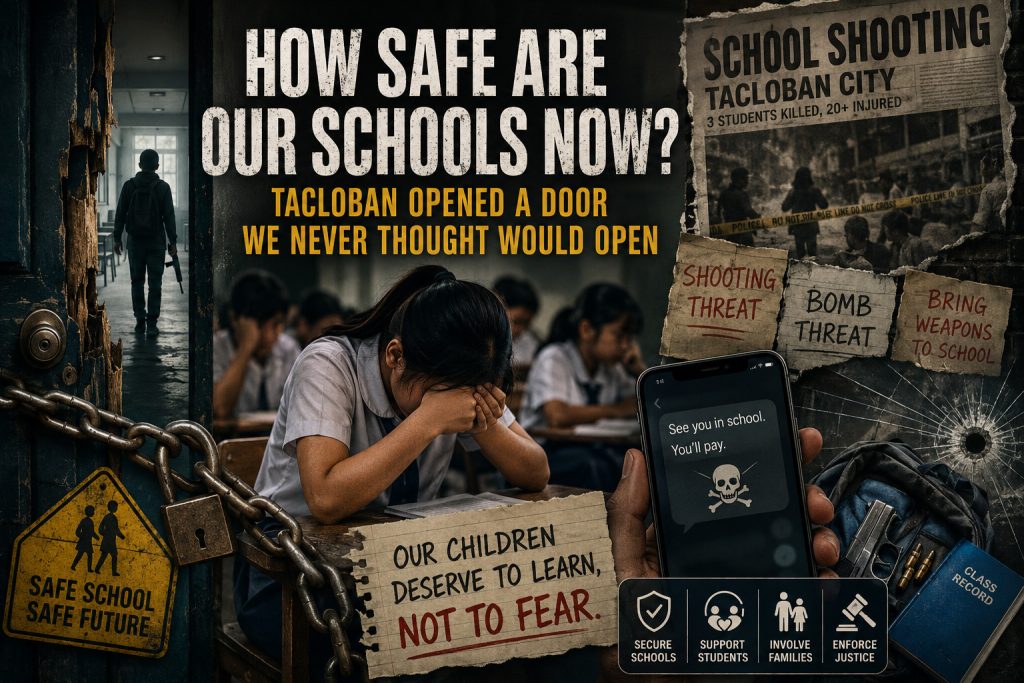
For generations, Filipino parents have sent their children to school with an expectation so basic that it rarely needed to be questioned: they would come home. School was supposed to be the second home. It was supposed to be where children learned mathematics, science, history and the values needed to become responsible citizens. It was supposed to be a place where teachers acted in loco parentis—trusted adults who would guide, protect and educate children while their parents were away. Parents worried about grades. They worried about bullying, bad influences, teenage relationships and whether their children were eating lunch. They were not supposed to worry about whether their child would be caught in a shooting inside a classroom.
But that assumption was shattered on June 22, 2026, in Tacloban City. And less than two months later, it was shattered again in Zamboanga City. The disturbing question now is no longer simply what happened in Tacloban? It is: What has changed—and are we prepared for what may happen next?
Tacloban was more than another crime story
The shooting at San Jose National High School in Tacloban City was a watershed moment. Two students, aged 14 and 15, allegedly entered their school armed with firearms and opened fire, killing three students and injuring about 20 others. Police later said the attack had allegedly been planned for more than a month.
That detail is perhaps one of the most disturbing elements of the entire case. This was not simply an argument that suddenly became violent. It was not a spontaneous fistfight that escalated. According to police, there was planning. The attackers allegedly had time to think about what they wanted to do, acquire weapons, prepare and ultimately carry out the attack.
That fundamentally changes how society must look at school violence. Because if a student can allegedly plan a school attack for weeks, enter a campus with firearms and execute it during school hours, then the problem is no longer simply about school discipline. It becomes a question of school security, child protection, mental and psychosocial support, online influence, firearm access, family and community responsibility, and the capacity of the justice system to respond to serious offenses committed by minors.
Tacloban was reportedly the first mass school shooting of its kind in the Philippines. And then came the incidents that followed.
The Pandora’s box opened
What happened after Tacloban is difficult to ignore. Within weeks, reports emerged from different parts of the country involving stabbings, firearms inside schools, shooting threats, bomb threats, physical assaults, brawls and alleged attack plans.
By July 9, 15 school-related violence and threat cases had been documented over roughly three weeks, involving at least 32 injured students and three deaths. The Department of Education also described the situation as concerning.
That does not mean every subsequent incident was caused by Tacloban. It would be irresponsible to make that claim without evidence. But Tacloban undeniably changed the national conversation. It showed young people, parents, teachers, police officers and school administrators something that had previously seemed almost unimaginable: A Filipino student could bring a gun into a school and use it against fellow students.
And once that possibility became real, schools across the country had to start asking themselves whether it could happen in their own campuses. That question was no longer theoretical.
The incidents that followed
The pattern was disturbing in its variety. On June 23, a student in San Carlos City, Negros Occidental, was reportedly stabbed by another student. The same day, several schools in Tarlac faced bomb threats, forcing authorities and school officials to respond to possible attacks.
On June 24, a 14-year-old student in Tolosa, Leyte, was reportedly investigated after threats of a school attack circulated through Facebook. On June 26, a student in another school was reportedly stabbed by a schoolmate, while in Aparri, Cagayan, three Grade 10 students were found carrying a knife and a loaded .38-caliber revolver. The students reportedly claimed the weapons were for protection amid a feud.
On June 27, violent threats circulated involving Allen National High School in Northern Samar and Palo National High School in Leyte. On June 29, a shooting threat affected Batangas City Integrated High School, while another alleged shooting plan surfaced at Escalante National High School in Negros Occidental. The following day, a loaded .38 revolver was reportedly found inside a student’s backpack at Barotac Nuevo National Comprehensive High School in Iloilo.
On July 1, two students at Cabaluay National High School in Zamboanga City were reportedly wounded in a confrontation involving a knife. And on July 3, an alleged bomb and gun threat circulated involving Eastern Samar National Comprehensive High School in Borongan.
Then the incidents continued. A group attack involving students in Davao City was reported on July 6. A Grade 8 student was reportedly stabbed during recess at Dasmariñas East Integrated High School in Cavite on July 13. A shooting threat forced Manaoag National High School in Pangasinan to suspend face-to-face classes on July 17. A troubling assault involving an 8-year-old student in Davao City later resulted in the child’s death, with police investigating the circumstances.
An online shooting threat disrupted classes at Camp Tinio National High School in Cabanatuan City on July 20. A fatal stabbing was reported at Las Piñas National High School on July 31, where a 13-year-old student was killed following an altercation with another student.
Then, in August, reports of online shooting threats prompted heightened security around schools in General Santos City, while classes at Lapasan National High School in Cagayan de Oro were suspended after an alleged mass-shooting threat circulated online.
And then came August 18.
Zamboanga.
And then it happened again
The shooting at the Ateneo de Zamboanga University Junior High School campus is the incident that makes the entire discussion even more urgent. A Grade 9 student allegedly brought firearms into the school and opened fire. A Grade 10 student was killed. The suspected shooter also died. Two other people were reportedly injured.
Authorities said the situation was brought under control, while the university confirmed two fatalities, including the suspected shooter.
This was not merely another shooting in another part of the country. It was another fatal school shooting involving a student, less than two months after Tacloban.
And that is precisely why the national response cannot stop at condolences. Because after Tacloban, authorities promised heightened security. Schools reviewed security measures. Local governments began considering active-shooter response plans and drills. Baguio, for example, moved toward developing school-shooting response protocols similar to earthquake preparedness exercises.
Yet on August 18, another student allegedly managed to bring firearms into a school. That raises a brutally simple question: What exactly did we learn from Tacloban?
The most uncomfortable question: How did the guns get inside?
This may be one of the most important questions following the Zamboanga shooting. Lawmakers have already raised concerns about how firearms could again enter a school despite the heightened security measures implemented nationwide after the Tacloban shooting. How were the students able to acquire the firearms, and how were those weapons transported into school premises without being detected? Were there gaps in security that allowed the weapons to pass through? Were there warning signs that authorities, school officials, teachers, parents or fellow students failed to recognize? Were there online indicators or behavioral changes that could have alerted adults to a potential threat? Were there conflicts involving the students that people around them already knew about but did not consider serious enough to report? And perhaps most importantly, were there systems in place to connect these warning signs before violence occurred?
These questions matter because school safety cannot simply mean putting more guards at school gates. Security is important, but a guard at a gate cannot necessarily detect a student who has been planning an attack for weeks. A metal detector cannot detect resentment, a CCTV camera cannot automatically recognize a child in psychological distress, a school ID cannot reveal whether a student is being bullied, and a security guard cannot know what is happening inside a student’s phone. The solution therefore cannot be purely physical. It has to be preventive, behavioral, technological, educational and community-based.
Are these incidents connected?
This is where caution is necessary. It would be irresponsible to say that every stabbing, brawl, threat or weapon incident since June 22 is part of one organized national pattern. There is currently no evidence establishing such a coordinated network.
The incidents have different circumstances and different alleged motivations. Some involved personal disputes. Some involved bullying allegations. Some involved threats that were never carried out. Some involved weapons possession. Some were online hoaxes or false alarms. And some were serious acts of physical violence.
But the sheer variety of incidents presents another problem: The threshold of what young people are willing to do—or threaten to do—appears to be changing.
That is the issue policymakers should investigate. Not whether every incident is connected, but why so many different forms of school violence are now appearing in public view at almost the same time.
The disturbing role of the internet
Tacloban also opened another Pandora’s box: the digital environment surrounding Filipino children.
Police said one of the Tacloban suspects reportedly claimed an online gaming application influenced him. Authorities subsequently examined the game and its possible relationship to the attack. The Cybercrime Investigation and Coordinating Center even sought discussions with the game’s developer.
But this requires nuance. Playing a violent game does not automatically make someone violent. Millions of young people play violent games without harming anyone. Therefore, it would be scientifically and journalistically wrong to conclude that a game caused the Tacloban shooting.
What deserves examination is the combination of factors: bullying or humiliation; social isolation; exposure to violent content; online communities; social-media algorithms; fascination with previous attacks; access to weapons; family and community circumstances; emotional distress; and whether adults recognized warning signs.
The internet can provide information about virtually anything. That includes information about previous school shootings. It can provide violent imagery. It can provide communities that normalize aggression. It can provide platforms for threats. And, as the Ateneo investigation now shows, authorities are also looking into the suspect’s online activity, gaming history and chat history before drawing conclusions about motive.
That investigation must be allowed to finish. Online influence should be investigated—not automatically declared the cause.
The copycat question cannot be ignored
There is another uncomfortable issue. Once an unprecedented event receives enormous media and social-media attention, it can potentially become part of the information environment of another troubled young person.
This is not to say that every later incident is a copycat. It is not. But experts and authorities have already raised concerns about modeling, imitation and the exposure of young people to violent material online following Tacloban.
That means the Philippines needs to learn from international experience without simply importing foreign explanations. We must ask how we report school attacks without inadvertently turning perpetrators into celebrities. How much of the attacker’s identity should be publicized? Should graphic videos be repeatedly broadcast? Should the alleged attacker’s social-media accounts be reproduced? Should manifestos, threats and livestreams be amplified?
These are not merely newsroom questions. They are public-safety questions.
But bullying cannot become the universal explanation
Bullying has emerged repeatedly in discussions surrounding these incidents. It deserves serious attention. A child who is humiliated, threatened, isolated or repeatedly abused at school may carry that trauma for years. Schools must take bullying seriously.
But we must also be careful. Most children who experience bullying do not become violent attackers. Therefore, bullying alone cannot explain school shootings. If it becomes the convenient explanation, society risks overlooking other factors—including firearm access, family circumstances, mental and psychosocial needs, online behavior, peer influence and previous threats.
The better question is not simply whether the child was bullied. It is what happened to that child before the violence, who knew about it, what warning signs existed, and what intervention was attempted?
That is a much harder question. But it is also the question that could save lives.
And then there is the Juvenile Justice Act
Perhaps no part of this discussion is more politically explosive. The Tacloban suspects were minors. The same is true of many of the students involved in the incidents that followed.
Under the Juvenile Justice and Welfare Act, as amended by Republic Act No. 10630, a child 15 years old or younger at the time of the offense is exempt from criminal liability, although the law provides for intervention. A child above 15 but below 18 may be held criminally liable if he or she acted with discernment.
That distinction matters enormously because the public naturally asks what happens when a child commits an extraordinarily serious offense. What happens when the victim is dead? What happens when there are dozens of injured students? What happens when investigators say the attack was planned? What happens when the alleged offender understands what a firearm does? What happens when the alleged perpetrator knows the difference between right and wrong? And what happens when the offender is still legally a child?
These are not easy questions. But anger alone should not determine the answer.
Should the age of criminal responsibility be lowered?
There are already renewed calls to reconsider the law. But there are also lawmakers and child-rights advocates warning that lowering the age of criminal responsibility will not necessarily prevent juvenile crime. Manila Rep. Joel Chua, for example, argued recently that the answer lies in stronger family guidance, counseling and proper implementation of the existing juvenile justice framework rather than simply lowering the age threshold.
That argument deserves consideration. Because the bigger problem may not simply be that “the law is too lenient.” It may be that “we are not detecting dangerous behavior early enough, and we are not actually implementing the intervention mechanisms the law already provides.”
A juvenile justice system that intervenes after a child commits a massacre is already too late. The goal should be intervention before the gun is fired, before the knife is drawn, before the threat is posted and before the plan is executed.
The real failure may be prevention
Imagine a hypothetical student who repeatedly threatens classmates, posts violent material, talks about attacking the school, is severely bullied, becomes increasingly isolated, searches for violent content, shows fascination with previous school attacks, has access to a firearm at home and tells a friend about a plan.
What happens next? Who receives that information? Who evaluates it? Who has the authority to intervene? Who talks to the family? Who protects the potential victims? Who provides psychological assistance to the student? Who determines whether the threat is real? And who is responsible for ensuring that the child does not simply disappear from the system after an initial intervention?
Those questions are more important than simply asking how many guards should stand at the school gate.
The most effective school safety system is not necessarily the one with the most guards. It is the one capable of recognizing danger early, connecting information across teachers, administrators, families and authorities, and intervening before a student reaches the point of committing violence.
A school cannot be safe only because nothing has happened yet
This may be the biggest lesson from Tacloban. Before June 22, a school without metal detectors could appear perfectly safe. A school with several entrances could appear perfectly safe. A school without armed security could appear perfectly safe. A school where teachers had no active-shooter training could appear perfectly safe.
Because nothing had happened.
But safety is not the absence of a previous incident. Safety is the ability to prevent, detect, respond to and recover from a threat.
That means schools now have to think differently. Do they have emergency lockdown procedures? Do teachers know what to do during an active attack? Can administrators communicate quickly with police and parents? Are entrances properly controlled? Can unknown individuals enter? Are firearms being detected? Are students able to report threats anonymously? Are bullying complaints being investigated? Are serious threats escalated immediately? Are social-media threats assessed professionally? Are school personnel trained to recognize behavioral warning signs? And perhaps most importantly, do students themselves feel safe enough to tell an adult when something is wrong?
The classroom should not become a fortress
There is also a danger in overreacting. We cannot transform every Philippine school into a prison. Students deserve dignity. Teachers should not have to teach behind layers of barbed wire. Children should not grow up believing that their classroom is a potential battlefield.
Security measures must therefore be proportional, intelligent and child-centered. The objective should not be to create a militarized education system. The objective should be to create a resilient education system, one where security and child welfare reinforce each other.
The victims must remain at the center
In discussions about school shooters, the perpetrator often becomes the center of attention. That is understandable from an investigative standpoint. But journalism and public policy must remember who ultimately paid the price.
The students.
The children who went to school expecting an ordinary day. The families who received phone calls they never expected. The classmates who witnessed violence. The teachers who had to protect children while trying to comprehend what was happening. The survivors who may carry the psychological consequences long after physical wounds heal.
The Tacloban victims were not statistics. Neither are the students wounded in the stabbings and assaults. Neither is the student killed in Las Piñas. Neither is the Grade 10 student killed in Zamboanga. And neither are the hundreds or thousands of children now wondering whether their school is truly safe.
The question after Zamboanga is no longer hypothetical
After Tacloban, authorities had a warning. After the subsequent threats and weapons incidents, they had additional warning. After schools began conducting security reviews and considering active-shooter drills, the country had begun adapting.
And now, after Zamboanga, the question becomes much harder: Was the response enough?
Lawmakers have already questioned how firearms could again be brought into a school despite heightened security following Tacloban.
That question deserves a serious answer. Not a political answer. Not a public-relations answer. Not an answer that simply says security was “heightened.”
The public deserves to know what was strengthened, where, how and whether it worked.
Because if a student can still enter a school with a firearm less than two months after Tacloban, then the country needs to determine whether the reforms were inadequate—or whether the problem lies somewhere deeper.
From Tacloban to Zamboanga: the warning has become a pattern worth studying
We should resist the temptation to declare that the Philippines has suddenly become a nation of school shooters. That would be inaccurate. School shootings remain extremely rare in the Philippines.
But rarity should not become an excuse for complacency.
The significance of the past two months lies precisely in the fact that something previously considered extraordinarily unlikely happened—and then happened again.
Between those two shootings were reports of stabbings, brawls, weapon possession, firearms discovered inside schools, shooting threats, bomb threats, online attack plans, physical assaults and false alarms.
Some were genuine attacks. Some were threats. Some were hoaxes. Some remain under investigation. But together they create a national warning signal that cannot simply be dismissed.
So, how safe are Philippine schools?
The honest answer is: We do not know yet.
And that should concern us.
We know schools remain overwhelmingly safe places for millions of Filipino children every day. We also know that the recent incidents exposed vulnerabilities that were previously easy to overlook.
A school can be academically excellent and still have inadequate security. A school can have guards and still fail to detect a weapon. A school can have a guidance office and still miss a warning sign. A child can be surrounded by teachers and classmates and still feel completely alone. A family can love a child and still fail to recognize what is happening online. And a community can discover a threat only after the warning becomes a crime.
That is why the country needs to move beyond the question of “Who is to blame?” The more urgent question is: “What failed, and how do we make sure it does not fail again?”
The way forward cannot be one-dimensional
The national response should bring together at least five areas. First, school security: entrances, exits, visitor protocols, firearm detection, emergency communications and lockdown procedures must be reviewed. Second, early intervention: guidance counseling, behavioral assessment, bullying response and confidential reporting systems must be strengthened. Third, family and community responsibility: firearms must never be accessible to children, and parents and firearm owners must understand that safe storage is not optional. Fourth, digital safety: authorities, schools and parents need better mechanisms to respond to online threats, violent content and digital communities that may encourage real-world harm—without casually blaming games or social media for complex behavior. Fifth, juvenile justice: the country must have an honest discussion about accountability, rehabilitation and the protection of children while ensuring that serious offenders cannot simply disappear from the system without meaningful intervention.
None of these alone will solve the problem. Together, they may.
The second home must remain a home
There is a line from President Ferdinand Marcos Jr.’s response to the Zamboanga shooting that captures the essence of the issue. He said schools are places where children are entrusted to learn, grow and dream—and that they must be among the safest places in the country.
That should not be merely a statement made after every tragedy. It should become a national policy principle.
Because a parent should not have to wonder whether sending a child to school means sending that child into danger. A student should not have to scan a classroom for an escape route before listening to a teacher. A teacher should not have to wonder whether a student entering the room is carrying a weapon. And a school administrator should not have to wait for gunfire before discovering that a child had been signaling distress for weeks.
Tacloban opened the door to a possibility that Filipinos once believed belonged somewhere else. Zamboanga showed that the door had not closed.
The answer cannot be panic. It cannot be collective punishment of children. It cannot be blaming video games. It cannot be simply lowering the age of criminal responsibility. And it cannot be another round of promises that security will be “heightened.”
The country now needs something harder: evidence, accountability, prevention, properly implemented juvenile justice, stronger school protection systems, responsible firearm ownership, digital-risk monitoring, better counseling and a willingness to confront uncomfortable warning signs before they become tragedies.
Because the real measure of school safety is not how quickly authorities respond after a gunshot.
It is whether they can prevent the next gunshot from ever being fired.
And after everything that has happened since June 22, that is no longer a question the Philippines can afford to postpone.