
The indefinite suspension of Bangsamoro Interim Chief Minister Abdulraof “Sammy Gambar” Macacua as Chief of Staff of the Bangsamoro Islamic Armed Forces (BIAF) by the Moro Islamic Liberation Front (MILF) Central Committee has opened a rare public window into internal tensions within one of Southeast Asia’s most consequential post-conflict political transitions.
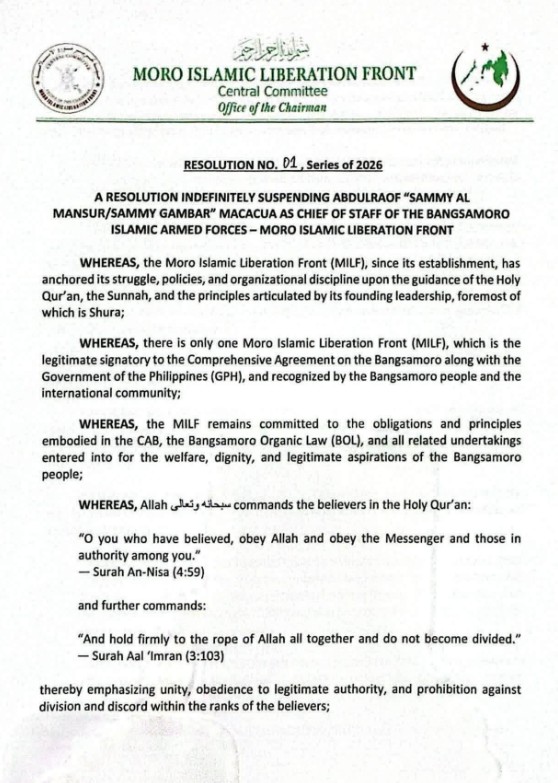
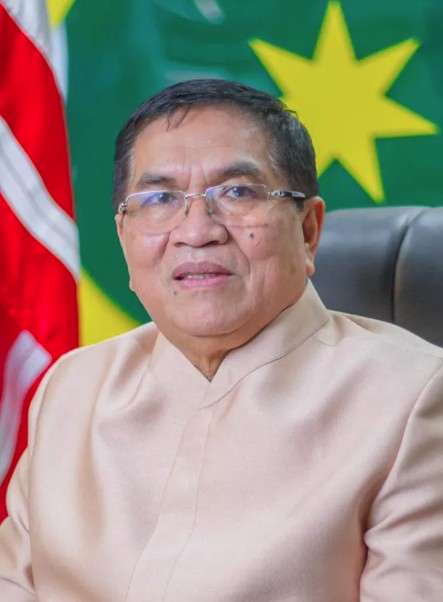
What began as an internal disciplinary resolution has now evolved into a broader political and ideological exchange, following Macacua’s public response defending his actions, asserting governance responsibilities, and reaffirming his commitment to institutional reform. The exchange underscores a deeper and increasingly visible question: how does a revolutionary organization transition into a democratic governing force without fracturing its own authority structure?
Two Narratives of Legitimacy
At the center of the dispute are two competing interpretations of legitimacy and authority.
For the MILF Central Committee, the issue is fundamentally about organizational discipline. Its resolution cites alleged insubordination, failure to comply with directives, and unilateral political and administrative decisions, including the removal of key officials and deviation from the United Bangsamoro Justice Party (UBJP) framework. The MILF frames these actions as violations of collective decision-making and threats to organizational unity—principles deeply rooted in its decades-long revolutionary structure.
In this view, cohesion is not merely administrative; it is existential. The MILF’s identity as a movement has long depended on a strict chain of command and shura-based consultation, which it considers essential to preserving unity and preventing factional fragmentation.
Macacua’s response, however, reframes the controversy in governance terms rather than organizational discipline.
He acknowledges the existence of internal disagreement but disputes key factual and procedural claims, including assertions about his candidacy alignment. More importantly, he situates his actions within the demands of public office, arguing that his decisions were driven by governance obligations, including accountability reforms, administrative independence, and the need to ensure that public institutions operate under the rule of law rather than internal political considerations.
In his framing, the issue is not disobedience but institutional responsibility.
The Fault Line Between Movement and Government
The divergence between these two positions reflects a structural tension embedded in the Bangsamoro transition itself.
The MILF remains the political and historical core of the peace process, having signed the Comprehensive Agreement on the Bangsamoro and led the struggle that culminated in the creation of BARMM. Its authority is rooted in revolutionary legitimacy and organizational continuity.
BARMM, however, is designed as a civilian autonomous government governed by legal-rational authority, public accountability mechanisms, and electoral legitimacy. In this system, the Chief Minister is not only a political representative of the MILF but also a constitutional actor within a devolved governmental structure accountable to law, oversight bodies, and public institutions.
Macacua’s invocation of audit findings, anti-corruption reforms, and administrative accountability reflects this latter framework. His argument suggests that governance decisions cannot be subordinated entirely to organizational consensus if they involve legal obligations tied to public office.
This tension—between revolutionary discipline and bureaucratic governance—is not unique to Bangsamoro. It is a recurring challenge in post-conflict transitions worldwide, where liberation movements evolve into governing parties and must reconcile internal hierarchy with institutional autonomy.
The Escalation Risk and the Politics of Reform
Macacua’s response also introduces a more politically charged dimension: a public commitment to anti-corruption measures, administrative restructuring, and continued reform efforts within BARMM institutions. His framing of governance issues, including allegations of inefficiency and misuse of public funds, signals that the dispute is not merely personal or procedural but tied to broader questions of state-building and institutional integrity.
This raises a sensitive but unavoidable question: can reform efforts inside transitional governments proceed without triggering resistance from legacy political structures?
For the MILF leadership, rapid or unilateral administrative changes may be perceived as destabilizing to the carefully negotiated balance of power established under the peace agreement. For reform-oriented administrators, however, delays or restrictions on institutional action may be seen as obstacles to effective governance and accountability.
The result is a governance paradox: the same institutions designed to ensure stability can also become arenas of internal contestation over the pace and direction of reform.
Implications for the Bangsamoro Transition
The implications of this rift extend beyond the individuals involved.
First, it tests the resilience of the MILF as a unified political actor during the transition period. Sustained internal disagreement risks complicating decision-making and weakening the organization’s ability to present a cohesive position in negotiations with the national government and other political actors.
Second, it highlights the fragility of transitional governance structures that depend simultaneously on revolutionary legitimacy and constitutional authority. The coexistence of MILF command structures and BARMM civilian institutions requires constant negotiation, and the boundaries between them remain politically sensitive and legally complex.
Third, it affects public perception of the Bangsamoro project. For ordinary citizens, the central concern remains not internal leadership disputes but whether governance delivers peace dividends—services, infrastructure, education, and economic opportunity.
If internal tensions overshadow service delivery, the broader credibility of the autonomy project could be affected.
A Transition Still in Formation
Despite the sharpness of current disagreements, both sides continue to affirm commitment to peace, reform, and the Bangsamoro project. Macacua’s call for restraint and continuity in government services, alongside the MILF’s emphasis on unity and discipline, suggests that neither side is seeking open rupture.
This is significant. It indicates that while institutional tensions are real, they are still being contested within the framework of political dialogue rather than armed or extra-institutional conflict.
Still, the trajectory of this dispute will matter. Whether it leads to clearer institutional separation between MILF structures and BARMM governance—or deeper fragmentation within the transitional leadership—will shape the next phase of the Bangsamoro experiment.
Conclusion: The Cost of Transition
The MILF-Macacua rift is not simply a leadership dispute. It is a stress test of a political transformation still in progress.
Every post-conflict society must eventually confront the difficult shift from unity built through struggle to pluralism required in governance. In Bangsamoro, that transition is now unfolding in real time, with competing interpretations of authority, accountability, and reform.
The challenge ahead is not merely to resolve the current suspension, but to clarify the evolving relationship between revolutionary legitimacy and democratic governance. How that balance is struck will determine whether the Bangsamoro project consolidates into a stable autonomous system—or becomes defined by recurring internal fractures.
For now, the region stands at a delicate intersection: between discipline and dissent, continuity and reform, unity and institutional differentiation. The outcome remains unwritten.