
On World Environment Day 2026, cities around the globe are celebrating sustainability, climate action, and responsible environmental stewardship. Ironically, in Davao City—long regarded as one of the cleanest and most disciplined urban centers in the Philippines—residents are witnessing a growing mountain of uncollected garbage, stranded dump trucks, and a bitter standoff between two government institutions that should be working together to protect both people and the environment.
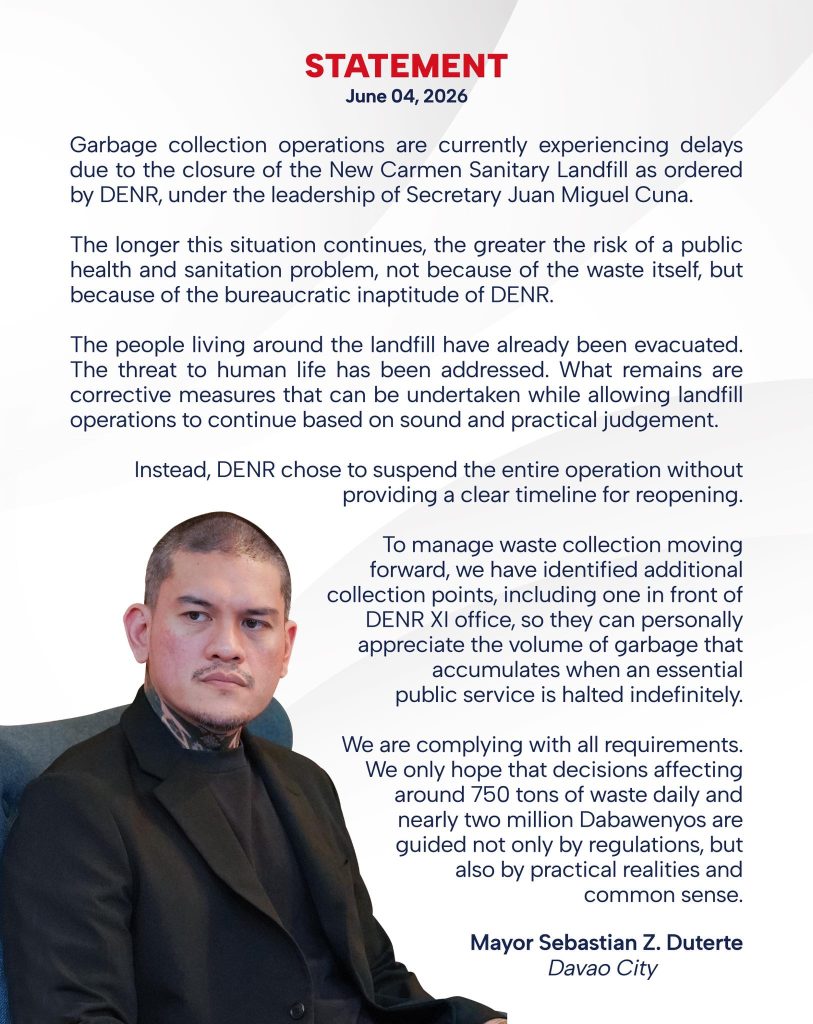
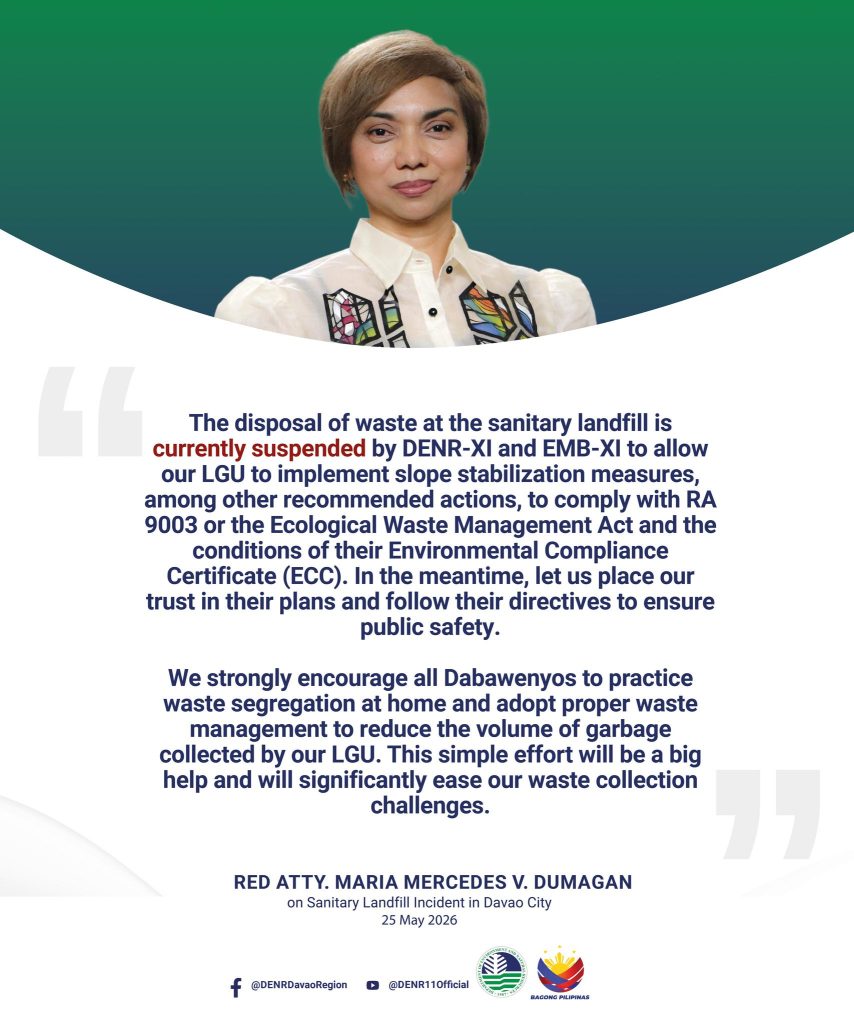
The dispute centers on the closure of the New Carmen Sanitary Landfill, ordered by the Department of Environment and Natural Resources (DENR) and the Environmental Management Bureau (EMB) following concerns over landfill slope stability and compliance with Republic Act 9003, or the Ecological Solid Waste Management Act. According to DENR Region XI, waste disposal operations were suspended to allow the city government to undertake slope stabilization and other corrective measures necessary to ensure public safety and compliance with environmental regulations.
From the perspective of environmental governance, DENR’s position is understandable. Laws and environmental compliance certificates exist for a reason. Landfills that fail to meet safety standards can pose serious risks, including landslides, groundwater contamination, and long-term ecological damage. Regulators are duty-bound to act when they believe public safety and environmental integrity are at stake.
Yet the Davao City Government raises an equally compelling concern.
Mayor Sebastian Duterte argues that while the immediate threat to nearby communities has already been addressed through evacuations and emergency measures, the indefinite closure of the landfill has created another public danger—an escalating sanitation and public health crisis affecting nearly two million Dabawenyos. The city generates approximately 750 tons of waste daily. Garbage collection operations have slowed significantly, forcing the establishment of temporary collection points, including one symbolically placed in front of the DENR XI office itself.
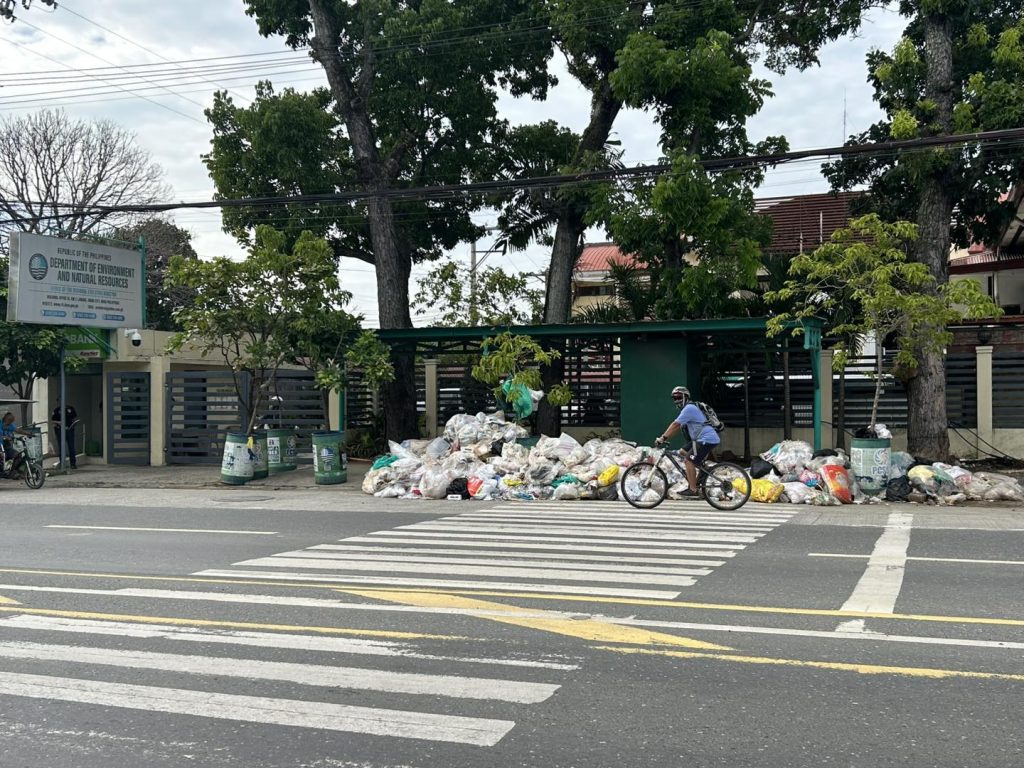
The images emerging from Davao are disturbing. Piles of garbage bags exposed to the scorching sun and intermittent rains have become increasingly common in various parts of the city. Dump trucks reportedly queue for long hours without a destination where waste can be safely disposed of. What was once a model of urban cleanliness is now confronting a challenge that threatens both public health and civic pride.
This is where the debate becomes more complicated than a simple choice between environmental protection and waste collection.
Both sides are technically correct.
DENR is right that environmental laws cannot simply be suspended because compliance is inconvenient. Regulatory agencies lose their credibility when they selectively enforce rules. Environmental disasters often occur precisely because authorities ignored warning signs in favor of expediency.
At the same time, the city government is correct in warning that waste accumulation poses immediate and tangible risks. Garbage left unattended attracts rodents, insects, and disease-carrying pests. It can contaminate waterways, clog drainage systems, contribute to flooding, and create health hazards for communities. In tropical cities like Davao, where high temperatures accelerate decomposition, the consequences can emerge rapidly.
The problem, therefore, is not merely the landfill closure itself.
The problem is the apparent absence of a clearly communicated, coordinated, and time-bound solution.
When government agencies become locked in public confrontation, governance suffers. Citizens begin to perceive institutions not as partners in public service but as adversaries engaged in a contest of blame. The public spectacle of garbage being deposited in front of a government office may effectively dramatize the city’s predicament, but it does not move a single ton of waste into a safe disposal facility. Likewise, regulatory directives without transparent timelines and contingency measures risk creating uncertainty that magnifies public frustration.
The unfortunate reality is that neither DENR nor the local government will bear the heaviest burden of this impasse.
Ordinary residents will.
It is not policymakers who must walk past rotting garbage on their streets. It is not agency officials who face increased exposure to pests, foul odors, and potential disease outbreaks in affected communities. It is not politicians who endure disruptions in waste collection services while trying to run households, businesses, schools, and public markets.
At the end of the day, the people suffer.
This situation also exposes a broader issue confronting many Philippine cities: the increasing difficulty of managing waste in an era of climate change and rapid urbanization. World Environment Day 2026 carries the theme of urgent climate action, reminding humanity that environmental protection and public welfare are inseparable. Climate change is already intensifying rainfall patterns, increasing the likelihood of landslides, flooding, and environmental hazards. Landfill safety therefore cannot be treated lightly.
But environmental sustainability also requires practical governance. Environmental policies must be implemented in ways that protect ecosystems without creating avoidable humanitarian and public health crises. The challenge is not choosing between environmental protection and sanitation. The challenge is achieving both simultaneously.
Davao’s current predicament should serve as a warning to local governments across the country. Urban waste management infrastructure can no longer rely on single-site disposal systems without robust contingency plans. Cities must invest in waste reduction programs, recycling facilities, segregation at source, composting initiatives, and alternative disposal strategies that reduce dependence on one landfill facility.
For now, however, Davao needs something more immediate than long-term policy discussions.
It needs leadership.
DENR and the Davao City Government must move beyond public exchanges and establish an urgent, transparent, and collaborative resolution process. The public deserves clear answers: What specific corrective measures remain unfinished? How long will they take? Can partial operations safely resume while repairs are ongoing? What contingency measures are available to prevent garbage accumulation across the city?
These are questions that require solutions, not political narratives.
On this World Environment Day, the irony could not be more striking. As the world calls for stronger environmental stewardship, one of the Philippines’ most celebrated cities is struggling to manage the most basic environmental challenge of all: where to put its garbage.
The Earth may be sending signals, as this year’s global campaign reminds us. In Davao City, another signal is equally clear. Environmental protection and public service are not competing responsibilities. They are inseparable obligations.
The sooner both sides recognize that reality, the sooner Davao can return to being a model not only of cleanliness, but also of effective governance.
Because when institutions stand their ground without finding common ground, it is the public that ultimately pays the price.