
What is happening today inside the Bangsamoro government is no longer an ordinary cabinet controversy. It is no longer merely about an audit observation, a resignation demand, or a legal disagreement between two senior officials. What the Bangsamoro people are witnessing is a painful and deeply symbolic fracture within the ranks of the very movement that once carried the hopes, sacrifices, and dreams of generations of Moros struggling for self-determination.
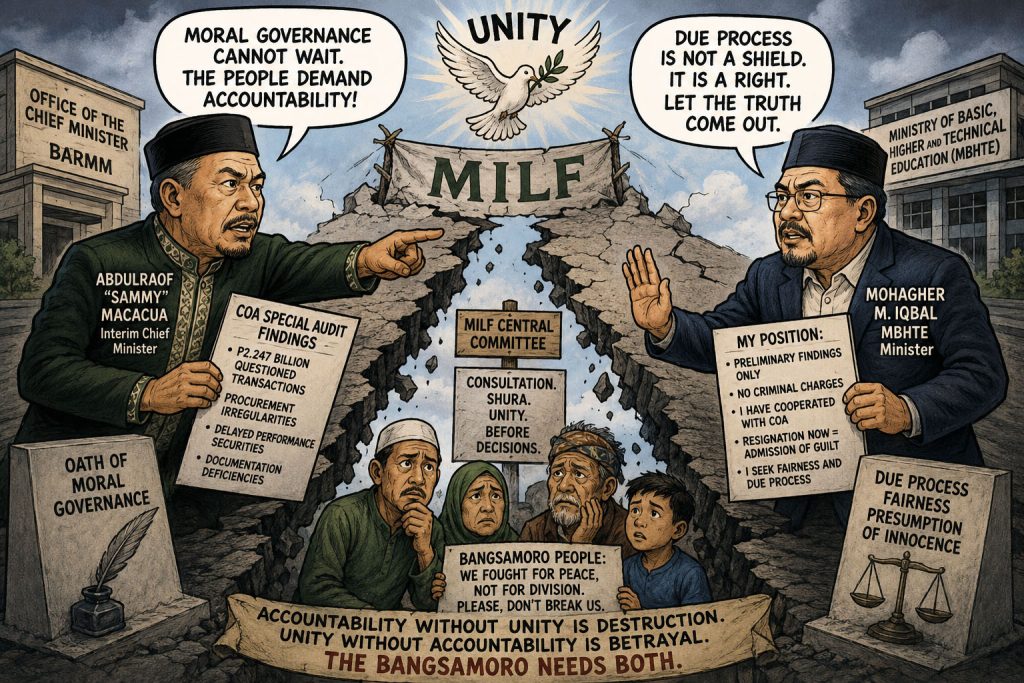
At the center of this political storm are two towering figures of the Moro struggle: Abdulraof Macacua and Mohagher Iqbal. Both men are not outsiders to the Bangsamoro cause. They are not traditional politicians who merely rode the waves of political convenience. They are products of war, negotiations, sacrifices, and decades of revolutionary struggle under the Moro Islamic Liberation Front. They stood shoulder to shoulder through some of the darkest periods in Mindanao’s history. They survived military offensives, political betrayals, peace negotiations, and internal crises. They helped transform an armed revolutionary movement into a governing institution through the Comprehensive Agreement on the Bangsamoro.
That is precisely why this conflict has struck a nerve across the Bangsamoro homeland. For many ordinary Moros, this is not being viewed as a normal political exercise. It feels personal. It feels emotional. It feels like brothers in the struggle are now confronting one another in public at a time when unity is most needed. And that perception alone is already dangerous.
Macacua’s Position: Moral Governance Cannot Wait
From the standpoint of governance, Interim Chief Minister Macacua is standing on firm constitutional and executive ground. As Chief Minister of the Bangsamoro Autonomous Region in Muslim Mindanao, he possesses the authority to appoint, reorganize, discipline, and remove cabinet officials under the transition government framework. Governance is impossible if a chief executive cannot exercise command responsibility over his cabinet.
The findings cited in the COA Special Audit are not small procedural lapses. The figures involved are staggering: over P2.247 billion in questioned transactions, procurement irregularities, delayed performance securities, defective bidding procedures, and documentation deficiencies. Whether these findings will eventually lead to criminal liability remains to be determined. But politically and administratively, the numbers alone are explosive.
Macacua’s argument is anchored on a principle that the Bangsamoro leadership itself repeatedly promised to the people: moral governance. This is not a minor slogan inside BARMM politics. “Moral governance” became one of the defining identities of the MILF-led transition government after the peace agreement. It was supposed to distinguish the Bangsamoro government from the corruption, patronage politics, and abuse that historically plagued many institutions in Mindanao and the Philippines.
Macacua appears to be sending a strong message: nobody is untouchable, not even senior comrades of the struggle. Politically, this is understandable. If he fails to act amid massive audit findings, he risks being accused of protecting allies and preserving a culture of impunity. Worse, he risks eroding public trust in the BARMM transition government at a time when critics are already questioning whether the Bangsamoro experiment can truly deliver cleaner governance than the old system it replaced. His supporters see this as courage. They see a leader willing to confront corruption regardless of friendship, history, or political consequences. From this perspective, Macacua’s decision is not betrayal. It is leadership.
Iqbal’s Position: Accountability Must Still Follow Due Process
But Mohagher Iqbal is also standing on legitimate ground. His response is neither emotional nor openly rebellious. In fact, his letter carefully frames the issue around constitutional fairness, institutional process, and legal procedure. Iqbal argues that the COA findings are still preliminary audit observations—not final judgments. That distinction matters.
COA findings, especially during special audits, often undergo clarification, responses, appeals, and document exchanges before notices of disallowance or legal actions become final. Audit observations are serious, but they are not automatic proof of criminal guilt. And here lies the heart of Iqbal’s argument: due process.
He insists that compelling resignation before the completion of the audit process creates the public impression of guilt even before formal proceedings conclude. He argues that resignation under pressure may appear as an admission of wrongdoing and may undermine the very principles of fairness and accountability that BARMM claims to uphold. Legally and politically, that argument also carries weight. A democratic institution cannot demand moral governance while disregarding procedural fairness. Otherwise, governance risks becoming selective, arbitrary, or vulnerable to factional politics.
Iqbal’s refusal to quietly disappear is also deeply symbolic. His letter was not simply a bureaucratic response. It was a political and emotional appeal to shared revolutionary history. He reminded Macacua that they were once brothers in a common struggle who fought for dignity, justice, and fairness. Those words resonated strongly because they reflected a deeper anxiety among MILF supporters: if senior leaders can publicly destroy one another without consultation, what does that mean for internal unity?
The MILF Central Committee Intervention Changes Everything
The intervention of the MILF Central Committee dramatically escalated the issue beyond ordinary cabinet management. When the Central Committee reminded Macacua that major political decisions require consultation and shura, the issue transformed from an administrative matter into an internal political crisis within the MILF itself. This is significant for several reasons.
First, Mohagher Iqbal is not just another minister. He is one of the principal architects of the Bangsamoro peace process and chairman of the MILF Peace Implementing Panel. Removing him abruptly carries implications not only for governance but also for the political balance within the MILF.
Second, the intervention exposed an uncomfortable reality: there may now be competing centers of power inside the Bangsamoro transition structure. One side emphasizes executive authority and anti-corruption reform. The other emphasizes collective leadership, consultation, and movement unity. Both principles are valid. But when they collide publicly, the result can become politically destabilizing. The danger is not merely institutional confusion. The danger is factionalization.
The People Are the Ones Carrying the Emotional Burden
Perhaps the most painful aspect of this controversy is how ordinary Bangsamoro citizens are reacting to it. Many Moros do not see Macacua and Iqbal as ordinary politicians. They see them as veterans of a liberation struggle. They see men who survived war together. They see leaders who once preached unity, sacrifice, discipline, and brotherhood.
That is why social media discussions, community conversations, and even rally narratives are becoming deeply emotional instead of purely political. Supporters are beginning to split into camps. Some defend Macacua as a reformist leader finally confronting corruption head-on. Others defend Iqbal as a respected revolutionary leader being politically humiliated without full due process. And this division is becoming increasingly dangerous because emotions can easily overtake institutional reasoning.
The emergence of rallies, competing narratives online, and public mobilizations signals a troubling trend: the politicization of revolutionary brotherhood. Once the Bangsamoro public begins interpreting every internal disagreement as a personal war between former comrades, institutional governance becomes harder to preserve.
This Is Bigger Than One Ministry
The MBHTE controversy is no longer just about procurement anomalies or audit observations. It is now testing several critical questions: Can the Bangsamoro government enforce accountability without destroying internal unity? Can revolutionary leaders transition fully into democratic governance without carrying the habits of movement politics into state institutions? Can moral governance coexist with due process? Can the MILF survive political disagreements without fragmenting into rival camps?
These are existential questions for the Bangsamoro transition. Because if the public begins losing trust not only in institutions but also in the unity of the leadership itself, the consequences may extend far beyond this controversy. The Bangsamoro peace process was built not only on signed agreements but also on public confidence that former revolutionaries could govern differently and govern better.
The Most Dangerous Outcome: Turning Governance Into a Loyalty Test
The greatest risk now is not the audit itself. The greatest risk is that every criticism, every legal process, and every institutional action will now be interpreted through loyalty politics. If supporting accountability means being labeled anti-Iqbal, or defending due process means being labeled anti-Macacua, then governance itself becomes poisoned by factional allegiance.
That would be catastrophic for BARMM. Institutions cannot mature if every issue is personalized. Democracy cannot function if political disagreements automatically become emotional wars between supporters. And revolutionary movements cannot successfully transition into stable governments if internal criticism is treated either as betrayal or rebellion.
The Bangsamoro Needs Statesmanship, Not Escalation
At this stage, both Macacua and Iqbal still possess an opportunity to prevent this controversy from evolving into a deeper institutional rupture. Macacua must prove that his anti-corruption campaign is rooted in fairness, consistency, and institutional integrity—not political consolidation. Iqbal, meanwhile, must prove that invoking due process is not a shield against accountability but a legitimate defense of democratic governance.
Both men must recognize that the Bangsamoro people are watching not only what they do, but how they do it. The MILF was once admired because it projected discipline, consultation, and collective leadership even amid armed struggle. Those values are being tested today under the pressures of political power and governance.
The real battle now is no longer in the mountains. It is inside institutions. It is inside leadership. It is inside the moral credibility of the Bangsamoro transition itself. And history will remember not only who was right or wrong in this controversy—but whether the leaders of the Bangsamoro chose statesmanship over division when their unity was tested the most.