
At 98.43 percent of precincts reporting, the first parliamentary election in the Bangsamoro is beginning to reveal its most important lesson: winning the most votes is not necessarily the same as winning the government. The latest partial and unofficial figures from the COMELEC Media Server show 5,130 of 5,212 precincts reporting, with 1,876,505 votes reflected in the current party-representation tally. The Bangsamoro Federalist Party is leading with 659,405 votes, or 35.1 percent, followed by the United Bangsamoro Justice Party with 607,966 votes, or 32.4 percent, while the Bangsamoro Grand Coalition has 386,027 votes, or 20.6 percent and the Raayat Democratic Party has 67,846 votes, or 3.6 percent. Based on the current projection for the 40 party-representative seats, BFP is positioned to take 14 seats, UBJP 12, BGC eight and Raayat one. These remain partial and unofficial results and should not be treated as the final COMELEC determination, but with only 82 precincts left unreported, the broad political picture is already becoming difficult to ignore. The BFP has emerged as the largest single force in the party-representation vote, but it has not emerged with anything close to a parliamentary majority. And that distinction may ultimately be the most important fact of this election.
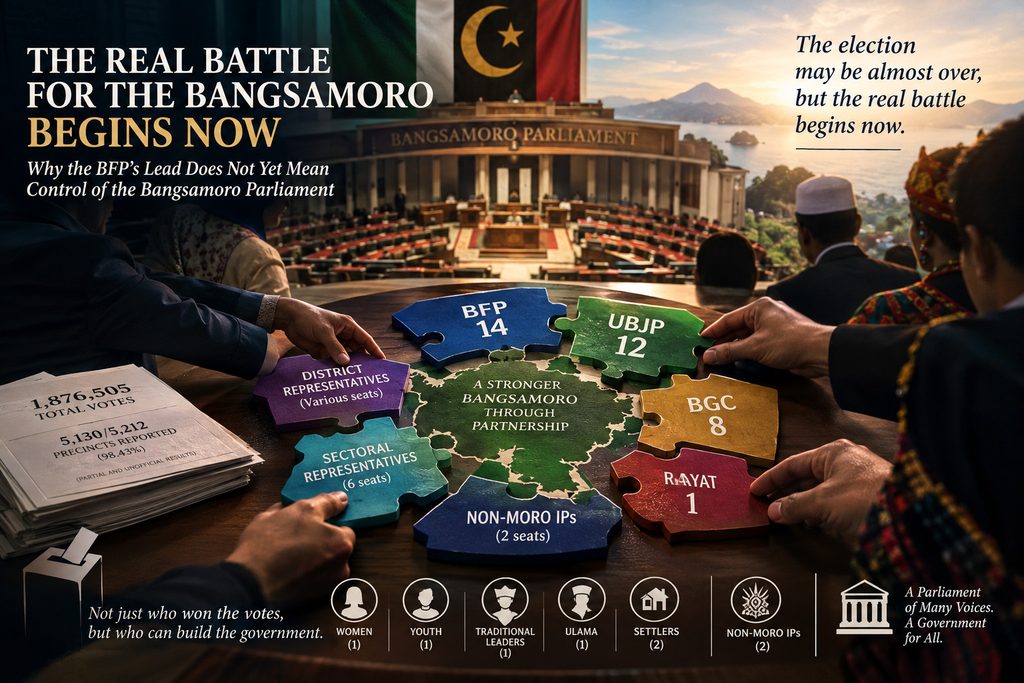
The BFP has, without question, won the first round of this contest. Its 659,405 votes put it ahead of UBJP by more than 51,000 votes and give it the largest projected bloc among the 40 party-representation seats. That is a substantial political achievement, particularly in the first parliamentary election of the Bangsamoro. But electoral strength and governing strength are two different things in a parliamentary system. The Bangsamoro is not electing a president who automatically takes executive power after winning the largest number of votes. It is electing a Parliament, and that Parliament will determine who will lead the executive government. The crucial question after the ballots are counted will therefore not simply be who came first in the party vote. It will be who can assemble enough members of Parliament to command a majority and elect a Chief Minister. That is why the current BFP lead, impressive as it is, should not be mistaken for control of the Bangsamoro government.
The 41-seat question
If the full 80-member Parliament is constituted, a majority requires 41 members. That number should now be at the center of every serious political calculation in the Bangsamoro. BFP’s projected 14 party seats leave it 27 seats short of that threshold. UBJP’s projected 12 leaves it 29 short, while BGC’s eight leaves it 33 short. Even if BFP, UBJP and BGC were somehow to unite, their projected party-representation seats would amount to only 34, still leaving them dependent on representatives from other components of Parliament. This is the fundamental arithmetic that makes the coming political negotiations so important. The party vote tells us who has the strongest electoral organization, but it does not by itself tell us who will form the government. That will depend on how the party representatives combine with district representatives and sectoral representatives, and on whether the political alliances created after the election can sustain the confidence of the parliamentary majority.
This is where parliamentary politics has a strange way of turning small numbers into enormous political leverage. A party does not have to be the largest to become decisive; it only has to become necessary. That is the fundamental political reality now confronting the Bangsamoro. If the current numbers largely hold after the remaining precincts are counted, the first elected Bangsamoro Parliament will not be a chamber in which one political organization can simply dictate the government. It will be a chamber in which alliances, negotiations, compromises and political agreements determine who controls the executive branch. The BFP may therefore have won the first battle by emerging as the strongest party, but the second battle — and arguably the more consequential one — has yet to begin. It will be fought not at the polling stations but across parliamentary caucuses and political negotiations, where the question will no longer be simply who received the most votes but who can persuade enough members of Parliament to support a Chief Ministerial candidate and sustain a governing majority.
The kingmakers are emerging
This is precisely why the political significance of BGC deserves close attention. With 386,027 votes and a projected eight party-representative seats, BGC has established itself as a major parliamentary force without becoming the dominant one. That may actually give it a unique form of political power. If BFP wants to form a government, it will need partners. If UBJP wants to prevent a BFP-led government or construct an alternative administration, it too will need partners. BGC therefore has the potential to become the bridge between the two larger blocs, the center of an alternative coalition, or the political force that determines which Chief Ministerial candidate ultimately obtains sufficient support. Eight seats are not enough to govern alone, but eight seats can become extraordinarily valuable when two larger political forces are competing for the same majority. The BGC could potentially support a BFP-led coalition, negotiate with UBJP, insist upon a consensus candidate, or seek substantive policy commitments before committing its support. Its eventual decision may reveal whether the first Bangsamoro coalition government will be built around a coherent political program or merely around the distribution of political positions.
The same logic applies, in an even more striking way, to Raayat Democratic Party. Its projected one party-representation seat may appear almost insignificant beside BFP’s 14, UBJP’s 12 and BGC’s eight, but parliamentary politics is not ultimately a contest over who has the largest bloc in isolation. It is a contest over whether those blocs can be assembled into a majority. If the eventual chamber becomes closely divided, that single Raayat seat could become much more politically valuable than its numerical size suggests. A one-seat party cannot independently determine a government, but it can potentially provide the final vote required for one coalition to cross the majority threshold. This is why smaller parties should not be dismissed simply because they occupy the lower end of the election table. Their influence will depend not only on how many votes they received but on whether the larger parties need them to govern.
The district representatives could rewrite the arithmetic
But even the party-representation figures do not tell the whole story. The district representatives will bring another layer of political power into Parliament, carrying with them direct territorial mandates, local alliances and constituency interests. The preliminary figures supplied from the parliamentary districts already demonstrate how different the political landscape can look outside the regional party ballot. BFP is projected to take three seats in Basilan, four in Maguindanao del Norte, two in Cotabato City and three in Maguindanao del Sur, while UBJP is positioned to secure seats in Basilan, Maguindanao del Norte, Cotabato City, Maguindanao del Sur and the Special Geographic Area. SIAP’s projected six seats in Lanao del Sur stand out as particularly significant, while ITIHAD is projected to secure a seat in Maguindanao del Sur and PRO Bangsamoro a seat in Tawi-Tawi. These representatives will not simply be numbers added to a regional party tally. They will enter Parliament carrying their own political mandates and obligations to the constituencies that elected them.
That distinction could become decisive when the Parliament eventually votes for Chief Minister. A district representative may have political relationships with one of the major regional parties, but that representative will also have to consider the interests of the people and local political constituencies that sent him or her to Parliament. The result could be alliances that look very different from the regional party vote. A party may dominate the party-representation ballot while finding itself dependent on district representatives whose political interests are not perfectly aligned with the party’s leadership. Conversely, a district-based political force can become an important parliamentary player without appearing near the top of the regional party results. This is why the eventual coalition arithmetic cannot be calculated simply by looking at BFP’s 14, UBJP’s 12, BGC’s eight and Raayat’s one.
The projected six seats for SIAP in Lanao del Sur are particularly worth watching because they demonstrate the potential influence of territorial political blocs. If that projection survives the final count, SIAP will have secured a substantial parliamentary presence despite not being among the leading forces in the regional party vote. Those six members could become important in any coalition negotiation if the larger parties find themselves short of a majority. The same applies to the other district representatives, whose political decisions could determine whether the largest regional party can actually transform its electoral lead into parliamentary control.
The two Non-Moro IP representatives are more important than their numbers suggest
The two Non-Moro Indigenous Peoples representatives should also not be treated as mere additions to a parliamentary tally. Numerically, two seats cannot by themselves determine who becomes Chief Minister. Politically, however, their presence carries significance that goes far beyond those two votes. They represent communities with distinct historical, cultural, ancestral-domain and governance concerns, and their participation in the first elected Bangsamoro Parliament is part of the region’s broader experiment in inclusive political representation. If the major parties approach these representatives simply as two additional votes to be recruited during a Chief Ministerial contest, they will miss the larger significance of their mandate.
The same principle applies to the other sectoral representatives. Women, youth, traditional leaders, Ulama and settlers are not simply additional seats to be counted when political leaders calculate a majority. They represent constituencies whose concerns must form part of the government’s policy agenda. The current projection indicates that UBJP is positioned to secure several of these sectoral seats, including representation for settlers, women, youth, traditional leaders and Ulama. If those projections hold, UBJP’s parliamentary strength could ultimately be greater than the 12 party-representation seats currently associated with its name. This is another reason why the party vote alone cannot determine who controls the future government.
For the Non-Moro IP representatives in particular, the coming negotiations could become an important test of whether the new parliamentary system genuinely embraces inclusive governance. Questions surrounding ancestral domains, customary rights, cultural preservation, livelihoods, environmental protection, education and security should not be reduced to bargaining chips. If a major party wants their support, the more meaningful question should be what commitments it is prepared to make to the communities they represent. Their votes matter, but the issues behind those votes matter even more.
The Chief Ministerial race will be a different election
All of this leads to the most consequential political contest of the post-election period: the choice of Chief Minister. The Chief Ministerial contest should not be understood as a simple extension of the party election. The electorate has chosen the Parliament; the Parliament will choose its government. That means a candidate associated with the party that finishes first could have the strongest initial claim to leadership but could still fail to secure the votes necessary to become Chief Minister. Conversely, a candidate from a smaller or second-place political bloc could potentially prevail if that candidate can assemble a broader parliamentary coalition.
This is where personality, credibility, political relationships and negotiating ability will become as important as electoral numbers. A Chief Ministerial candidate may be highly popular within his or her own political organization but unacceptable to rival blocs. Another candidate may have a smaller base but possess the ability to bring together competing factions. One candidate may represent continuity, another change, while a third could emerge as a consensus figure precisely because no major party can impose its preferred choice. The person who eventually becomes Chief Minister will therefore have to demonstrate something different from the ability to win votes in a regional party contest. That person will have to demonstrate the ability to govern a Parliament.
For BFP, this is the most important test of its current victory. Its 14 projected party seats give it the strongest starting hand, but the party now has to prove that it can turn electoral momentum into parliamentary consensus. It must convince district representatives that their constituencies will be heard, persuade sectoral representatives that their mandates will be respected, and assure smaller parties that joining a BFP-led government will mean participation in a genuine governing program rather than simply becoming an additional number in the administration’s majority. The party that wins the most votes carries the strongest political argument to lead, but the party that can build the broadest parliamentary coalition ultimately has the stronger claim to govern.
UBJP, meanwhile, cannot be dismissed simply because it currently trails BFP. Its projected 12 party-representation seats, combined with its potential strength in the sectoral component and its district representation, make it a formidable parliamentary force. If UBJP can persuade enough district representatives, BGC members, smaller parties or sectoral representatives to support its preferred candidate, it could potentially challenge a BFP-led government. The difference between first place and second place in the party vote may therefore prove far less important than the final parliamentary arithmetic.
The negotiations must be about the government, not merely the positions
There is, however, a danger that the first elected Bangsamoro Parliament must avoid. That danger is allowing coalition-building to become nothing more than a negotiation over positions. The coming discussions will inevitably involve the Chief Ministership, Deputy Chief Ministerships, Cabinet positions, parliamentary leadership and committee chairmanships. Those are legitimate aspects of government formation, but they cannot be the entire basis of the coalition. The people of the Bangsamoro did not participate in the region’s first parliamentary election simply to create another political arrangement among competing elites. They voted to establish a new system of government.
A credible coalition should therefore be able to explain what it intends to accomplish. It should have clear priorities for peace and security, economic development, education, health, agriculture, fisheries, infrastructure, poverty reduction, Indigenous Peoples’ rights, women, youth and institutional reform. It should explain how the government intends to confront corruption and improve accountability, how it will translate autonomy into better public services and economic opportunities, and how it will ensure that communities outside the political centers are not forgotten. If the negotiations produce only an agreement about who receives which office, the first elected government risks beginning its historic mandate with the wrong message.
This is why the public should demand transparency from the coming coalition negotiations. Political compromise is not inherently suspicious; it is fundamental to parliamentary government. But voters should know what their representatives are negotiating and why. If BGC becomes the decisive coalition partner, the public should know what principles or policy commitments shaped that decision. If Raayat’s single vote becomes critical, the public should know what brought that representative into the coalition. If district representatives negotiate collectively, their constituencies deserve to know what they are seeking. If sectoral representatives become part of the governing majority, their constituents should know what commitments the government has made to them. Coalition agreements should ultimately be judged not only by who gets power but by what that power is intended to accomplish.
The first great test of Bangsamoro parliamentary democracy
The current election has produced something more politically interesting than a simple winner and loser. It has produced a Parliament in which power appears likely to be dispersed among competing political forces. BFP has the largest party bloc. UBJP remains close behind. BGC has enough seats to become potentially decisive. Raayat has a small but potentially valuable position. District representatives will carry their own territorial mandates into the chamber. Sectoral representatives will bring the interests of specific constituencies into parliamentary deliberations. The two Non-Moro IP representatives will provide a direct institutional voice for Indigenous communities whose political concerns cannot simply be absorbed into the agendas of the major regional parties.
That fragmentation could become a weakness if it produces unstable and purely transactional coalitions. But it could also become a strength if it forces political leaders to negotiate, compromise and listen to constituencies beyond their own political organizations. A government that must maintain parliamentary support cannot simply assume that every member will follow the administration regardless of what it does. A Chief Minister who must maintain a coalition has to keep the coalition together. A parliamentary majority that is built through negotiation can create stronger incentives for consultation and accountability.
The first elected Bangsamoro government therefore has an opportunity to establish a political culture that will outlast the individuals who win these first seats. The precedent created now will matter. Future Chief Ministers will inherit whatever traditions are established in these negotiations. Future parties will study how the first coalition was formed. Future representatives will know whether parliamentary support was exchanged primarily for positions or whether it was built around policy and public interest. The first Parliament is not merely choosing a government; it is establishing the rules of political engagement for the Bangsamoro’s parliamentary future.
The election may be almost over, but the real battle is only beginning
The final precincts will determine the final numbers, and only the official COMELEC canvass and proclamations can establish the definitive results. But even at 98.43 percent, the emerging picture is already clear enough to understand where the next political struggle will take place. The BFP has apparently won the first contest by securing the largest share of the party vote and the largest projected party-representation bloc. But that victory does not give it a parliamentary majority. UBJP remains strong enough to challenge it. BGC is positioned to become a potentially decisive coalition partner. Raayat could become important if the final arithmetic is tight. District representatives could alter the balance between the major regional parties. Sectoral representatives could demand concrete policy commitments. And the two Non-Moro IP representatives could become important voices in ensuring that the first government does not forget the communities whose representation is specifically protected within the parliamentary system.
This is why the most important political story in the Bangsamoro is no longer simply who leads the election results. The more important question is who can build a government from those results. The BFP has the strongest starting position, but it still has to negotiate. UBJP has enough strength to make the contest genuinely competitive. BGC has enough seats to potentially become the kingmaker. Smaller parties may discover that their political importance has increased precisely because the larger parties need them. District representatives may become the bridge between regional party politics and territorial interests. Sectoral representatives may insist that parliamentary support must translate into policies for the constituencies they represent.
And somewhere in that complicated arithmetic will be the person who eventually asks the Bangsamoro Parliament for its confidence.
That person will need more than the largest party behind him or her.
That person will need a coalition.
The first parliamentary election has therefore not yet answered the most important question facing the Bangsamoro. It has answered who is ahead in the party vote, but it has not answered who will govern. That question will be decided through the difficult and sometimes uncomfortable work of parliamentary negotiation. It will require political leaders to determine what they are willing to compromise on, what principles they will defend, what policies they will demand and, ultimately, whom they trust to lead.
The ballots may be nearly counted.
The winners may soon be officially proclaimed.
But the government has not yet been chosen.
The first battle was for votes.
The real battle now begins — for 41 votes, for coalition, for confidence, and ultimately for the right to lead the first elected government of the Bangsamoro.