
SULTAN KUDARAT, MAGUINDANAO DEL NORTE — The Government of the Philippines (GPH) and the Moro Islamic Liberation Front (MILF) have formalized guidelines governing their ceasefire-related coordination during the first Bangsamoro Autonomous Region in Muslim Mindanao (BARMM) Parliamentary Elections, reinforcing mechanisms intended to prevent conflict and help ensure a peaceful and credible vote on September 14, 2026.
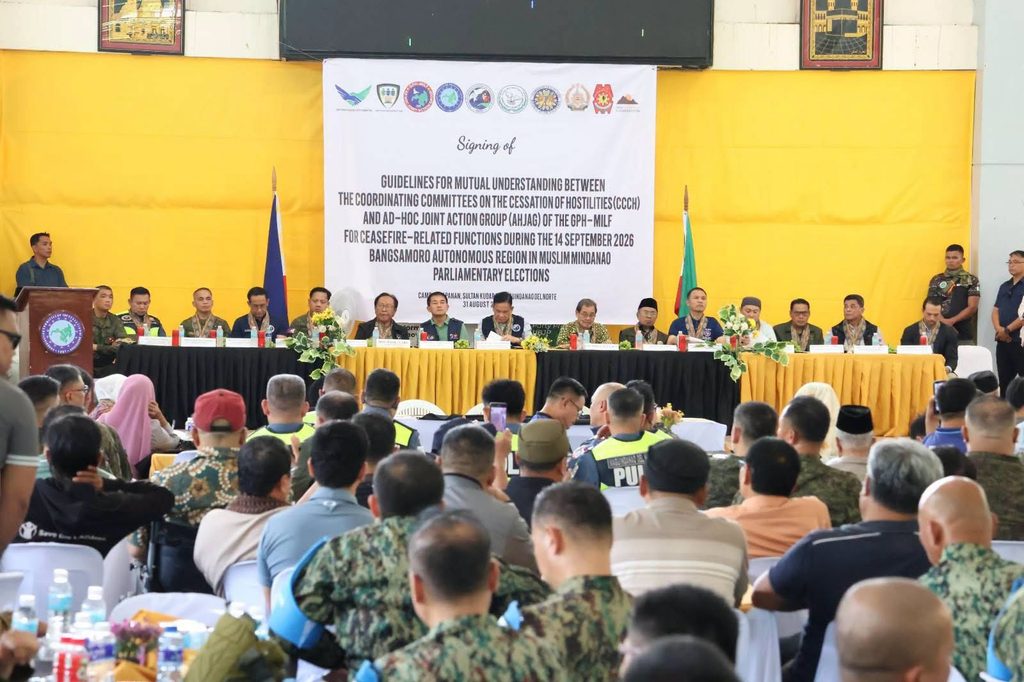
The GPH and MILF Peace Implementing Panels signed on Monday, August 31, the Guidelines for Mutual Understanding between the Coordinating Committees on the Cessation of Hostilities (CCCH) and the Ad Hoc Joint Action Group (AHJAG) for ceasefire-related functions during the upcoming parliamentary elections.
The ceremonial signing was held at Camp Darapanan in Crossing Simuay, Sultan Kudarat, Maguindanao del Norte, with senior officials from the government and MILF peace mechanisms, the Armed Forces of the Philippines (AFP), Philippine National Police (PNP), and other stakeholders in attendance.
The GPH Peace Implementing Panel was represented by its chair, Presidential Adviser on Peace, Reconciliation and Unity Secretary Mel Senen Sarmiento, while the MILF panel was represented by its chair, Mohagher Iqbal.
The guidelines establish the respective ceasefire-related functions of the CCCH and AHJAG and provide a framework for coordination between the government and MILF mechanisms during the electoral period.
Officials said the agreement is intended to strengthen communication, prevent misunderstandings and address potential incidents through peaceful mechanisms while the region prepares for its historic parliamentary elections.
The agreement also reaffirms the parties’ commitment to maintaining the ceasefire and ensuring that their respective responsibilities are carried out in a manner consistent with the peace process.
Safeguarding the electoral process
The guidelines are particularly significant because the September 14 elections will mark the first parliamentary elections of the BARMM, an important component of the political transition established under the peace agreement between the Philippine government and the MILF.
The framework for the ceasefire-related functions takes into consideration relevant provisions of the Bangsamoro Organic Law, or Republic Act No. 11054; the 1987 Constitution provisions on the mandate of the Commission on Elections; the Omnibus Election Code; and the Comprehensive Agreement on the Bangsamoro (CAB).
Under the agreement, the GPH and MILF peace mechanisms are expected to maintain close coordination and avoid actions that could undermine the ceasefire or disrupt the electoral environment.
The guidelines are also designed to facilitate coordination with election authorities and other government institutions responsible for ensuring the orderly conduct of the polls.
For the parties involved in the peace process, the objective extends beyond simply preventing armed confrontations. It is also aimed at creating conditions in which Bangsamoro voters can exercise their right to vote freely and without intimidation.
Sarmiento emphasized this responsibility in his message during the ceremony, calling on the peace mechanisms to protect the democratic character of the elections and safeguard the peace that has been built over many years.
He stressed that the success of the elections should not be measured by who wins or loses, but by whether Bangsamoro voters are able to cast their ballots freely, peace is maintained, and the final results genuinely reflect the will of the electorate.
Sarmiento also underscored the importance of the people in the peace process, particularly citizens who can participate productively in society while living with dignity.
He urged the various peace mechanisms to perform their duties through democratic processes and protect the gains of the peace process without intimidation or political interference.
MILF welcomes additional security forces
Iqbal, meanwhile, called on all stakeholders to work together to ensure the success of the September 14 elections.
He said the MILF, the national government and other sectors share the objective of achieving a successful election, describing the polls as an important element of empowering the people of the Bangsamoro.
Iqbal also expressed appreciation to President Ferdinand Marcos Jr., the AFP and the PNP for the deployment of additional security forces in preparation for the elections.
He said the MILF welcomed the augmentation of troops, emphasizing the importance of collective efforts to protect the electoral process.
The additional security presence comes as government authorities and peace mechanisms prepare for an election that will require coordination among civilian election authorities, security forces and the established GPH-MILF ceasefire mechanisms.
Military backs ceasefire coordination
The leadership of the 6th Infantry (Kampilan) Division and Joint Task Force Central expressed full support for the signing, stressing the importance of the agreement in maintaining peace and stability during the electoral period.
Among those present at Camp Darapanan were Maj. Gen. Jose Vladimir R. Cagara, Acting Commander of the Western Mindanao Command; Maj. Gen. Patricio Ruben P. Amata, Chairman of the GPH-CCCH; Brig. Gen. Ricky P. Bunayog, Acting Commander of the 6ID/JTF Central; and Brig. Gen. Edgar L. Catu, Assistant Division Commander.
Army brigade and battalion commanders, PNP personnel, representatives of the GPH and MILF peace mechanisms, and other key stakeholders also attended the ceremony.
The Guidelines for Mutual Understanding were signed by senior officials of the two peace mechanisms, including Police Brig. Gen. Jemuel F. Siason, Chairman of the GPH-AHJAG, and Director Anwar Alamada, Chairman of the MILF-AHJAG, together with members of their respective mechanisms.
Bunayog said the 6ID and JTF Central fully support the agreement, noting that sustained coordination between the government and MILF mechanisms can help preserve peace and stability in the region and contribute to the peaceful conduct of the elections.
Cagara likewise underscored the importance of continued dialogue and coordination between the parties.
“Our continued dialogue and coordination are essential to achieving a peaceful, orderly, and credible election,” Cagara said.
He added that the Western Mindanao Command remains committed to professionalism, impartiality and fairness in carrying out its responsibilities to protect the people and help ensure a safe and peaceful electoral process.
A test for the peace process
The signing comes at a critical stage in the implementation of the Bangsamoro peace process, with the first parliamentary elections serving as a major test of the region’s transition from armed conflict toward democratic governance.
The establishment of clear lines of coordination between the CCCH and AHJAG is intended to reduce the possibility that misunderstandings, security incidents or ceasefire-related concerns could escalate during the election period.
The mechanisms are expected to work within their respective mandates while maintaining communication with the broader network of government authorities, security forces and election stakeholders.
For the government and MILF, the agreement represents another effort to translate commitments under the peace process into practical arrangements on the ground.
The September 14 parliamentary elections will determine the political representation of the Bangsamoro Parliament and form part of the continuing transition toward greater political autonomy for the region.
With the election drawing closer, government and MILF officials are emphasizing that preserving peace will be a shared responsibility.
The Camp Darapanan signing therefore goes beyond the adoption of a technical set of ceasefire guidelines. It underscores the continuing role of the GPH-MILF peace mechanisms in managing potential tensions and protecting the environment necessary for democratic participation.
As the Bangsamoro prepares for its historic vote, the parties have reaffirmed a common objective: to keep the ceasefire intact, prevent avoidable conflict, respect the democratic process and allow the people of the region to freely determine their political future through the ballot.