
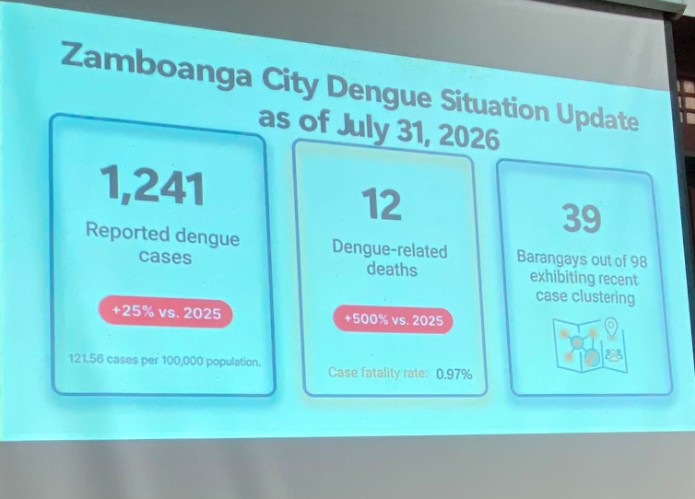
ZAMBOANGA CITY, Philippines – Zamboanga City has officially declared a dengue epidemic after confirmed cases skyrocketed to 1,241, with 12 deaths recorded and active transmission clusters spreading across 39 barangays, prompting authorities to intensify emergency response measures to contain the outbreak.
The declaration came following a recommendation from the City Disaster Risk Reduction and Management Council (CDRRMC) during an emergency meeting on Monday, where officials assessed the alarming rise in infections and the growing public health threat. Mayor Khymer Olaso formally announced the epidemic during a press conference at City Hall on Tuesday afternoon.
According to the City Health Office (CHO), the number of dengue cases represents an increase of more than 500 percent compared to the figures recorded during the first six months of 2025, making it one of the city’s most severe dengue outbreaks in recent years. Zamboanga City last declared a dengue epidemic in 2022.
Mayor Olaso said that 39 of the city’s 98 barangays are currently experiencing active case clustering, indicating sustained community transmission. Among the hardest-hit areas are Calarian, Sta. Maria, Talon-Talon, Ayala, and Putik, which recorded the highest concentration of cases during the four-week monitoring period from June 25 to July 27, 2026.
City Health Officer Dr. Dulce Miravite warned that mosquito breeding conditions have reached dangerous levels, revealing that recent entomological surveillance found vector indices up to 12 times higher than the accepted safety threshold.
“The environment is highly favorable for intensified urban transmission,” Miravite said, stressing that immediate community participation is essential to stop the spread of the disease.
CHO Epidemiology Unit Head Dr. Ivy Rosette Iturralde explained that several key indicators confirmed the city had entered an epidemic phase.
She cited the continuous increase in dengue cases for five consecutive epidemic-level weeks through Morbidity Week 29, widespread transmission across dozens of barangays, persistent clustering of infections, heightened clinical concerns, and ideal breeding conditions for dengue-carrying mosquitoes.
Mayor Olaso has directed all 98 barangays to immediately strengthen cleanliness and sanitation campaigns, emphasizing the elimination of mosquito breeding sites in homes, schools, public spaces, and communities.
Health authorities are urging residents to strictly follow the 5-S Strategy, a community-based approach to dengue prevention that includes:
- Search and destroy mosquito breeding places;
- Self-protection by wearing protective clothing and using mosquito repellents;
- Seek early consultation when symptoms appear;
- Support fogging and spraying operations in identified hotspot areas; and
- Sustain hydration for patients suspected of having dengue.
Doctors remind the public that dengue commonly begins with high fever, severe headaches, muscle and joint pain, skin rashes, weakness, and in some cases nausea, vomiting, or diarrhea. Immediate medical consultation is strongly advised once symptoms develop to prevent life-threatening complications.
Philippine Red Cross Assures Stable Blood Supply
As hospitals continue treating dengue patients, the Philippine Red Cross (PRC) Zamboanga City Chapter assured the public that it currently maintains an adequate supply of blood and blood components despite the increasing demand brought about by the outbreak.
PRC officials said the blood bank is continuously monitoring its inventory, particularly platelets, which are often required for patients suffering from severe dengue.
While supplies remain stable, the organization appealed to the public to continue participating in voluntary blood donation drives to help sustain lifesaving blood reserves for dengue patients and other medical emergencies.
The Philippine Red Cross reaffirmed its commitment to providing uninterrupted blood services while supporting local health authorities in responding to the city’s dengue epidemic.
DOH Intensifies Dengue Prevention During Rainy Season
Meanwhile, the Department of Health (DOH) Zamboanga Peninsula has also intensified its dengue prevention campaign as the rainy season increases mosquito breeding across communities.
The agency called on households to consistently practice the “Taob, Taktak, Tuyo, Takip” (4Ts) strategy by emptying water containers, removing stagnant water, drying potential breeding sites, and covering water storage containers to prevent mosquito reproduction.
The DOH also encouraged the public to wear long-sleeved clothing, use mosquito repellents, and support targeted fogging operations in areas identified by health authorities. Officials emphasized, however, that fogging alone cannot eliminate dengue unless communities actively destroy mosquito breeding sites.
Health authorities further urged anyone experiencing symptoms such as persistent high fever, severe headache, body pain, skin rashes, weakness, nausea, vomiting, or diarrhea to immediately seek medical attention at the nearest health center or hospital for early diagnosis and proper treatment.
The DOH-Zamboanga Peninsula called on local government units, community leaders, partner agencies, and residents to unite in implementing aggressive dengue prevention and control measures, emphasizing that sustained community participation remains the most effective defense against the spread of the disease.