
MARAWI CITY, Lanao del Sur — A serious allegation circulating on social media has raised concerns over patient safety and public trust in Amai Pakpak Medical Center (APMC), after an anonymous Facebook user claimed that patients who could not afford to pay for medical services were allegedly injected with potassium chloride to induce cardiac arrest.
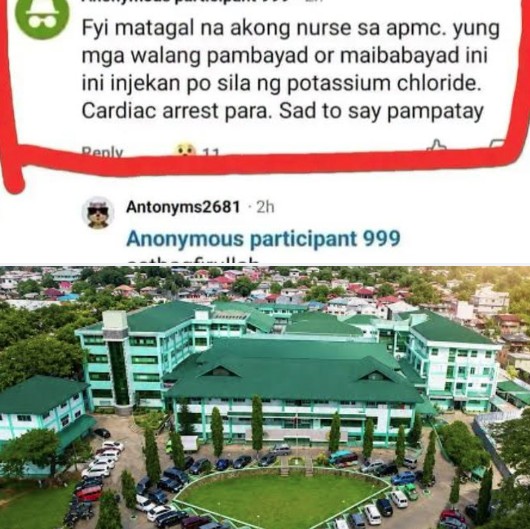
In a post attributed to “Anonymous participant 999,” the individual, who claimed to have worked as a nurse at APMC for a long time, alleged that patients unable to pay were given potassium chloride injections, which the user described as a means of causing cardiac arrest and killing patients.
The accusation is grave because it suggests the possible deliberate harming of vulnerable patients in a public healthcare facility. However, the post provided no publicly verifiable medical records, patient identities, incident details, or other supporting evidence in the materials available for this report. The individual’s claimed employment at the hospital has also not been independently verified.
While the allegation remains unverified, its potential implications are serious enough to warrant careful attention. The issue should not be dismissed as merely a social media controversy, nor should the accusation be treated as established fact without evidence. The priority must be to establish the truth, protect patients, and ensure accountability where warranted.
APMC calls for evidence and directs complaints to formal channels
In an official statement, Amai Pakpak Medical Center management urged individuals making accusations against the hospital to substantiate their claims with credible evidence.
The statement responded to social media posts describing the facility as a “killer hospital” that allegedly kills patients. Management said serious accusations should not be made casually, warning that such claims can create fear among patients and their families and undermine public confidence in the hospital and its healthcare workers.
APMC encouraged anyone with evidence of negligence, misconduct, or other irregularities to submit it to the appropriate authorities for a proper and impartial investigation.
The hospital also said it would not engage in arguments over social media or online public criticism. Instead, it directed complainants to its Public Assistance and Complaint Desk or Legal Service Office, where grievances could be addressed through formal procedures.
The statement further warned that defamatory online publications and the unauthorized sharing of photographs or videos of hospital personnel could result in legal action. It cited Republic Act No. 10175, or the Cybercrime Prevention Act of 2012, in discussing potential cyberlibel liability.
The hospital has a legitimate interest in protecting its personnel and institutional reputation against demonstrably false claims. However, legal action should not become a substitute for examining credible patient-safety concerns. The legal implications of a particular post depend on the specific circumstances and applicable law, and patients, employees, and witnesses must remain able to report suspected wrongdoing through appropriate channels.
Why the potassium chloride allegation warrants urgent scrutiny
Potassium chloride is a medically used substance that can be essential in treating certain conditions, particularly when potassium levels need to be corrected under appropriate clinical supervision. However, excessive or improperly administered potassium can cause dangerous hyperkalemia, disrupt the heart’s electrical activity, and lead to life-threatening arrhythmias or cardiac arrest.
That medical risk makes the allegation particularly serious. It does not, however, establish that the alleged conduct occurred at APMC, nor does cardiac arrest alone prove that a patient was deliberately killed. Cardiac arrest can result from numerous medical conditions and circumstances.
Determining whether a drug was appropriately prescribed and administered requires examination of the patient’s clinical condition, medical orders, medication administration records, laboratory results, monitoring records, and other relevant evidence.
If the allegation is fabricated, it could unfairly damage the hospital’s reputation, frighten patients who depend on its services, and erode confidence in healthcare workers. If it reflects actual misconduct, however, dismissing it as mere online defamation without an adequate assessment could leave patients at risk and undermine accountability.
Neither conclusion should be reached on the basis of a social media post or a public statement alone.
Management urged to initiate an independent, documented review
Given the gravity of the allegation, APMC management should consider initiating an urgent, documented, and risk-based review rather than relying solely on a demand for proof from the anonymous poster.
The review should be conducted by qualified personnel who are sufficiently independent of any individuals or departments potentially implicated. Where warranted, the hospital should coordinate with the appropriate regional office of the Department of Health (DOH) and other competent investigative authorities to ensure an impartial assessment.
The review should determine whether there are identifiable patients, specific dates, relevant clinical records, witnesses, or other evidence that can substantiate or disprove the allegation. Any available medication administration records, physician orders, laboratory findings, incident reports, and relevant audit trails should be preserved in accordance with applicable privacy, medical-records, and evidence-handling requirements.
The hospital should also establish a confidential reporting mechanism for current and former employees, patients, and witnesses who may have relevant information. Those who raise concerns in good faith should be protected from intimidation or retaliation. Every complaint should be assessed on its merits, regardless of whether it originates from social media, a formal grievance, or an internal report.
If credible evidence of intentional harm or serious clinical misconduct emerges, the matter should be promptly referred to the appropriate authorities for further investigation and necessary protective action. If the claim cannot be substantiated, the findings should be communicated responsibly, within legal and patient-confidentiality limits, to help address public concern.
The management should ensure that potentially relevant records are preserved and that any review is not compromised by conflicts of interest. A process that is independent, documented, and based on clinical evidence would help protect patients while also safeguarding the rights of healthcare workers against unsupported accusations.
Financial hardship must never justify harmful treatment
At the center of the allegation is an issue that demands an unequivocal institutional position: a patient’s inability to pay must never be a reason to deliberately harm that person or subject them to punitive treatment.
Public hospitals must handle billing difficulties, financial assistance, and eligibility for medical support through lawful and established procedures. Patients and families should be able to seek assistance and raise concerns without fearing retaliation or mistreatment.
APMC management should reaffirm its commitment to patient safety, ethical medical practice, and the proper handling of patients who lack financial resources. It should also ensure that its complaint channels are accessible, responsive, and credible, particularly for vulnerable patients and families who may not know how to navigate formal procedures.
This is not a demand to presume wrongdoing. It is a call for the institution to demonstrate that patient safety takes precedence over reputational concerns and that every credible complaint receives appropriate attention.
Public trust requires transparency, fairness, and accountability
The public also has a responsibility to distinguish allegations from established facts. Sharing an unverified claim as though it were proven can spread fear and harm people who have not been shown to have committed wrongdoing. Anyone with direct knowledge or supporting evidence should preserve relevant information and report it through appropriate channels rather than relying solely on viral posts.
At the same time, hospitals must recognize that criticism and complaints can be important signals of potential problems. Demanding evidence is reasonable, but it should be accompanied by a credible process for receiving, assessing, and acting on that evidence.
As of the information available for this report, the anonymous user’s claim remains unverified. APMC’s statement establishes the management’s position on the accusation, but it does not independently resolve whether the alleged events occurred. No findings from an independent investigation were included in the materials provided.
The issue must therefore be handled with urgency, seriousness, and due process. Protecting the hospital’s reputation is legitimate, but protecting patients and establishing the truth must come first.
If the allegation is false, a credible investigation can help clear the institution and its personnel. If it is true, swift action is necessary to protect patients, hold responsible individuals accountable, and prevent further harm.
For an allegation involving possible intentional harm to patients, silence, speculation, and online confrontation are inadequate substitutes for a documented and impartial examination of the facts. APMC management must demonstrate through concrete action—not merely public statements—that patient safety, ethical conduct, and accountability remain its priorities.