
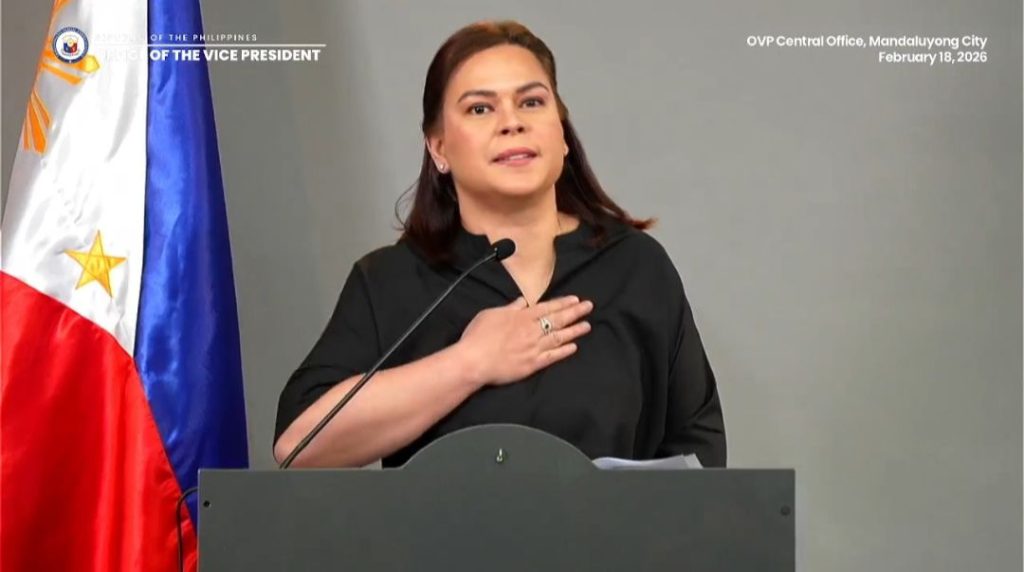
The early declaration of presidential intent by Sara Duterte on February 18, 2026, sent shockwaves across the country’s political landscape. Announcing her 2028 bid nearly three years ahead of schedule defied conventional campaign wisdom and immediately altered the balance of power. Instead of waiting for the “right time,” Duterte chose to seize the narrative, forcing allies, rivals, and institutions to react on her terms. This was not a routine political announcement—it was a strategic disruption that signaled her readiness to engage in a long and high-stakes battle for national leadership.

Breaking Away from the Marcos Administration
One of the most dramatic moments of her announcement was her public apology for helping elect Bongbong Marcos. In Philippine politics, where loyalty is often valued above accountability, such a statement was both rare and risky. By expressing regret, Duterte effectively distanced herself from the current administration and its controversies. This move allowed her to reposition herself as an independent political force rather than a continuation of the ruling coalition. It reframed her image from being a former ally of power to a potential alternative to it.
The Duterte Tradition: Unpredictability as Power
Duterte’s early declaration reflects the political DNA she inherited from her father, Rodrigo Duterte, whose late entry into the 2016 race shocked opponents and propelled him to victory. While her approach is the opposite in timing, it shares the same strategic logic: unpredictability. By defying expectations, she unsettles rivals and keeps them off balance. This calculated unpredictability has become a hallmark of the Duterte brand, turning uncertainty into a political weapon.
The Impeachment Context: The Real Battle Behind the Move
Beyond the 2028 election, Duterte’s announcement must be understood in the context of looming impeachment efforts in the House of Representatives of the Philippines. Allegations surrounding the misuse of confidential funds have placed her under institutional pressure. By declaring her candidacy early, she transformed impeachment into a politically dangerous move for lawmakers. Any attempt to remove her now risks alienating her growing base of supporters, potentially costing legislators their future electoral prospects. In effect, her announcement serves as a shield, discouraging political attacks through the threat of future retaliation at the ballot box.
From Defense to Offense: Reclaiming Political Initiative
Before her declaration, Duterte was largely confined to a defensive posture—responding to criticism, justifying budgets, and managing controversies. Her early campaign launch reversed this dynamic. She is now setting the agenda, dominating headlines, and forcing others to respond to her actions. Instead of reacting to impeachment narratives, she has made her presidential bid the central storyline. This shift from defense to offense marks a crucial turning point in her political trajectory.
A Message to Congress: Political Consequences Await
For members of Congress, Duterte’s announcement functions as a warning. Lawmakers who support impeachment now face the possibility of confronting a future president they once tried to remove. The cost-benefit calculation has changed dramatically. Political survival in future elections may depend on whether representatives are perceived as allies or enemies of Duterte’s movement. As a result, hesitation within Congress is likely to harden into quiet resistance against impeachment proceedings.
Building the Machine: Nationwide Mobilization
The rapid activation of SARA regional groups across the country demonstrates that Duterte’s campaign is not spontaneous. It is supported by an organized, disciplined, and nationwide political network. These structures aim to mobilize volunteers, coordinate messaging, and strengthen grassroots engagement. In modern elections, organization often determines victory, and Duterte’s early preparation suggests she intends to dominate not only in popularity but also in operational capacity.
Critics Respond: “Distraction” and “Political Theater”
Opposition lawmakers, including Antonio Tinio, Renee Co, and Sarah Elago, were quick to denounce Duterte’s move as a diversion from accountability. They argued that the timing was designed to overshadow investigations into confidential funds. From their perspective, the announcement is less about leadership and more about survival. While this criticism highlights legitimate governance concerns, it also underscores how effectively Duterte has redirected public attention.
Reconfiguring Alliances: The Marcos-Duterte Chessboard
The proposal by Robin Padilla for a possible tandem between Duterte and Imee Marcos illustrates the fluidity of political alliances. Despite tensions between major political clans, fragments of old coalitions remain open to realignment. These shifting alliances reflect a broader chessboard in which loyalty is conditional and power is constantly renegotiated.
Appealing to the “No-Exit” Majority
A key emotional element of Duterte’s speech was her recognition of Filipinos who have no option to leave the country. By highlighting those without second passports, foreign opportunities, or safety nets, she framed her campaign as a moral responsibility rather than mere ambition. This appeal resonates with millions who feel trapped by economic uncertainty and political instability. It positions her as a defender of those who must endure the consequences of governance failures with no escape.
Weakening Rivals Before They Emerge
By declaring early, Duterte has effectively narrowed the political field. Potential challengers now face a well-organized frontrunner with strong public support and a nationwide machinery. Many aspiring candidates may reconsider their plans, while others may be discouraged entirely. This pre-emptive move allows Duterte to dominate the political space long before formal campaigning begins.
Risks of an Early Campaign
Despite its strategic advantages, Duterte’s approach carries significant risks. Declaring early exposes her to prolonged scrutiny, legal challenges, and sustained attacks. Voter fatigue may set in, and coalition partners may defect over time. Every mistake will be magnified, and every controversy will be weaponized. This strategy demands discipline, consistency, and resilience over an extended period.
A Battle for Malacañang Begins Early
The ultimate prize remains Malacañang Palace, and Duterte has made it clear that the fight has already begun. Her declaration marks the start of a long campaign to secure loyalty, deter rivals, and shape public perception. Like a political “Game of Thrones,” the struggle for power is unfolding years before the final vote is cast.
Conclusion: Masterstroke or High-Stakes Gamble
Vice President Sara Duterte’s early declaration is both a defensive shield and an offensive weapon. It protects her from immediate political threats while positioning her as the dominant figure in the 2028 race. It sends a warning to Congress, energizes supporters, weakens opponents, and reframes national debate. Whether this strategy becomes a masterstroke or a costly gamble will depend on how she navigates the next three years. What is certain, however, is that the race for 2028 did not start in the future—it began in February 2026, and Philippine politics will never be the same again.