
COTABATO CITY — The Moro Islamic Liberation Front (MILF) is raising serious doubts that the first-ever Bangsamoro Parliamentary Election can push through on March 30, 2026, citing legal barriers that render the scheduled polls “impossible” unless the Bangsamoro Transition Authority (BTA) urgently passes a constitutionally compliant redistricting law.
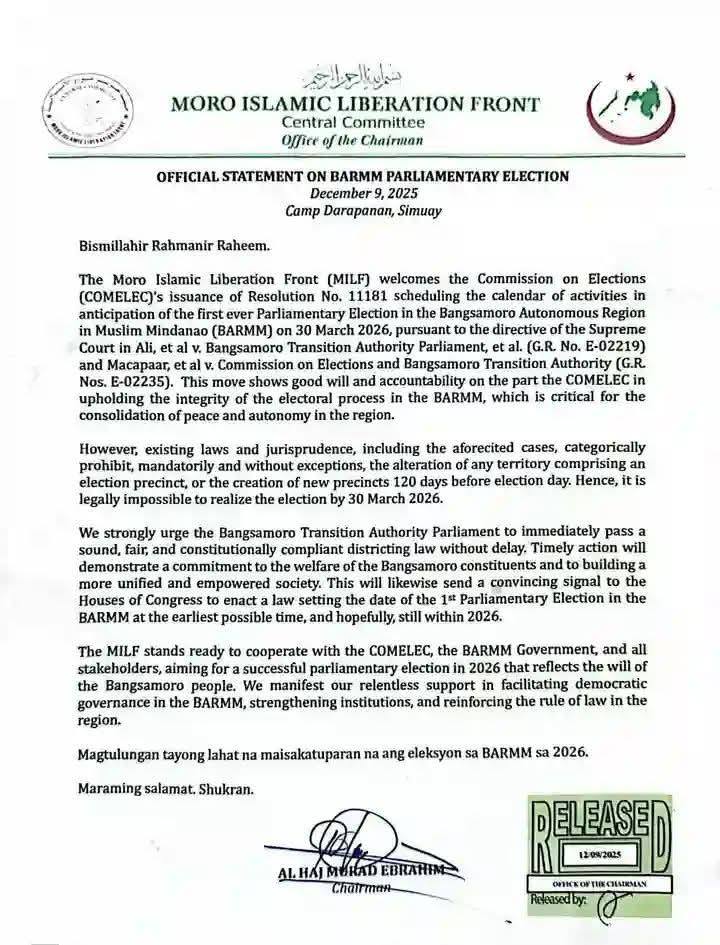
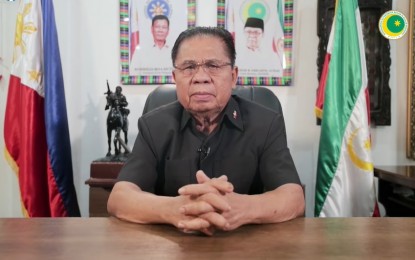
In an official statement issued December 9 from Camp Darapanan, MILF Chairman Al Haj Murad Ebrahim acknowledged the Commission on Elections’ (COMELEC) recent Resolution No. 11181, which laid out preparations for the long-awaited regional polls following directives from the Supreme Court. The MILF said this move signals good faith on the part of COMELEC in ensuring transparent and credible elections in the Bangsamoro Autonomous Region in Muslim Mindanao (BARMM).
But the group stressed that existing law is unambiguous: once within 120 days before election day, no changes may be made to precinct boundaries or territorial jurisdictions. With March 30 just months away, the MILF said it is already “legally impossible” to conduct an election without a new districting law—something only the Bangsamoro Parliament can deliver.
“We strongly urge the Bangsamoro Transition Authority Parliament to immediately pass a sound, fair, and constitutionally compliant districting law,” Ebrahim said, warning that any further delay would jeopardize the region’s political transition and the credibility of its first parliamentary government.
The MILF added that swift action from the BTA would send a strong signal to Congress to legislate a new election date—ideally still within 2026—to ensure that the political transition does not stretch into yet another extension.
The group reaffirmed its readiness to work with COMELEC, the BARMM Government, civil society, and other stakeholders to secure a peaceful, democratic, and legitimate election that reflects the true will of the Bangsamoro people.
A Critical Crossroads for BARMM
The MILF’s warning highlights a deeper truth: BARMM stands at a critical juncture. After years of transition and multiple extensions, the region’s credibility now rests on whether its leaders can demonstrate political maturity and institutional readiness.
Passing a redistricting law is not merely a legal requirement—it is a test of the BTA’s commitment to genuine self-governance. Failure to act swiftly could erode public trust, fuel political tension, and invite criticism that the transition government is unable—or unwilling—to complete the roadmap it promised.
On the other hand, if the BTA delivers a fair and transparent districting law, it will mark a major step forward in strengthening the foundations of parliamentary democracy in the region. It could pave the way for a more inclusive and accountable leadership that reflects the diversity of the Bangsamoro.
Ultimately, the future of BARMM depends not on timelines alone but on the collective ability of its institutions to rise above political interests and uphold the principles of autonomy, justice, and peace. The coming weeks will reveal whether the region is truly ready for its next chapter—or whether the long transition will be extended once again.