
The confirmed compromise of a public school teacher’s email account has exposed the potential international consequences of weak government cybersecurity. While investigators have yet to identify those responsible, independent threat monitoring points to a much wider problem involving exposed credentials, infostealer malware and the security of government digital infrastructure.
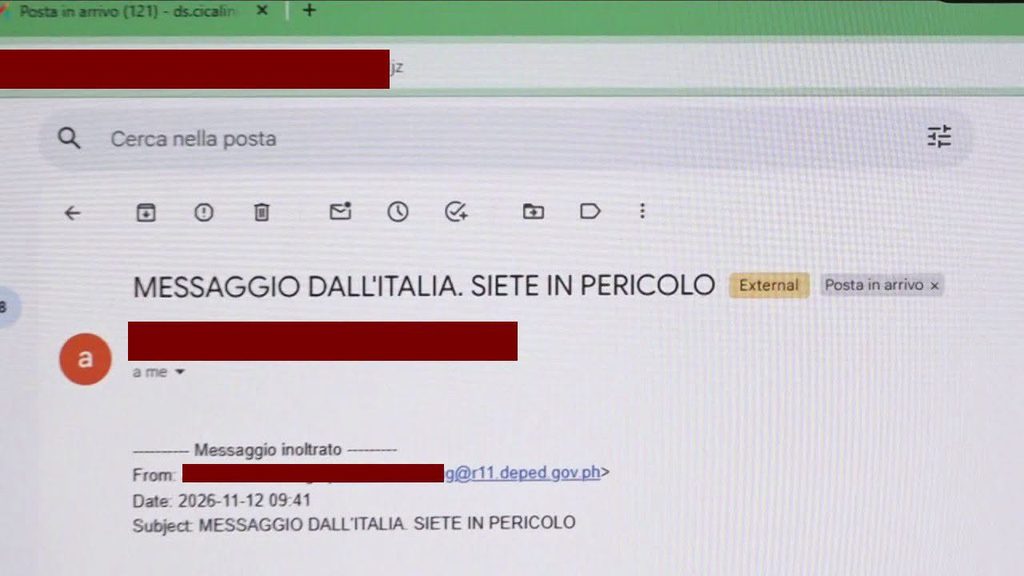
DAVAO REGION — The Department of Education (DepEd) has confirmed that the official email account of a public school teacher from Davao Oriental was compromised and used in a series of bomb threat emails sent to thousands of schools in Italy, raising serious questions about the cybersecurity of government communication systems and the protection of employee credentials.
SPONSORED LINK: https://lightlypowerfulgourmet.com/u9i107dsea?key=63025114fa6eb96108de24ad21ec0671
In a statement, DepEd said its review of system logs confirmed unauthorized login attempts originating from overseas locations involving the affected account. The agency immediately disabled the account to prevent further unauthorized access and said it had launched an investigation while strengthening security measures across its official communication channels.
The incident is particularly concerning because the compromised account was reportedly used to transmit threatening messages to educational institutions in another country. The emails, distributed on November 12, claimed that explosive devices had been planted inside school buildings and at Palazzo Chigi, the headquarters of the Italian government and office of Prime Minister Giorgia Meloni.
The messages carried the name “Mikhail Andropov” and demanded Meloni’s resignation. One of the reported emails, written in Italian and titled “MESSAGGIO D’ITALIA. SIETE IN PERICOLO” (Message from Italy. You Are in Danger), allegedly contained claims that explosives involving ammonium nitrate and nitromethane had been planted inside buildings.
There is, however, no established evidence that the teacher personally sent the threats or participated in the campaign. The confirmation that an account was compromised points to unauthorized access, making it essential to distinguish the legitimate account holder from whoever may have taken control of the mailbox.
Thousands of Italian schools targeted in successive threat waves
The November 12 incident followed an earlier wave of mass-distributed bomb threats on November 11, when approximately 6,300 schools across Italy reportedly received threatening emails.
The subsequent wave reached approximately 3,778 schools, according to a preliminary count cited by the Italian government’s office. Authorities reported 77 evacuations, while 36 schools subsequently resumed classes that same morning.
Despite the widespread disruption, no explosives were reportedly found in the schools that received the threats, and no confirmed bombing incident was established in connection with the messages.
Following the previous day’s disruption, Italian authorities advised schools against automatically evacuating buildings solely because they received mass-distributed threatening emails. Instead, evacuations were to be based on specific and concrete indications of an actual danger, with local authorities retaining the power to order evacuations when necessary.
The approach highlights the difficult balance between responding seriously to security threats and avoiding unnecessary panic, disruption of education and the diversion of emergency resources.
Nevertheless, the absence of discovered explosives does not make the threats harmless. Bomb threats can disrupt thousands of students and teachers, force emergency deployments, create public anxiety and undermine confidence in institutional security.
At least four DepEd accounts reportedly identified
Beyond the single account confirmed by DepEd, independent threat-monitoring group Deep Web Konek (DWK) reported identifying at least four distinct email accounts associated with DepEd domains that were allegedly used in the November 12 campaign.
One was reportedly assigned to a public school educator in Region XI. DWK said its findings were based on external threat monitoring, technical analysis and information concerning the agency’s exposed digital footprint.
The group emphasized that identifying government-associated email addresses in the transmission trail does not establish who operated the accounts or prove that DepEd’s central email infrastructure was directly breached.
This distinction is important. A compromised employee mailbox, stolen login credentials and a breach of an agency’s central servers are different cybersecurity incidents requiring different investigative approaches.
The available information confirms the compromise of the Davao-based teacher’s account, but the precise method of access and the identities of those responsible remain matters for forensic investigation.
More than 400,000 leaked records and credential exposures reported
More troubling are DWK’s broader findings concerning credential exposure across DepEd-associated digital assets.
According to the group’s monitoring, it has identified more than 400,000 leaked records and credential exposures associated with DepEd domains since October 2024 through November 2026.
The monitored domains include:
- lis.deped.gov.ph
- lrmds.deped.gov.ph
- commons.deped.gov.ph
- training.deped.gov.ph
DWK clarified that the cumulative figure should not be interpreted as 400,000 unique individuals, confirmed active accounts or evidence of a single database breach. Rather, it represents records and credential exposures accumulated through its monitoring activities.
The group also reported approximately 118,000 credentials exposed or associated with infostealer infections between January and October 2026 across DepEd-associated digital assets.
These figures have not been independently established as a comprehensive government-wide breach count. They should therefore be treated as findings from DWK’s monitoring rather than a confirmed inventory of compromised DepEd personnel or accounts.
Even with that qualification, the reported volume warrants serious attention. Credential exposure can create continuing risks long after the initial leak, particularly when passwords are reused, compromised devices remain connected to institutional networks or active login sessions are not revoked.
Infostealer malware and stolen credentials under scrutiny
DWK identified credential harvesting and possible infostealer malware infections as among the plausible explanations for how unauthorized individuals could have accessed the affected accounts.
Infostealer malware is designed to secretly collect information stored on infected computers. This may include usernames, passwords, browser cookies, authentication sessions and other sensitive information.
Once extracted, these credentials can circulate through underground marketplaces, dark web channels and publicly accessible data dumps. Attackers may then use them to access legitimate email accounts without necessarily breaching the institution’s central servers.
Credential harvesting can also occur through phishing messages, fraudulent login pages and other deceptive techniques designed to trick users into surrendering their passwords.
When attackers gain control of legitimate government email accounts, they can send messages that appear to originate from trusted institutional addresses. This can make malicious communications more convincing and potentially complicate spam detection and security investigations.
However, DWK’s assessment remains a threat hypothesis, not a confirmed forensic explanation for the Davao teacher’s compromised account. Investigators must still establish whether the access resulted from stolen passwords, session theft, infected devices, email spoofing or another method.
Previous phishing incidents raise questions about recurring vulnerabilities
The reported incident also brings renewed attention to earlier phishing campaigns in which compromised DepEd-associated email accounts were allegedly used to impersonate financial institutions, including the Land Bank of the Philippines.
Those messages reportedly contained fraudulent security notifications and malicious links designed to persuade recipients to disclose sensitive information.
The similarities raise an important question: Are previously exposed government credentials and compromised devices continuing to be exploited across different malicious campaigns?
If the same credentials or accounts remain accessible to unauthorized individuals, the consequences could extend far beyond international bomb threats. Government employees, teachers, students, parents and members of the public could become targets of phishing, financial fraud, identity theft and other forms of cybercrime.
The issue therefore cannot be treated as an isolated incident involving one teacher’s email account.
International implications and the need for caution
The threats also form part of a broader reported pattern of disruptive messages targeting European media organizations, commercial aviation services, schools and government institutions.
The recurring use of the alias “Mikhail Andropov” has prompted security analysts to examine possible connections between the incidents.
Some officials and analysts have raised the possibility of a broader hybrid disruption or cognitive warfare campaign designed to spread fear, undermine public confidence and strain emergency response systems.
However, the available information does not establish the identity of the perpetrators or confirm the involvement of any government or state-sponsored organization.
The use of Philippine government-associated email accounts in an international campaign should not automatically be interpreted as evidence of Philippine government participation. Equally, the possibility of a compromised account should not be used to prematurely dismiss the need for a thorough investigation.
At this stage, the priority must be to establish the technical facts, identify the responsible individuals and determine whether other accounts or government systems were affected.
DepEd must go beyond disabling one compromised account
Disabling the affected teacher’s account was an immediate and necessary containment measure. But if the reported credential exposures reflect continuing vulnerabilities, securing one mailbox will not be enough.
DepEd should conduct a broader assessment of its institutional email environment, particularly accounts associated with schools and personnel whose credentials may have appeared in previous data leaks.
The investigation should include password resets for potentially exposed accounts, revocation of suspicious active sessions, enforcement of multi-factor authentication and examination of login histories, email forwarding rules and unusual outbound activity.
The agency should also assess whether employee devices have been infected with infostealer malware, strengthen continuous monitoring of authentication attempts and coordinate with appropriate national cybersecurity authorities and law enforcement agencies.
Just as important is transparency. DepEd should communicate the scope of the investigation, clarify whether additional accounts have been identified and explain what measures are being taken to protect teachers and other personnel.
Schools and government employees, meanwhile, must treat unexpected login requests, suspicious links and unsolicited password-reset messages with caution. Reusing passwords across personal and official accounts should be avoided, and suspected phishing incidents should be reported immediately.
Organizations that received the threatening emails should preserve the original messages, including their full technical headers, rather than relying exclusively on screenshots or forwarded copies. Such information can help investigators establish the actual transmission path and distinguish a compromised mailbox from email spoofing.
A breach of trust that demands accountability
The incident illustrates how a seemingly individual cybersecurity failure can produce consequences far beyond the person whose account was compromised.
A teacher’s official email address is part of a government institution’s communication infrastructure. When that account is hijacked, the damage is not limited to the employee. It can undermine public confidence, expose institutional information and turn a trusted government identity into a weapon for intimidation and deception.
Teachers should not be made convenient scapegoats for a security failure they may have had no role in causing. At the same time, government institutions cannot treat credential protection as merely an individual employee’s responsibility.
The government has a duty to provide secure digital systems, effective safeguards, regular cybersecurity training and timely responses to known vulnerabilities. Employees, for their part, must observe responsible digital practices and promptly report suspicious activity.
Ultimately, the investigation must answer three fundamental questions: Who accessed the accounts? How did they obtain the credentials or authentication sessions? And what has DepEd done to ensure that other accounts cannot be similarly exploited?
The international bomb threats may turn out to be hoaxes, but the reported compromise of Philippine government-associated email accounts is a legitimate security concern that must not be dismissed.
The credibility of public institutions increasingly depends not only on the accuracy of their official statements but also on their ability to protect the digital identities and information entrusted to them. DepEd must demonstrate that this incident will lead to meaningful security reforms, not simply the temporary disabling of compromised accounts.