
SURIGAO CITY / DINAGAT ISLANDS — More than eight decades after the waters of Surigao Strait witnessed one of the most consequential naval engagements of World War II, military forces, government agencies, local governments, and emergency responders will return their attention to the strategic waters of northeastern Mindanao—not to relive a battle, but to strengthen the country’s preparedness for the security and humanitarian challenges of the present.
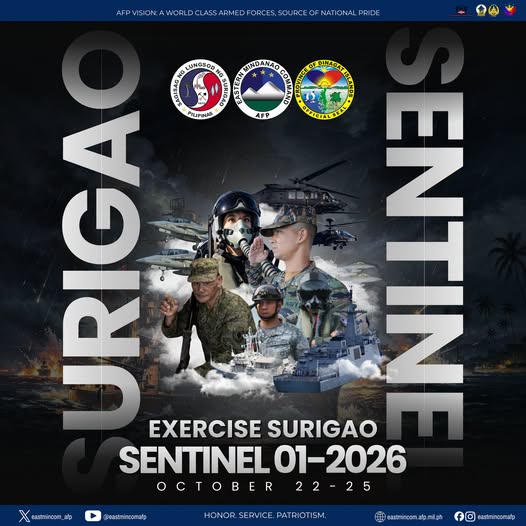
The Eastern Mindanao Command (EastMinCom) of the Armed Forces of the Philippines (AFP), in partnership with the City Government of Surigao and the Provincial Government of Dinagat Islands, will conduct Exercise Surigao Sentinel 2026 from October 22 to 25 in Surigao City, Dinagat Islands, the Surigao Strait, and other designated areas in Eastern Mindanao.
Guided by the theme “Beyond the Strait: Converging Historical Legacy and Multi-Domain Security,” the four-day joint inter-agency exercise will commemorate the 82nd anniversary of the Battle of Surigao Strait while testing the coordination, operational readiness, and response capabilities of participating military units and civilian agencies.
More than a historical commemoration, the exercise reflects a changing understanding of national defense—one that increasingly depends on the ability of military forces, local governments, emergency responders, and other institutions to work together across maritime, land, air, cyber, and information domains.
Remembering a battle that changed naval history
On the night of October 24–25, 1944, Surigao Strait became the setting for a decisive nighttime naval battle during the wider Battle of Leyte Gulf, one of the largest naval campaigns of World War II.
The Allied fleet, under Rear Admiral Jesse B. Oldendorf, confronted the Japanese Southern Force led by Vice Admiral Shoji Nishimura. The engagement culminated in the destruction of the Japanese battleship Yamashiro, while Fusō had been disabled and sunk earlier during the battle after torpedo attacks disrupted the Japanese formation.
The battle is widely recognized as the last battleship-versus-battleship engagement in naval history. It also demonstrated the effectiveness of coordinated naval operations, with destroyers, torpedo boats, cruisers, and battleships combining their capabilities against an advancing enemy force.
One of its defining tactical features was the Allied fleet’s use of the traditional naval maneuver known as “crossing the T,” positioning its line of battle across the path of the advancing Japanese ships to bring concentrated gunfire against them.
Yet the historical significance of Surigao Strait extends beyond the fate of the warships involved. The engagement took place in waters connecting Mindanao and Leyte, underscoring the strategic importance of the Philippine archipelago to maritime movement, regional security, and military operations.
As the Philippines faces evolving security requirements, the legacy of the battle offers a continuing reminder of the importance of maritime awareness, coordinated action, and preparedness.
For EastMinCom and its partners, Exercise Surigao Sentinel 2026 will connect that historical experience with present-day defense requirements and the practical demands of responding to emergencies.
From historical remembrance to operational readiness
Modern defense is no longer confined to conventional engagements between ships or forces operating within a single domain. Maritime security, territorial defense, intelligence gathering, surveillance, disaster response, and the protection of civilians increasingly require coordinated capabilities across multiple operational environments.
Exercise Surigao Sentinel 2026 is designed to strengthen these capabilities by bringing military and civilian institutions together under simulated operational conditions.
Anchored on the AFP’s Comprehensive Archipelagic Defense Concept (CADC), the exercise will focus on improving joint operational capabilities, strengthening command and control, and validating interoperability among participating forces and agencies.
The initiative also supports EastMinCom’s continuing transition toward external defense operations, reflecting the growing importance of protecting the country’s maritime approaches and coordinating responses to emerging security challenges.
Through joint activities and inter-agency coordination, participating units will have opportunities to test procedures, assess operational capabilities, identify gaps, and improve how they work together during complex situations.
These preparations are particularly relevant to an archipelagic country such as the Philippines, where the protection of maritime areas and the safety of coastal communities require cooperation among national agencies, local governments, uniformed services, and other stakeholders.
A multi-domain exercise across sea, air, and coastal areas
The exercise will feature a range of military activities designed to test different aspects of maritime security and defense operations.
Among them are Maritime Domain Awareness and Intelligence, Surveillance, and Reconnaissance (ISR), which focus on developing a clearer operational picture of maritime activity through information gathering, monitoring, and surveillance.
Surface Exercise (SURFEX) and Maritime Interdiction Exercise will also be conducted as part of the broader effort to strengthen coordination in maritime operations.
Other activities will include Counter-Landing Live-Fire Exercise (CLLFEX), Maritime Air Strike Operations (MASO), Visit, Board, Search, and Seizure (VBSS), Coastal Defense Exercise, and Indirect Fire Exercise.
Together, these activities will address different operational requirements, from monitoring maritime activity and conducting vessel-related security procedures to practicing coastal defense and coordinated military responses under simulated conditions.
The exercise is also intended to help participating units validate command arrangements and improve coordination when multiple forces and agencies must operate within the same environment.
However, the significance of the exercise extends beyond combat-related scenarios. Its humanitarian components underscore the need to maintain capabilities that protect civilians and support communities during emergencies.
Humanitarian response remains part of the mission
Water Search and Rescue (WASAR) and Noncombatant Evacuation Operations (NEO) will form part of Exercise Surigao Sentinel 2026, highlighting the importance of preparedness for disasters, emergencies, and other situations that may require the rapid movement or rescue of civilians.
For coastal and island communities, maritime response capabilities are essential during incidents involving people in distress at sea, emergencies affecting isolated areas, and situations in which residents must be moved to safety.
WASAR activities are intended to strengthen coordination in locating and rescuing people in aquatic environments. NEO, meanwhile, focuses on the organized evacuation of civilians from areas facing danger or other serious contingencies.
These activities emphasize that readiness is not measured solely by the ability to conduct military operations. It also involves the capacity to coordinate personnel, resources, communications, and decision-making when civilian lives are at risk.
The participation of local governments and other government agencies is therefore an important element of the exercise. During actual emergencies, military units may need to coordinate with local authorities, disaster risk reduction and management offices, medical personnel, and other responders to ensure that assistance reaches affected communities.
By practicing these arrangements in advance, participating institutions can identify weaknesses in coordination and improve their ability to respond under pressure.
Why Surigao Strait remains strategically significant
The geography surrounding Surigao Strait helps explain why the area remains an important setting for discussions about maritime preparedness.
Situated between northeastern Mindanao and Leyte, the strait forms part of the maritime environment linking waters around the southern Philippines with the wider Philippine archipelago.
Its historical role in World War II illustrates how waterways can shape military movement and the outcome of naval operations. Today, maritime security also involves maintaining awareness of activity at sea, protecting territorial interests, coordinating responses to incidents, and ensuring that institutions can work together when threats or emergencies arise.
For the Philippines, an archipelagic state whose communities depend on maritime transportation, fishing, trade, and connections between islands, effective maritime awareness and preparedness have implications that extend beyond military installations and naval operations.
The ability to coordinate across sea, air, land, and civilian response systems is particularly important when an incident requires several institutions to act simultaneously.
Exercise Surigao Sentinel 2026 places these requirements within a shared operational framework, using the historical significance of the area as a starting point for strengthening present-day readiness.
Building stronger partnerships before a crisis happens
A central objective of a joint inter-agency exercise is to ensure that participating organizations understand their respective roles before a real emergency occurs.
Military units may possess specialized operational capabilities, but effective responses to complex situations also depend on reliable communication, clear responsibilities, timely information sharing, and coordination with civilian institutions.
Local governments, meanwhile, play essential roles in community preparedness, evacuation planning, public information, and the mobilization of local resources. Other government agencies and responders contribute expertise and services needed to address specific emergencies.
Exercises such as Surigao Sentinel provide an opportunity to test these relationships in a controlled setting rather than relying entirely on coordination arrangements during an actual crisis.
They can also help participating institutions identify capability gaps, review procedures, and determine where additional training or coordination may be needed.
The practical value of these preparations will ultimately depend on how lessons from the exercise are incorporated into future planning, training, and operational procedures.
Although the activities are scheduled for four days, the readiness they seek to strengthen must extend beyond the exercise period.
Connecting the sacrifices of the past with the demands of the future
The Battle of Surigao Strait remains a defining chapter in Philippine and world naval history, remembered for the forces engaged, the ships lost, and the tactical significance of the encounter.
Its legacy also serves as a reminder that maritime security is shaped by geography, preparedness, technology, coordination, and the ability to adapt as operational demands change.
In 1944, the strait witnessed a decisive confrontation between opposing naval forces at a time when battleships still played a central role in fleet warfare. In the decades since, advances in naval aviation, submarines, surveillance systems, and guided weapons have transformed maritime operations.
The underlying requirement for readiness, however, remains.
For the AFP and its inter-agency partners, the challenge is to ensure that capabilities evolve alongside emerging threats while maintaining the ability to protect civilians and respond to humanitarian emergencies.
Exercise Surigao Sentinel 2026 seeks to bring these responsibilities together—honoring the courage and sacrifices associated with the historic battle while strengthening the partnerships and operational capabilities required today.
As Surigao City, Dinagat Islands, and the surrounding waters prepare to host the exercise from October 22 to 25, the commemoration will carry a message extending beyond the battlefield: remembrance becomes more meaningful when it informs present-day responsibilities.
Four days. One mission. Shared history. Stronger partnerships. Greater readiness.
From the historic naval engagement of 1944 to the evolving demands of modern maritime security, Surigao Strait continues to remind the nation of the importance of protecting its waters, preparing its institutions, and safeguarding the communities whose lives are connected to the sea.