
CAGAYAN DE ORO CITY — A Bureau of Customs (BOC) officer is among five individuals arrested during a late-night anti-illegal drug operation that dismantled a suspected drug den in Barangay Balulang, Cagayan de Oro City, an arrest that raises serious concerns about public trust and the responsibility of government personnel to uphold the law.
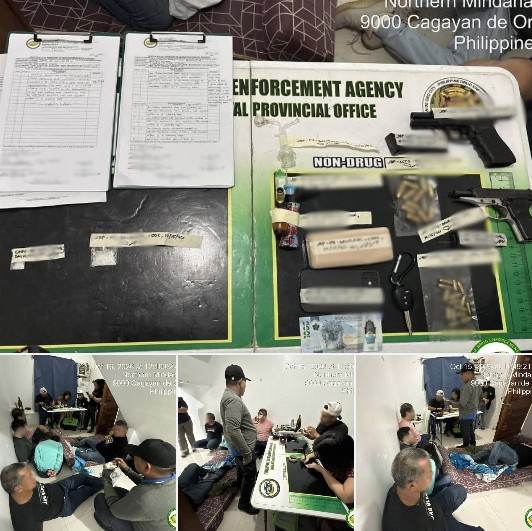
Joint operatives of the Philippine Drug Enforcement Agency (PDEA) Region 10 and local police arrested the five suspects during a buy-bust operation at around 11:35 p.m. on October 15, 2026, at Adelaida Park Residences in Barangay Balulang.
The arrest of a government officer in an operation involving suspected illegal drugs is particularly troubling because public servants are expected to uphold the law, protect the public, and maintain the integrity of their respective institutions. If the allegations against the officer are established through the proper legal process, the case could carry consequences beyond the criminal proceedings, including potential damage to the reputation of the Bureau of Customs.
Customs officer among five arrested
The suspects were identified only by their aliases in the information provided by authorities.
They include alias “Drew,” 39, and alias “Cha,” 37, both residents of Barangay Balulang, who were identified as alleged co-owners and maintainers of the suspected drug den.
Also arrested were alias “Al,” 57, and alias “Adi,” 41, both residents of Looc, Plaridel, Misamis Occidental.
The fifth suspect, alias “Ton,” 38, is a resident of Mandaue City, Cebu, and was identified as an officer of the Bureau of Customs.
Authorities have not provided further details about the Customs officer’s specific position, assignment, or alleged role in the suspected drug den. These details remain important in determining the scope of the investigation and whether the case has implications for the officer’s official duties.
The arrest does not, by itself, establish the guilt of any of the suspects. All five remain entitled to the presumption of innocence and due process.
Nevertheless, the involvement of a government employee among those arrested underscores the importance of accountability, particularly when allegations concern activities prohibited by law.
Suspected shabu worth ₱34,000 seized
During the operation, authorities confiscated two sachets containing suspected shabu, with an estimated combined weight of five grams and a standard drug valuation of ₱34,000.
The operatives also recovered an eyeglass case, a cellular phone, various drug paraphernalia, and the buy-bust money used in the operation.
Two firearms and their ammunition were also seized: a Glock 21 caliber .45 pistol with one magazine loaded with 13 live rounds, and a Bersa Thunder caliber .380 pistol accompanied by 15 rounds of caliber .380 ammunition.
A Toyota Vios was likewise recovered during the operation.
The firearms and ammunition could become significant elements of the investigation, particularly in establishing whether the suspects had the required licenses and permits and whether any firearm-related offenses were committed. However, the available information does not establish the ownership or licensing status of the weapons.
The confiscated suspected drugs will also be subject to the appropriate examination and evidentiary procedures as the case moves forward.
Joint operation involving PDEA and police units
The operation was conducted by personnel of the PDEA Region 10 Misamis Oriental Provincial Office, in coordination with the Cagayan de Oro City Police Office’s City Intelligence Branch, Police Station 4, and the 1001st Regional Mobile Force Battalion.
Authorities described the operation as a successful effort to dismantle a suspected drug den and arrest individuals allegedly connected to illegal drug activities.
The coordinated involvement of intelligence personnel, local police, mobile force operatives, and anti-drug agents highlights the continuing enforcement effort against suspected drug distribution and use in the region.
However, the long-term impact of the operation will depend not only on the arrests and confiscations but also on the strength of the evidence, the completion of the investigation, and the outcome of any cases filed in court.
Possible criminal charges
Authorities said the arrested suspects would face charges for alleged violations of Sections 5, 6, 7, 11, 12, and 15 of Article II of Republic Act No. 9165, or the Comprehensive Dangerous Drugs Act of 2002, as well as Republic Act No. 10591, or the Comprehensive Firearms and Ammunition Regulation Act.
The cited provisions cover various drug-related offenses, including illegal sale and other prohibited drug activities, maintenance of a drug den, possession of dangerous drugs and drug paraphernalia, and use of dangerous drugs, depending on the evidence and the specific circumstances of each suspect.
The precise charges ultimately filed against each individual will depend on the findings of investigators and prosecutors. Not every provision necessarily applies to every suspect, and the applicable firearm-related charges will depend on the evidence concerning the seized weapons and ammunition.
A test of public accountability
The arrest of a Customs officer alongside four other suspects places a spotlight on the responsibility of government agencies to ensure that their personnel remain accountable under the same laws they are tasked with enforcing.
The Bureau of Customs plays a critical role in protecting the country’s borders, preventing smuggling, and enforcing customs and related laws. Allegations involving one of its personnel in a suspected drug-related case can therefore undermine public confidence if they are not addressed transparently and decisively.
The case should not be treated as proof of institutional involvement or wrongdoing by the Bureau of Customs as a whole. Rather, it highlights the need for a thorough, evidence-based investigation and appropriate administrative action if warranted by the findings.
Any disciplinary proceedings should follow established rules and respect the officer’s right to due process. At the same time, the agency has a responsibility to protect the integrity of public service and demonstrate that allegations involving its personnel will be taken seriously.
Authorities reiterated their commitment to intensify anti-illegal drug operations and urged the public to report suspected drug-related activities to the nearest PDEA or police office.
As the investigation proceeds, the central questions will be whether the evidence supports the allegations against each suspect, what role each individual allegedly played, and whether the appropriate criminal and administrative measures will follow.
For the Customs officer, the case carries a particularly serious public-trust dimension: government service demands conduct consistent with the law, and any proven involvement in illegal drug activities would bring discredit not only upon the individual but also upon the public office entrusted to him or her.
All allegations remain subject to investigation and judicial determination. The suspects are presumed innocent unless proven guilty by a competent court.