
MANILA — The Philippine National Police (PNP) has reminded its personnel to exercise prudence, restraint and professionalism when expressing personal opinions on social media, particularly on politically sensitive issues, following an investigation into an alleged post by a police corporal assigned to Region 13 concerning proposed changes to the 1987 Constitution.
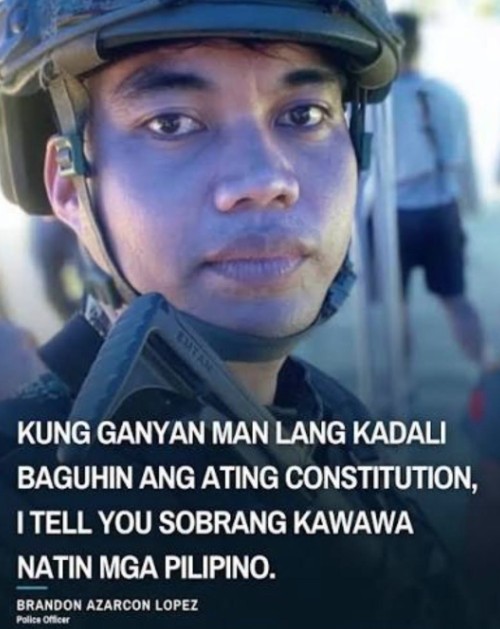
The controversy arose after a September 24, 2026, post attributed to the corporal circulated online, drawing public attention and raising questions about the boundaries between a police officer’s right to personal expression and the institution’s obligation to remain politically neutral.
The post reportedly stated: “Kung ganyan man lang kadali baguhin ang ating Constitution, I tell you sobrang kawawa natin mga Pilipino.”
The statement emerged amid discussions surrounding proposed constitutional changes and the voting threshold in the impeachment proceedings involving Vice President Sara Duterte, placing the officer’s remarks within a politically sensitive national debate.
However, the PNP emphasized that the authenticity, ownership and circumstances surrounding the post must first be established before any determination of administrative liability can be made.
PNP: Verification must come before disciplinary action
PNP Public Information Office Chief Col. Allen Rae Co said authorities must first establish whether the social media account and the original statement genuinely belonged to the police corporal before deciding whether the post violated existing regulations.
Co warned that if investigators confirm that the officer personally published the statement, it could constitute a violation of the PNP Code of Conduct and Ethical Standards, particularly the requirement for police personnel to maintain political neutrality.
“If it will be proven that he was the one who posted this, this is a direct and a clear violation of our Code of Conduct and Ethical Standards,” Co said.
He stressed that the police organization respects the personal opinions of its members but expects them to recognize the professional responsibilities attached to their positions.
“We respect our personnel’s right to their own opinion but keep it to yourself, kasi the PNP as an institution should remain apolitical,” Co said.
The PNP has not established that the corporal committed an administrative offense. Any possible disciplinary action would depend on the results of the investigation, the applicable regulations and the proceedings required under existing rules.
The corporal is reportedly undergoing schooling in Cavite.
Police officers retain personal views but must observe neutrality
PNP Chief Gen. Jose Melencio Nartatez Jr. clarified that the reminder should not be interpreted as a prohibition against police personnel having opinions, remaining informed or participating in legitimate discussions about national affairs.
“Hindi naman ibig sabihin na wala nang sariling boses ang ating mga personnel,” Nartatez said, emphasizing that police officers must exercise the judgment expected of members of the profession.
The distinction, according to the PNP, lies between holding personal beliefs and publicly expressing political positions in ways that could compromise, or appear to compromise, the impartiality of the police service.
Under the PNP Code of Professional Conduct and Ethical Standards, non-partisanship is among the principles expected of police personnel. The organization also maintains social media guidelines under Memorandum Circular No. 2024-077, which draws on the PNP Ethical Doctrine, Republic Act No. 6975, Republic Act No. 6713 and other applicable policies.
These standards cover content published through both official and individual accounts, reflecting the PNP’s position that an officer’s public statements can have institutional implications even when made through a personal profile.
The organization has also reminded personnel not to use their rank, authority, uniforms or official association in ways that could undermine public confidence in the impartiality of law enforcement.
Corporal clarifies original intention, cites subsequent repost
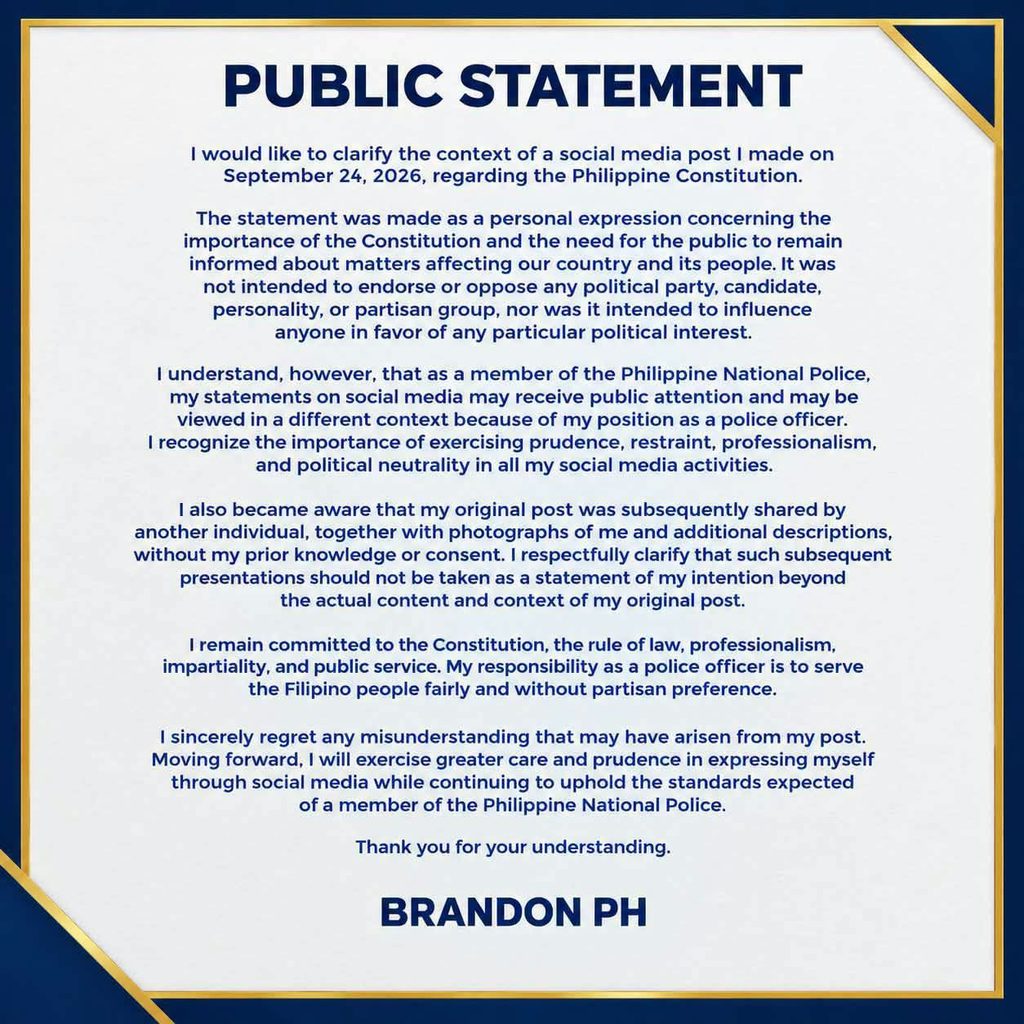
In a public statement, the corporal, identified as Police Officer Brandon Azarcon Lopez, clarified that his September 24 post was intended as a personal expression about the importance of the Constitution and the need for Filipinos to remain informed about issues affecting the country.
He maintained that the statement was not intended to endorse or oppose any political party, candidate, personality or partisan group, nor was it meant to influence the public in favor of a particular political interest.
Lopez also said he later learned that another individual had reposted his original statement alongside photographs of him and additional descriptions, without his prior knowledge or consent.
He argued that the subsequent presentation of the post should not automatically be interpreted as reflecting his original intention, particularly if the additional material introduced a context beyond the statement itself.
Nevertheless, the corporal acknowledged that his membership in the PNP affects how his public statements may be understood, especially when they concern politically sensitive matters.
He expressed regret over any misunderstanding arising from the post and said he would exercise greater prudence and care in future social media activities.
Lopez reaffirmed his commitment to the Constitution, the rule of law, professionalism, impartiality and public service, stressing his responsibility to serve Filipinos fairly and without partisan preference.
Possible administrative consequences depend on findings
The PNP’s warning has also brought attention to the administrative rules governing police personnel who may be found to have violated professional standards.
Under Republic Act No. 8551, or the Philippine National Police Reform and Reorganization Act of 1998, police authorities have disciplinary powers that may include reprimand, restrictive custody, suspension, forfeiture of salary, demotion and, in appropriate cases, dismissal from the service.
However, these penalties are not automatic consequences of a controversial social media post. Authorities must establish the relevant facts, identify the specific violation and observe due process before imposing any sanction.
The nature of the alleged offense, the circumstances surrounding the publication and the applicable disciplinary provisions would all have to be considered.
For now, the case remains subject to verification and assessment, with no established finding of administrative liability against the corporal.
Balancing personal expression and public trust
The controversy highlights a recurring challenge for public servants in the digital age: how to exercise personal expression while maintaining the standards and responsibilities attached to public office.
For police personnel, the issue carries particular significance because public confidence in law enforcement depends in part on the perception that officers perform their duties fairly, regardless of political affiliations or disagreements.
The PNP’s reminder underscores that personal social media accounts do not necessarily separate an officer’s public identity from professional responsibilities. At the same time, the corporal’s statement raises the importance of examining the actual content, original context and verified circumstances of a post before drawing conclusions about its intent.
As the investigation proceeds, the central questions remain whether the corporal personally made the original post, whether its content violated applicable standards and whether any administrative action is warranted under the rules.