
DAVAO REGION — Ordinary commuters will face another increase in transportation expenses beginning Monday, September 28, as new fare adjustments covering jeepneys, provincial buses, city buses, UV Express, taxis and transport network vehicle services (TNVS) take effect under the fare guides issued for the Davao Region.
The adjustments will directly affect workers, students, daily wage earners and families who rely on public transportation to reach their workplaces, schools, markets and other essential destinations. For commuters who make several trips every day, the additional fares could translate into a significant recurring expense over the course of a month.
The increase comes at a time when transportation is already a necessary part of household spending, leaving commuters with limited options to avoid the additional cost. While the adjustments cover different vehicle classifications and routes, the common consequence for passengers is having to allocate more money simply to get from one place to another.
Traditional and modernized jeepneys: Higher costs for daily commuters
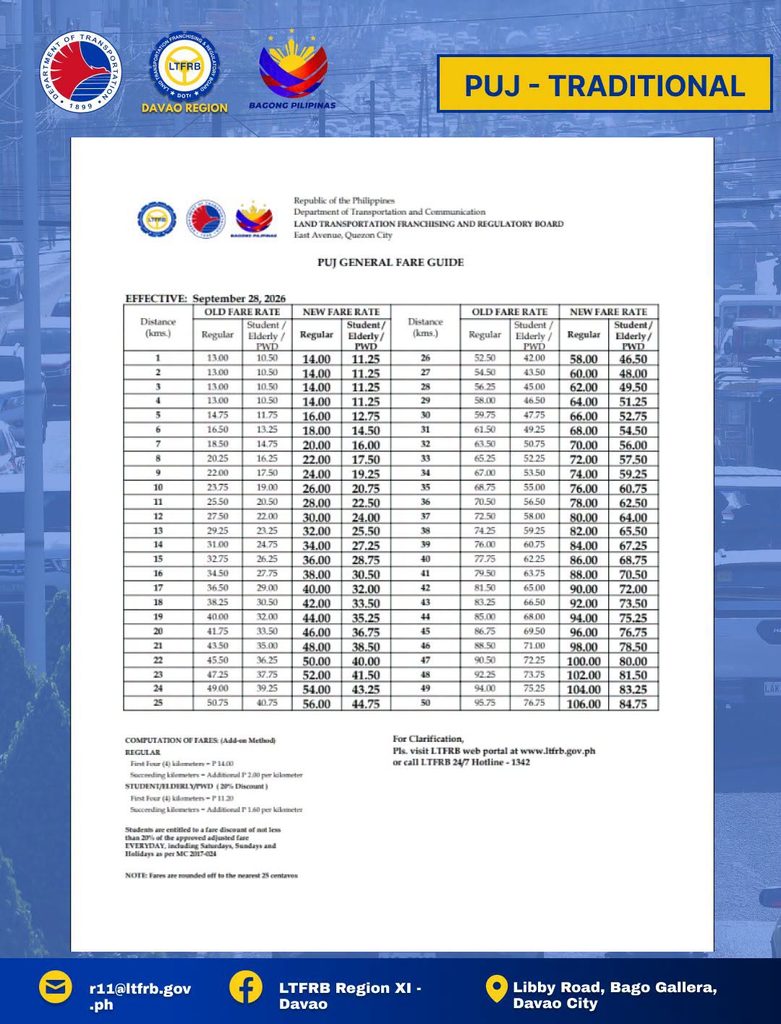
For traditional jeepney passengers, the minimum fare for the first four kilometers will increase from ₱13 to ₱14 for regular passengers, while the discounted fare for students, senior citizens and PWDs will rise from ₱10.50 to ₱11.25.
For modernized and electric jeepneys, the minimum fare will increase from ₱15 to ₱17 for regular passengers and from ₱12 to ₱13.60 for discounted passengers. The succeeding-kilometer rate will also increase, adding to the expense of commuters traveling beyond the minimum-fare distance.
For workers and students who use jeepneys several times a day, the adjustment will be felt every time they board. Even a seemingly small increase can accumulate when multiplied across daily trips and an entire working or school month.
Provincial buses: Longer journeys, higher fares
Provincial bus passengers will also face higher fares, with adjustments covering ordinary, deluxe, super deluxe and luxury services. The revised rates vary according to distance and bus classification, making the impact particularly relevant to commuters who regularly travel between cities, municipalities and provincial communities.
Under the new ordinary provincial bus fare guide, a five-kilometer trip will increase from ₱11 to ₱12 for regular passengers, while the corresponding discounted fare will rise from ₱8.75 to ₱9.50. At 10 kilometers, the regular fare will increase from ₱20.50 to ₱23, while the discounted fare will rise from ₱16.50 to ₱18.50.
For super deluxe provincial buses, the five-kilometer regular fare will increase from ₱11.75 to ₱13.50, while the discounted fare will rise from ₱9.50 to ₱10.75. Luxury bus passengers will face a five-kilometer regular fare increase from ₱14.50 to ₱16.75, with the discounted fare rising from ₱11.50 to ₱13.50.
Deluxe services will also implement revised distance-based fares. These adjustments mean that passengers traveling longer distances will need to check the applicable fare matrix for their specific bus classification and destination.
For provincial workers, students and families who depend on buses for regular travel, the increases could place additional pressure on transportation budgets, especially when travel involves several long-distance trips each month.
City buses and UV Express services
City bus passengers are also among the commuters identified in the regional fare adjustment announcement. However, the supplied fare materials do not specify the new city bus rates, so passengers should refer to the applicable official fare matrix for the exact charges.
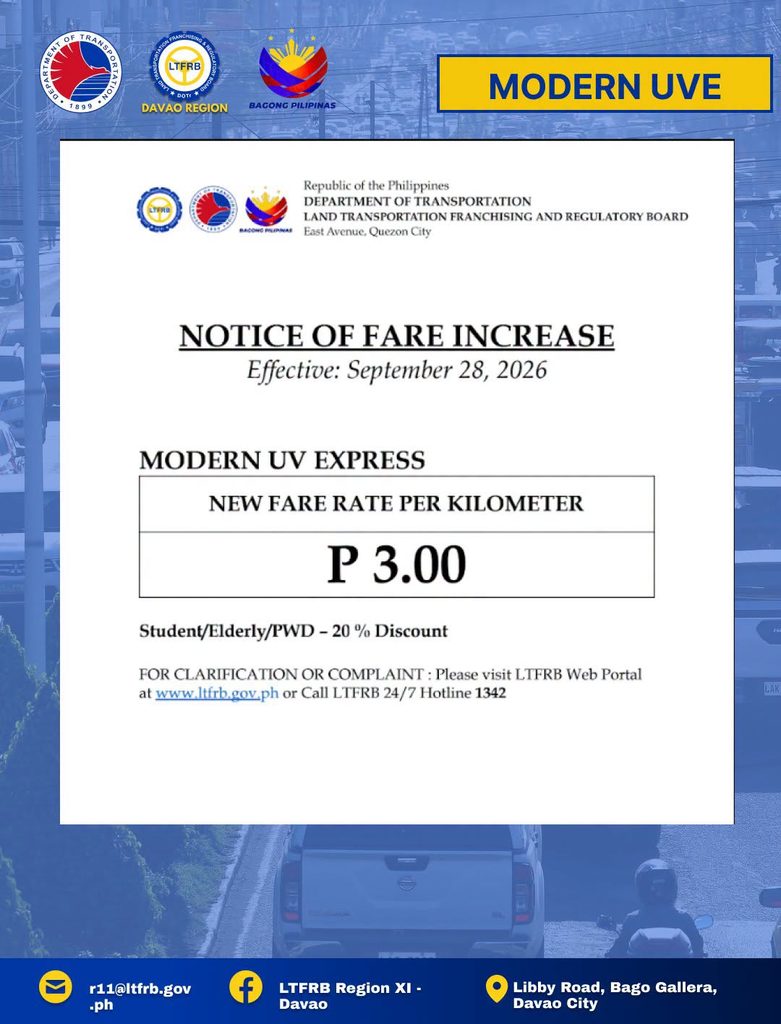
Traditional UV Express services will implement a new rate of ₱2.60 per kilometer, while modernized UV Express vehicles will charge ₱3 per kilometer. Since these services often connect residential areas with major transport hubs and commercial centers, the adjustment will affect passengers who depend on them for regular commuting.
Taxi and TNVS passengers face revised charges
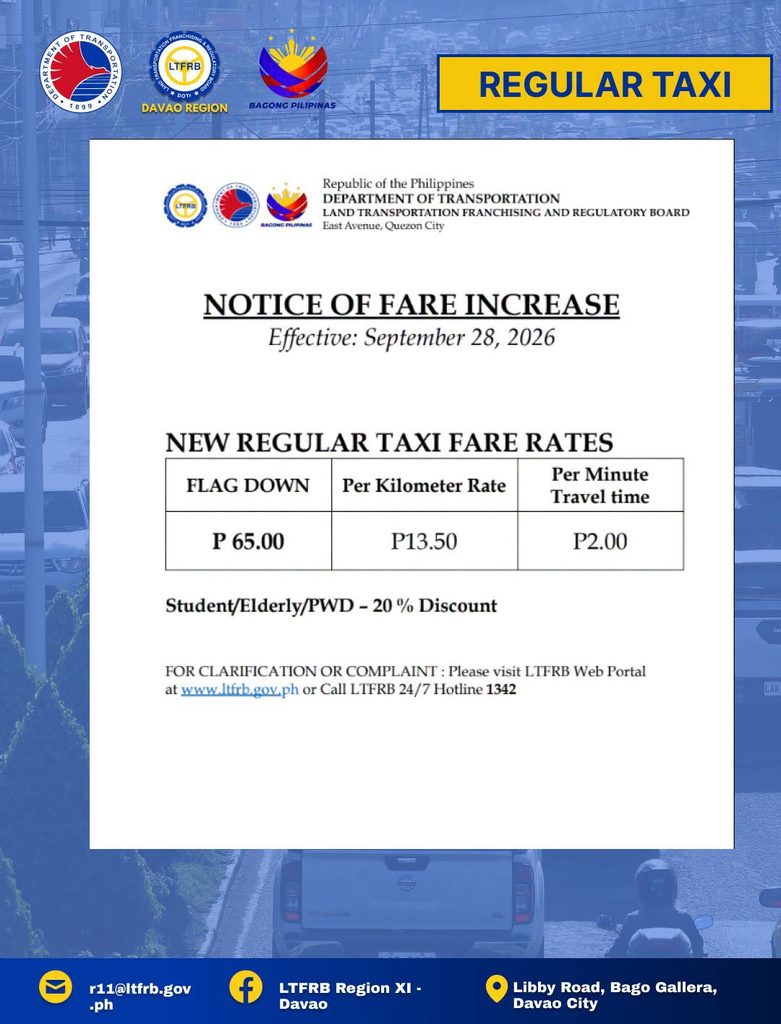
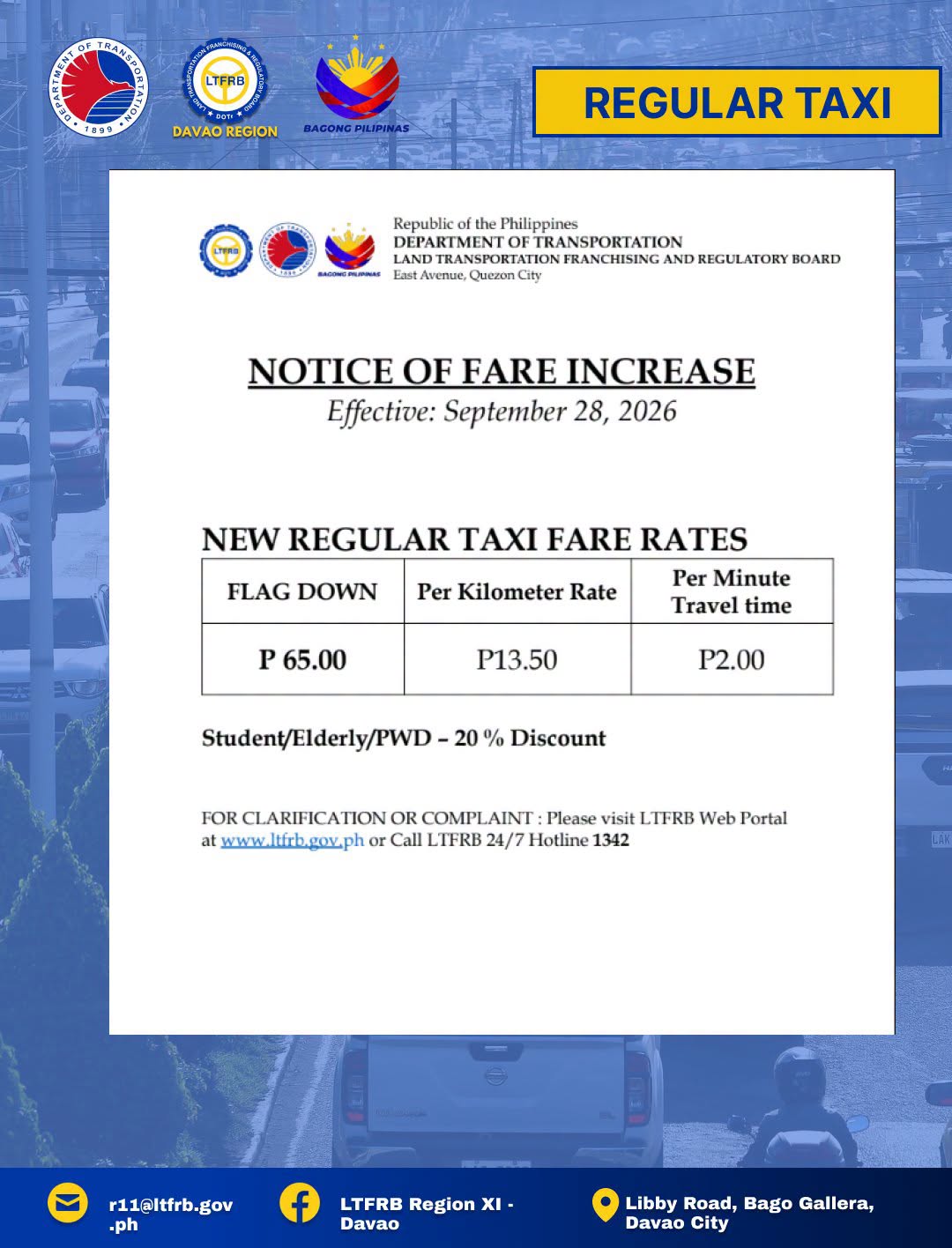
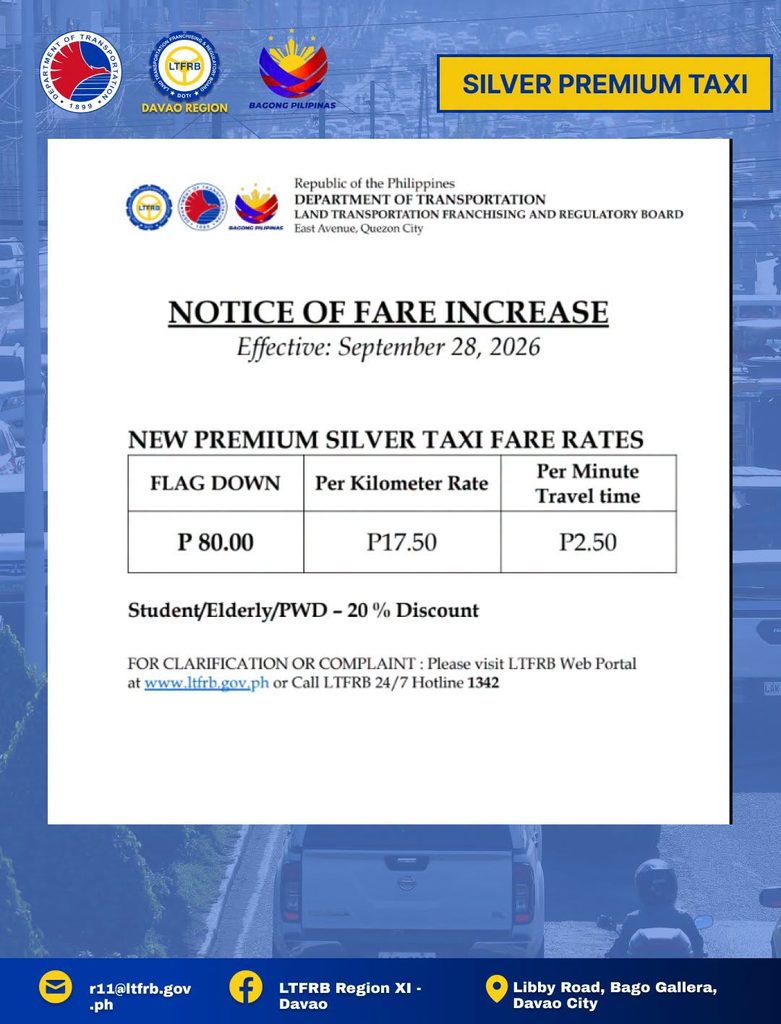
Regular taxi fares will increase to a ₱65 flag-down rate, ₱13.50 per kilometer and ₱2 per minute of travel time. Silver premium taxis will charge ₱80 upon boarding, ₱17.50 per kilometer and ₱2.50 per minute.
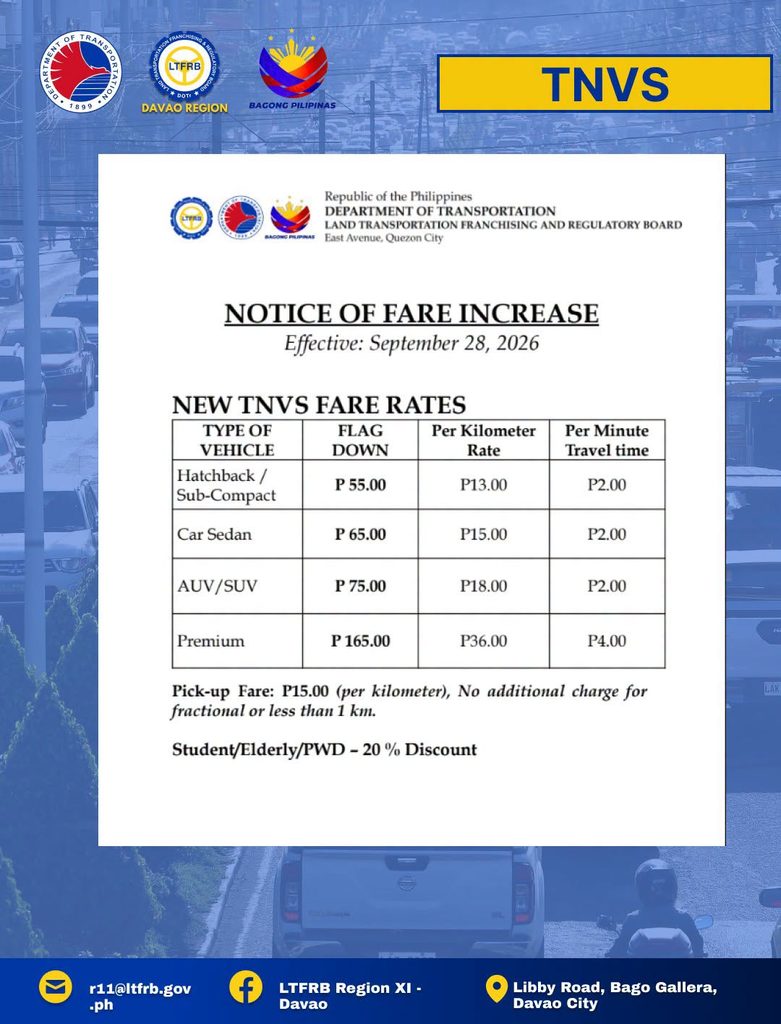
TNVS rates will also vary by vehicle category. Hatchback and subcompact vehicles will have a ₱55 flag-down fare, ₱13 per kilometer and ₱2 per minute. Sedan services will charge ₱65 upon boarding, ₱15 per kilometer and ₱2 per minute, while AUVs and SUVs will have a ₱75 flag-down rate, ₱18 per kilometer and ₱2 per minute. Premium TNVS vehicles will have a ₱165 flag-down fare, ₱36 per kilometer and ₱4 per minute. The supplied notice also specifies a ₱15-per-kilometer pickup fare.
These revised rates are particularly relevant to passengers who use taxis and app-based transport when public transportation is unavailable, inconvenient or unsuitable for their journeys.
Discounts remain available for eligible passengers
Students, senior citizens and PWDs remain entitled to a 20% discount under the supplied fare notices. The traditional and modernized jeepney guides also specify that the applicable discounts are available every day, including Saturdays, Sundays and holidays.
However, discounted fares do not remove the financial impact of the adjustment. Families with multiple students or working members who commute daily may still face higher combined transportation expenses.
The burden extends beyond the fare itself
The impact of the adjustment is not simply a matter of paying a few pesos more for one ride. For commuters who depend on multiple transport services, the increases may compound across different legs of a journey.
A worker who takes a jeepney, transfers to another vehicle and repeats the trip after work may encounter several fare adjustments in one day. Students who travel to school throughout the week will likewise have to account for the revised rates, even when their budgets are already limited.
For households managing food, electricity, water, education and other basic expenses, transportation becomes another competing financial priority. The adjustment may require families to reorganize their spending, particularly those whose members have no practical alternative to commuting.
LTFRB XI advises commuters to check temporary fare guides
The LTFRB Region XI announcement states that temporary fare guides may be used while the signed official fare matrices are awaited. Commuters are advised to check the applicable guide for their vehicle type and route and to retain the information for reference when paying their fares.
For clarification or complaints, passengers may visit the LTFRB website at www.ltfrb.gov.ph or call its 24/7 hotline at 1342.
With the new fares scheduled to take effect on September 28, the immediate challenge for ordinary commuters is clear: transportation will require a larger share of their daily budgets, even though getting to work, attending school and accessing essential services remain unavoidable necessities.