
In a time marked by rising fuel costs and growing economic uncertainty, the leadership of Jose Paolo Evangelista stands out as a model of calm, compassionate, and decisive governance—placing people above politics and public welfare above convenience.
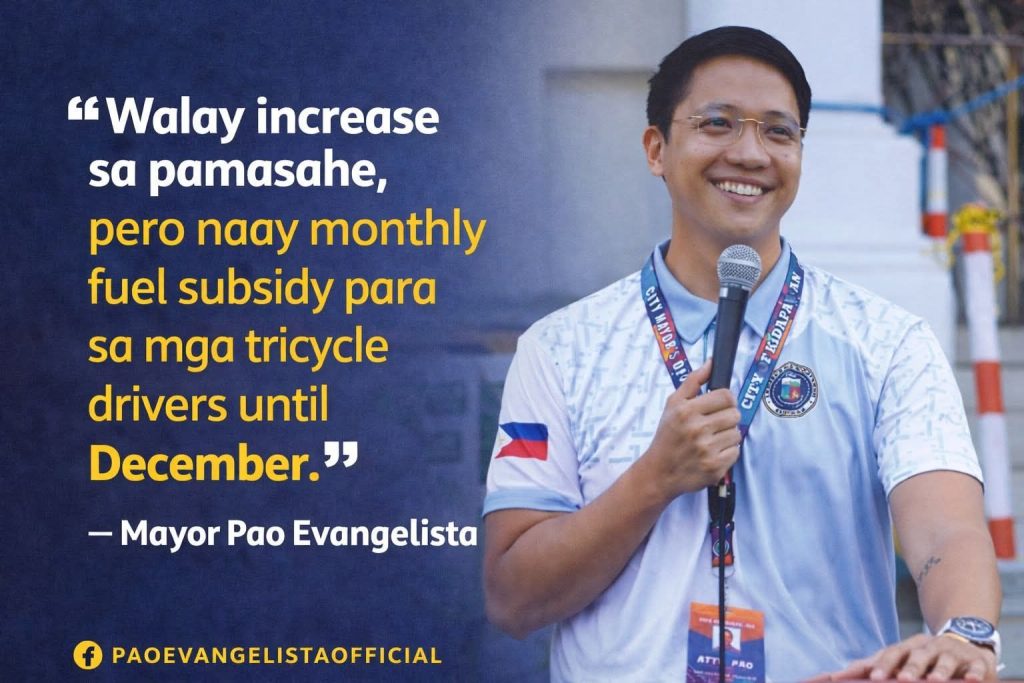
Mayor Evangelista’s firm declaration that there will be no increase in tricycle fares across Kidapawan City is more than just a policy decision—it is a powerful statement of principle. At a moment when many localities might default to passing the burden onto commuters, the city government chose a more humane path: to absorb the shock, protect the vulnerable, and stabilize the local economy.
This is leadership that listens, understands, and acts.
By rolling out Fleet Cards loaded with ₱1,000 monthly fuel subsidy for registered tricycle drivers until December 2026, the city government has demonstrated a strategic and forward-thinking response. It recognizes the dual reality faced by both drivers and commuters—drivers struggling with rising fuel prices, and passengers already stretched thin by daily expenses. Rather than pitting one sector against another, the solution uplifts both.
Equally commendable is the city’s proactive coordination with the Department of Social Welfare and Development, ensuring that additional subsidies reach more than 3,000 tricycle operators and drivers. This efficient mobilization of national resources, coupled with local implementation through the City Social Welfare and Development Office, reflects a government that works with urgency and precision.
But perhaps the most striking aspect of this response is the willingness of the city leadership to make difficult choices. The cancellation of concerts and fiesta activities—often seen as staples of local culture—signals a rare and admirable prioritization of essential needs over celebratory spending. It is a reminder that true public service sometimes requires sacrifice, discipline, and the courage to go against expectations for the greater good.
Mayor Evangelista’s message is clear: the burden of crisis should not fall on the shoulders of ordinary citizens. Instead, government must step forward—not just as an administrator, but as a protector and partner of the people.
This approach fosters not only economic relief but also trust—an invaluable currency in times of crisis. It reassures the people of Kidapawan that their leaders are not detached decision-makers, but active stewards of their welfare.
In the face of global uncertainties and local challenges, Kidapawan City offers a compelling example of how responsive governance can soften the harshest impacts of crisis. It is a testament to what can be achieved when leadership is grounded in empathy, guided by data, and driven by an unwavering commitment to the common good.
Indeed, as Mayor Evangelista himself expressed, every crisis carries within it an opportunity—to learn, to grow, and to emerge stronger. Through this decisive and people-centered response, Kidapawan City is not merely enduring the crisis—it is setting a standard for others to follow.