
The Philippines is confronting a school-violence problem that can no longer be dismissed as a collection of isolated incidents. From January to September 20, 2026, reported school-related cases included 2,500 bullying incidents, 26 bomb threats, 13 shooting threats, five cases involving illegal firearm possession, two death threats, three shootings, five stabbings, eight deaths and 35 injuries. The figures are deeply disturbing, but they also require careful interpretation. As registered psychologist and development practitioner Kloe A. Carvajal-Yap cautions, the numbers alone are not enough to establish whether school violence is increasing or changing over time. That would require comparable historical data, details about the incidents and information about the people involved.
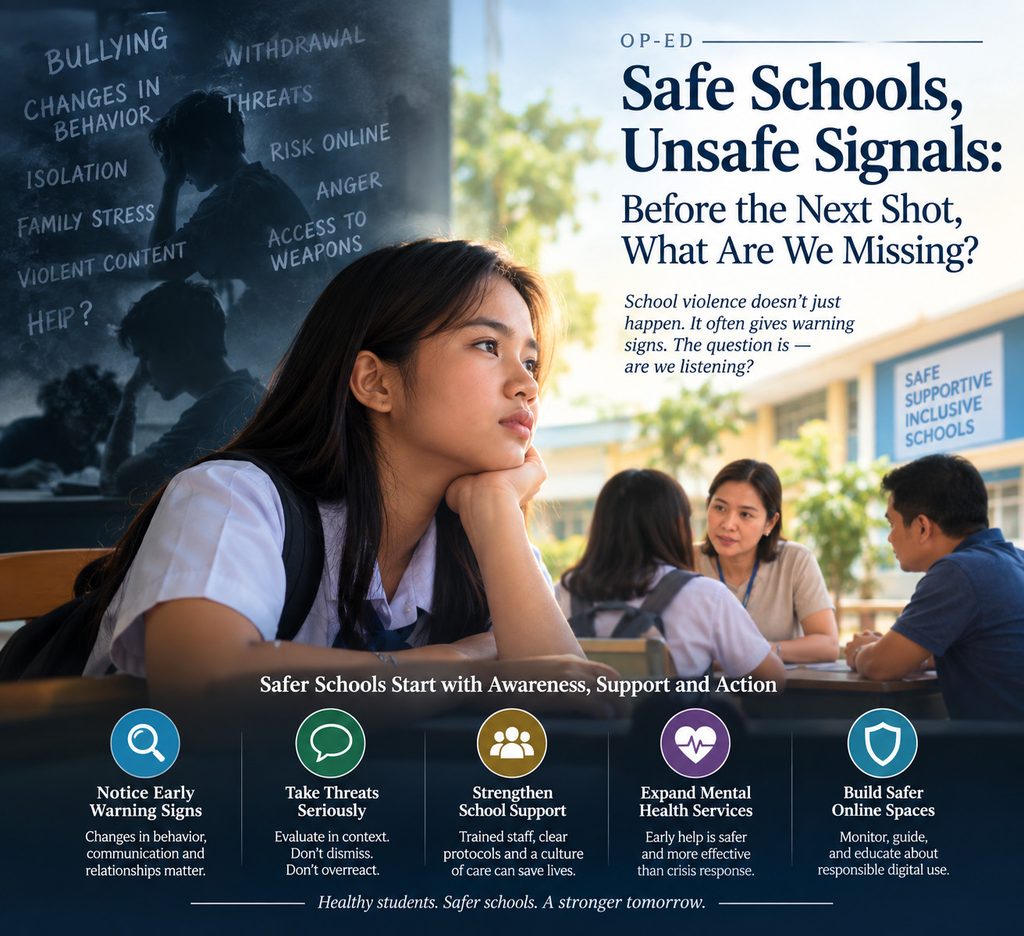
Yet the absence of a definitive trend should not become an excuse for complacency. The more urgent question is what happens before a student reaches the point of making a serious threat, bringing a weapon into school or attacking another person. Violence does not follow one predictable psychological pathway, and there is no single profile that can reliably identify a future attacker. But serious acts of violence are sometimes preceded by observable changes in behavior, communication, relationships and circumstances. The challenge for schools is to recognize meaningful combinations of warning signs without turning every troubled, angry or withdrawn student into a suspect.
The warning may come before the violence
Carvajal-Yap emphasizes that threats have to be evaluated in context. Not every threat represents genuine intent to act, but neither should threats automatically be dismissed as jokes, attention-seeking behavior or ordinary adolescent anger. Concern becomes greater when a student identifies a target, communicates specific intent to cause harm, acquires access to a weapon or begins taking concrete steps toward preparing for an attack. That means schools need more than disciplinary rules. They need people who know how to understand what happened before the threat, what grievance the student believes he or she has, against whom that grievance is directed, whether a target has been identified, whether the language has become increasingly specific, whether the student has sought access to a weapon, whether there has been preparation, whether supportive adults are involved and whether the student’s behavior has changed over time.
These questions should not be used to prejudge a student. They are meant to understand risk. That distinction is fundamental because the purpose of a psychologically informed threat-assessment process should be both safety and intervention. Schools should not wait for an actual attack before seeking professional help, but neither should they declare a distressed student dangerous simply because that student is angry, isolated, withdrawn or struggling. Psychological and behavioral assessment should happen at a lower threshold than a declaration of imminent danger. The objective is to understand what is happening early enough to intervene appropriately.
Violence is rarely the product of one cause
School violence is not adequately explained by a single factor. Bullying, peer conflict, social isolation, family circumstances, exposure to violence, violent content, developmental stage, emotional regulation, coping skills and access to support can interact in complicated ways. Family and peer relationships can either mitigate or compound risk, while the school environment itself can either provide protective relationships or leave students feeling increasingly disconnected.
A student experiencing chronic family conflict, inadequate supervision, persistent bullying or limited access to counseling may have fewer healthy mechanisms for dealing with anger, humiliation, rejection or perceived injustice. That does not mean such a student will become violent. Most will not. But when several vulnerabilities converge, particularly in an environment where support is weak and access to weapons exists, a volatile situation can become more dangerous.
The difficulty is that early warning signs are often ambiguous. A quiet student can easily be overlooked. A withdrawn student may simply be struggling privately. A student who repeatedly gets into conflicts may be regarded only as a discipline problem. A threat may be dismissed because adults assume the student is joking or merely seeking attention. Yet later, when a serious incident occurs, those earlier behaviors may appear in a different light. This is why context matters. Schools need systems capable of distinguishing ordinary adolescent difficulties from situations that require deeper assessment.
The digital world cannot be treated as an afterthought
The online environment adds another layer of complexity. Carvajal-Yap points out that online behavior can be difficult for adults to monitor and that concerning activity may include obsessive research into weapons or methods of conducting an attack when such activity forms part of broader preparation.
This does not mean that young people’s online interests should automatically be treated as evidence of violent intent, nor does it mean schools should attempt to monitor every aspect of a student’s private digital life. The issue is context. A disturbing search becomes more significant when it occurs alongside a specific grievance, threats, target identification, weapon acquisition or other preparatory behavior.
This is precisely why simplistic explanations about violent content online are inadequate. Exposure is not destiny. Millions of young people encounter violent material without becoming violent. The harder question is what happens when digital exposure intersects with an existing grievance, social isolation, emotional dysregulation, peer conflict or preparation for real-world violence. That is a much more difficult issue to address, but it is the question schools and families actually need to confront.
The counseling shortage is not the entire problem
The country’s shortage of school-based mental-health professionals is an obvious institutional concern, but reducing school violence to a shortage of guidance counselors would itself be an oversimplification. Carvajal-Yap argues that school violence requires a multidisciplinary response involving guidance counselors, teachers, administrators, parents, social workers, psychologists, health professionals and, when necessary, law-enforcement and public-safety agencies.
That is an important correction to the assumption that one professional group can carry the entire burden. A counselor cannot compensate for a school without an effective referral system. A teacher cannot conduct a comprehensive psychological assessment. A police officer cannot replace sustained counseling. A parent cannot be expected to manage a serious behavioral crisis without professional support. The system has to work collectively.
At a minimum, schools need access to psychological first aid and psychosocial support, individual and group counseling, behavioral assessment and intervention, bullying and peer-conflict interventions, crisis response and appropriate referral pathways when a student’s needs exceed what the school can provide. There must also be confidential mechanisms through which students, teachers and parents can report concerns.
The question, therefore, is not simply how many counselors the government can hire. It is whether a student who needs help can actually move through a functioning continuum of care. A student may be identified by a teacher, referred to a counselor, assessed by a professional and still receive no meaningful follow-up. That is not a functioning system. Prevention depends not only on identifying a problem but on ensuring that the student can actually reach the appropriate level of assistance.
Security and psychology must work together
There is no meaningful argument that physical security should be abandoned in favor of psychology. The two are not substitutes. Access control, emergency response, threat reporting, security assessments and coordination with law enforcement are essential when a threat emerges. These measures can reduce opportunities for violence and help limit its consequences, but they do not necessarily address the underlying reasons a student has become increasingly distressed, aggrieved, aggressive or threatening.
Carvajal-Yap argues that prevention, counseling, behavioral assessment and early intervention must operate alongside physical security rather than being treated as competing priorities. That distinction is critical because a school can have a security protocol and still fail to identify a student in distress. It can conduct an emergency drill and still lack a functioning referral system. It can establish a reporting mechanism and still fail to follow up on the information received.
The existence of a policy does not prove the existence of a functioning system. A school can have rules on paper and still lack the personnel, coordination and institutional culture necessary to implement them effectively. School safety therefore has to be understood as both a physical-security issue and a human-development issue.
The real test is whether prevention works before the headline
Government will inevitably measure school safety through incidents: shootings, stabbings, threats and injuries. Those numbers matter, but they are not enough to determine whether prevention is working.
Carvajal-Yap points to other indicators that deserve attention, including the prevalence of bullying and serious threats, patterns of escalating behavior, utilization of counseling and mental-health services, the timeliness and completion of referrals, student perceptions of safety and belonging, and whether identified high-risk cases receive appropriate multidisciplinary follow-up.
These may be less dramatic measurements, but they may be more revealing. If bullying is reported but students do not receive meaningful intervention, the system has a problem even if no shooting occurs. If a serious threat is reported but the referral process stops at paperwork, the system has a problem. If a student is assessed but there is no follow-up, the system has a problem. If students do not trust adults enough to report concerns, the problem exists before the first emergency call is ever made.
Prevention is difficult to measure because its greatest successes are invisible. The most successful intervention may be the attack that never happens, the threat that is resolved before becoming violence, or the student who receives help before a grievance becomes an obsession. A serious national strategy should therefore examine not only how many violent incidents occurred but how effectively schools identify distress, respond to threats, connect students with professional help and sustain interventions after the immediate crisis has passed.
The Bangsamoro question deserves a closer look
There is another question that should not be ignored in this national discussion: why does school-based violence appear to manifest differently in the Bangsamoro despite the region’s long experience with armed conflict, firearms, rido and other forms of community-level violence?
The question must be approached carefully. It would be irresponsible to conclude that young people in the Bangsamoro are inherently less violent or that schools there are somehow immune from serious violence. The available incidents do not justify such a sweeping conclusion. But the apparent difference in where and how violence occurs deserves investigation.
Carvajal-Yap suggests that youth involvement in violence in conflict-affected communities can be shaped by collective identities, kinship ties, community affiliations and broader political or social grievances. Violence may take collective forms, including rido or involvement in armed or extremist groups, rather than emerging primarily from individual interpersonal conflict inside a school.
That distinction matters because youth violence is not one uniform phenomenon. The motivations, social relationships and environments surrounding violence can differ dramatically from one community to another. Schools may also represent a distinct social space, with their own authority structures, expectations and cultural meaning. Strong family and community networks may influence how disputes are managed and where conflict is expressed.
This does not mean that the Bangsamoro has solved the problem of youth violence. It means that the region may offer an important research question for the rest of the country. If schools in conflict-affected communities are demonstrating protective factors that reduce the translation of community-level violence into school-based attacks, those factors deserve serious study. Researchers should examine the role of families, community intervention, religious and cultural values, relationships between students and teachers, and the ways disputes involving young people are handled before they enter the school environment.
Such research should be evidence-based rather than romanticized. The objective should not be to portray the Bangsamoro as exceptionally peaceful or to deny the region’s continuing challenges. It should be to understand whether particular social structures, relationships or practices are helping keep schools safer and whether lessons from those experiences can inform broader national policy.
The United States comparison needs caution
The reported figures comparing the Philippines and the United States are striking, but they must be treated carefully. The comparison being discussed places 19 U.S. K–12 school shootings resulting in injury or death and 12 deaths through September 3 against three deadly school shootings in the Philippines and eight deaths from those incidents.
At first glance, that may suggest that fewer Philippine incidents produced a comparatively high number of deaths. But the psychologist correctly cautions against drawing a firm conclusion from the figures alone. The United States and the Philippines may differ in how school shootings are defined and recorded, the school populations covered, the periods being compared and the circumstances surrounding individual incidents. With only a small number of Philippine cases, a single incident can dramatically affect the average.
Nor does lethality necessarily have to be explained psychologically. The type of weapon used, whether victims had an opportunity to escape and how quickly authorities responded can all influence the number of casualties. The comparison therefore should not be transformed into a sweeping conclusion about which country’s schools are more or less prepared based solely on the number of incidents and deaths.
The figures can tell us that something deserves investigation, but they do not automatically tell us why it happened. That distinction is essential whenever statistics are used to shape public policy. Before drawing conclusions from international comparisons, policymakers should make sure that the definitions, time periods, populations and reporting systems are genuinely comparable.
The danger of waiting for certainty
Perhaps the most important lesson from this discussion is that prevention does not require schools to predict the future. They do not need to know with certainty that a particular student will become violent. They need to be able to recognize when something has changed, understand what that change might mean, know what to do next and have professionals capable of assessing the concern.
They need families to be part of the intervention, referral mechanisms that actually work, clear procedures for managing serious threats and consistent follow-up after an initial intervention. Without those components, early identification becomes little more than an exercise in documentation.
This is where the distinction between prevention and punishment becomes important. A student who is distressed needs help. A student who is threatening someone needs assessment. A student who presents an imminent danger needs immediate safety intervention. Those are not necessarily the same student, and those situations should not automatically be treated as though they are.
A psychologically informed school-safety system must therefore be compassionate without being naive and vigilant without turning every troubled young person into a suspect. The objective is not to punish students for being angry, isolated or emotionally distressed. It is to understand when ordinary difficulties have become something more serious and to respond proportionately and professionally.
The next school shooting should not be the beginning of the conversation
The Philippines will continue to strengthen school security. It should. It will conduct drills, review disciplinary policies, improve emergency procedures and coordinate with law enforcement. It should do all of these things. But none of those measures should become substitutes for the harder work of prevention.
The country needs schools where bullying is addressed before resentment becomes entrenched; where students have trusted adults they can approach; where behavioral changes can be recognized without stigmatizing ordinary adolescent struggles; where threats are assessed rather than casually dismissed; where families are engaged; where counselors and other professionals have functioning referral networks; and where serious cases can move quickly from identification to appropriate intervention.
Most importantly, the country needs to stop thinking about school safety only in terms of what happens when violence arrives at the school gate. The real test begins much earlier, when a student starts struggling, when a grievance becomes persistent, when isolation deepens, when bullying goes unanswered, when a threat is dismissed as a joke, or when someone notices that a young person’s behavior has changed and takes the time to ask why.
There may never be a guarantee that every act of violence can be prevented. Carvajal-Yap’s analysis makes clear that there is no single pathway that allows society to predict violence with certainty. But uncertainty is not an excuse for inaction.
The purpose of early intervention is not to predict perfectly who will become violent. It is to make sure that when a student is in distress, the adults around that student have the knowledge, systems and professional capacity to respond before the situation becomes a crisis. It is to make sure that a warning does not disappear into paperwork, that a threat is not casually dismissed, that a bullied child is not left alone with a growing grievance, and that a student who needs help can actually reach someone qualified to provide it.
A school should be more than a place protected from violence. It should be a place where young people are seen before they reach a breaking point, where problems are addressed before they become crises, and where safety is understood not simply as the absence of a gunshot or a knife attack, but as the presence of relationships, systems and adults capable of responding when something begins to go wrong.
The next school shooting should not be the beginning of the conversation. The conversation has to begin long before that.
About the expert
Kloe A. Carvajal-Yap is a registered psychologist and development practitioner with experience in peacebuilding, psychology, disaster risk management and violence prevention. She maintains a private clinical practice and has served as a Disaster Risk Management Consultant to the World Bank, supporting policy and institutional reforms for disaster preparedness, resilience and response in the Philippines. She also spent more than a decade with International Alert, most recently serving as Deputy Country Director Philippines, with previous work involving restorative justice, private-sector engagement, preventing violent extremism, monitoring and evaluation, research, training and curriculum development. Her professional background includes work at the intersection of collective violence and developmental psychology, with a focus on applying psychological and behavioral insights in conflict-affected and conflict-sensitive settings.