
There is something profoundly disturbing about a child going to school with dreams of learning, building a better future, and eventually escaping the hardships of poverty, only to find himself or herself fighting a much more immediate battle: hunger.

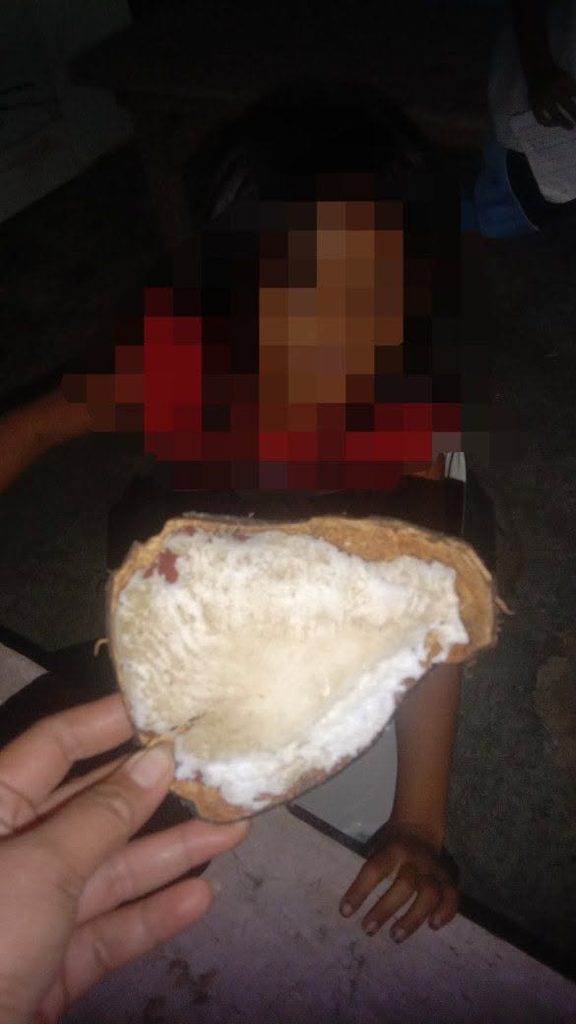
Imagine a young student sitting inside a classroom in Barangay Kimlawis, Kiblawan, Davao del Sur. While a teacher discusses a lesson, the child quietly chews on the fibrous, hardened meat of a coconut—not because it is a favorite snack, not because it is a delicacy, and certainly not because there is nothing else to eat at home, but because an empty stomach demands something, anything, to keep going.
Just imagine that. A child who should be thinking about mathematics, reading, writing, science, and the possibilities of tomorrow is instead trying to silence the growling of an empty stomach.
This is not simply a heartbreaking classroom incident. It is a disturbing reflection of the realities that many Filipino children, particularly those in remote and economically disadvantaged communities, continue to endure. And it raises questions that this country should no longer be comfortable ignoring. What nourishment can a child possibly get from chewing hardened coconut meat just to survive the school day? Will it sustain the child until the next meal? Will it provide the nutrients necessary for growth, brain development, concentration, and physical strength?
Coconut meat does contain nutrients, including fats and dietary fiber. But let us not confuse its nutritional content with the circumstances surrounding this incident. A child resorting to whatever food remains available simply because there is nothing else to eat is not a story about nutrition. It is a story about food insecurity, poverty, and a system that has yet to reach every child who needs it. The concern is not whether coconut meat can provide some energy. The real concern is why a schoolchild has to depend on it in the first place.
When Hunger Becomes an Invisible Barrier to Education
We often hear government officials, politicians, and education leaders speak about the importance of education as the great equalizer. We are told that every child deserves access to quality education, that no Filipino child should be left behind, and that education is the pathway out of poverty. These are noble statements, but for some children, they remain promises written on paper.
Before a child can absorb a lesson, that child needs to eat. Before a student can concentrate on a classroom discussion, the student needs enough nourishment to keep the mind and body functioning. Before we expect children to participate, perform, compete academically, and achieve excellent grades, we must first ask whether they have eaten.
Hunger does not always announce itself through crying. Sometimes, it appears as silence. It manifests as a child who stares blankly at the blackboard, struggles to follow instructions, falls asleep during class, or becomes unusually withdrawn. Unfortunately, these behaviors are sometimes mistaken for laziness, disinterest, poor discipline, or a lack of motivation. But what if the child is simply hungry? What if the student who rarely raises a hand is not incapable of understanding the lesson but is physically struggling to concentrate? What if the child who cannot participate in classroom activities is preoccupied with something as basic as wondering when the next meal will come?
This is precisely why the experience of the teacher in Kiblawan deserves attention. According to the account shared by the teacher, she had noticed that her student was unusually quiet and rarely participated in classroom discussions. When she discovered the child eating coconut meat, she immediately called the student and provided biscuits. More importantly, she chose not to publish the video of the incident, recognizing that the child’s dignity and the family’s privacy mattered more than the attention that a heartbreaking social media post might generate.
That decision deserves recognition. The child is not a spectacle, the child’s hunger is not entertainment, and the family’s hardship is not material for public humiliation. The story must be told, but the child must be protected. The message of the teacher should resonate in every classroom: Do not be too quick to judge a struggling student. Sometimes, what looks like a lack of interest in education is actually a struggle for survival.
The Children Are Dreaming, but Poverty Is Standing in Their Way
Let us remember something important: Many children in remote communities are not asking for luxury. They are not asking for expensive gadgets, branded shoes, fashionable clothes, or comfortable lifestyles. They simply want to go to school. They want to learn how to read and write, understand the world, and become teachers, nurses, doctors, engineers, soldiers, journalists, farmers, and professionals who can eventually help their families.
They have dreams just like children in urban communities and ambitions just like students who enjoy the privilege of eating breakfast before school, carrying packed lunches, drinking milk, and returning home to a prepared meal. But the difference is that some children have to confront circumstances that make even the simplest educational aspirations difficult to achieve.
In geographically isolated and disadvantaged areas, poverty can be compounded by distance, inadequate transportation, limited livelihood opportunities, insufficient health and nutrition services, and the absence of reliable access to basic necessities. Some children walk considerable distances to reach school, while others attend classes without breakfast. Some bring whatever food their families can afford, while others bring nothing at all. And there are children whose circumstances are so difficult that whatever they find in their surroundings becomes something to eat.
How can we expect these children to compete on equal footing with students who have their basic needs consistently met? How can we measure their academic performance without considering the conditions under which they are expected to learn? Education cannot be separated from the realities of poverty. A classroom may have a teacher, chairs, books, and a blackboard, but if the child sitting inside it is hungry, something fundamental is still missing. A school may be ready to teach, but a hungry child is not necessarily ready to learn.
While Children Go Hungry, Where Do Our Priorities Really Stand?
And here is where the conversation becomes uncomfortable. The Philippines is a country that allocates enormous public resources to government programs, infrastructure, public services, and various development initiatives. Every year, billions of pesos pass through government budgets, and public officials argue over allocations, projects, priorities, and political influence. Yet, how can we reconcile these enormous public expenditures with the reality of a child chewing hardened coconut meat inside a classroom because of hunger?
How can a country that repeatedly declares education and child welfare national priorities still allow the basic nutritional needs of some schoolchildren to remain uncertain? While political figures compete for influence, positions, and access to public funds, and while controversies over alleged corruption, questionable expenditures, political patronage, and the misuse of government resources continue to surface, there are children whose immediate concern is not politics. They are wondering what they will eat.
Let us be clear: Not every politician is corrupt, and not every public program has failed. There are government personnel, teachers, local officials, and public servants genuinely working to improve the lives of disadvantaged communities. But public service must be measured not by speeches, press releases, ribbon-cutting ceremonies, or impressive budget figures. It must be measured by the lives it improves and the basic needs it manages to address.
If public funds are intended to serve the people, then hungry children should be among the highest priorities. What is the value of a grand infrastructure project if the children in the communities it is supposed to serve cannot afford their next meal? What is the meaning of economic growth if some of the country’s youngest citizens are still struggling to obtain adequate food? What does national development mean if children are growing up without the nutrition they need to develop their full potential?
A government that wants to build a competitive, educated, and productive nation must understand that investment in children begins long before graduation. It begins with food, health, safety, and the opportunity to learn.
School Feeding Programs Must Reach the Children Who Need Them Most
The government has existing initiatives intended to address child hunger and malnutrition, including school-based feeding programs. These efforts are important and must be sustained. However, the existence of such programs does not automatically mean that every hungry child is being reached. Beyond the number of feeding programs launched, schools included, or funds allocated, the more important consideration is whether these initiatives are actually reaching the children who need them most, particularly those in geographically isolated and disadvantaged communities. Are these schools adequately covered? Are the resources sufficient to provide consistent and nutritious meals? Are the programs properly monitored to ensure that no intended beneficiary is overlooked? More importantly, are local governments, schools, communities, and national agencies working together to identify children experiencing food insecurity and provide timely assistance to them and their families?
School feeding should never be treated merely as a temporary charitable activity or another government accomplishment to be highlighted during official ceremonies. It must be recognized as an essential investment in education, public health, child development, and the country’s future. Children need more than occasional biscuits to get through a school day; they need regular access to adequate, nutritious, and age-appropriate meals. In communities where poverty is deeply rooted, school feeding programs must also be complemented by interventions that help families secure sustainable livelihoods and access basic necessities. We cannot address childhood hunger by continually relying on teachers to personally purchase biscuits or provide food for students whose families cannot afford it. That responsibility must be shared by institutions and government agencies mandated to protect children’s welfare.
Teachers Are Educators, Not Substitutes for a Failing Social Safety Net
There is another dimension to this incident that deserves recognition. The teacher did not simply see a student eating something unusual and ignore it. She paid attention, noticed a behavioral change, recognized that something might be wrong, and responded with compassion. That is the human side of education that cannot be measured through examination results or classroom performance indicators.
Our teachers are often among the first people to recognize when something is happening in a child’s life. They see the student every day and notice changes in behavior, attendance, participation, physical appearance, and academic performance. In many communities, teachers become more than educators. They become counselors, protectors, sources of encouragement, and sometimes the only adults outside the household who recognize a child’s silent suffering.
But we must also be careful not to romanticize their sacrifices. Teachers already carry enormous responsibilities. They should not be expected to personally shoulder the burden of feeding hungry children because the systems intended to protect them are insufficient. Their compassion deserves support, not exploitation.
Schools need functioning mechanisms for identifying malnutrition and food insecurity, referring children to appropriate services, coordinating with local social welfare offices, and ensuring that vulnerable students receive assistance without being stigmatized. One teacher’s biscuits may have temporarily eased a child’s hunger, but what happens tomorrow? What happens when that child returns to school the following day? What happens to the other children who may be experiencing the same situation but have not yet been noticed? A compassionate response must lead to a collective and institutional response.
A Child’s Dignity Must Never Become the Price of Receiving Help
There is also a lesson in the teacher’s decision not to publish the video. In an age when almost every emotional incident can become viral content, there is a growing temptation to turn human suffering into social media material. But not every painful situation needs to be filmed, shared, or exposed to prove that poverty exists.
The child’s identity, dignity, and privacy must remain protected. We can raise awareness without humiliating the people whose experiences we are trying to highlight. We can demand government accountability without turning a vulnerable child into a symbol of shame. We can tell this story because the public deserves to understand the realities of hunger in our communities, but we must never forget that behind this story is a child who deserves protection, compassion, and an opportunity to live a normal childhood.
The objective should not be to make the child famous for eating coconut meat. The objective should be to make sure that no child has to do it again because there is nothing else available.
The Real Measure of Our Future Is How We Treat Our Most Vulnerable Children
Perhaps the most painful part of this story is that the child was doing exactly what we want children to do: going to school. Despite whatever difficulties existed at home, the student still showed up. There was a classroom to attend, a teacher to listen to, and a lesson to learn.
Somewhere inside that young mind may be a dream of becoming somebody someday. Perhaps the child wants to help the family, secure a better life, or simply have the opportunity to experience the things other children take for granted. But dreams require more than determination. They require nourishment, support, and opportunities. Above all, they require a society willing to ensure that poverty does not become a permanent barrier to a child’s future.
We cannot keep telling children that education is their way out of poverty while ignoring the poverty that follows them into the classroom. We cannot keep telling them to study hard when some have to spend their school hours battling hunger. We cannot keep demanding better academic performance without confronting the conditions that make learning difficult. And we cannot continue celebrating the country’s educational aspirations while overlooking the children who are struggling to meet their most basic needs.
A hungry child does not need another political speech about the importance of education. A hungry child needs food. A child who walks to school dreaming of a better future needs a system that gives that dream a fighting chance. A child in a remote community deserves the same opportunity to learn, grow, and succeed as a child in a prosperous city. That should never be considered a privilege. It is a basic responsibility of a society that claims to value its children.
Let this incident in Kiblawan, Davao del Sur, be more than another heartbreaking story that circulates on social media for a few days before being forgotten. Let it challenge our schools, local governments, national agencies, lawmakers, and every public official entrusted with public resources. We must find the hungry children, feed them, protect their dignity, support their families, make school feeding programs effective, and ensure that even the most remote communities are not forgotten.
Because somewhere in another classroom, there may be another child quietly chewing whatever can be found, trying to endure the school day without anyone noticing. And while that child is fighting hunger, we are telling that same child to dream big.
But how can we ask a child to dream of a better tomorrow when we cannot even guarantee that the child will have enough food today?
A nation cannot build its future on hungry children. And no child should ever have to choose between going to school and having something to eat.
The Mindanao Sentinel — Regional Focus. National Relevance.