
The attempted ambush of BARMM Interim Chief Minister Abdulraof “Sammy Gambar” Macacua’s convoy in Datu Odin Sinsuat, Maguindanao del Norte, should not be treated as simply another security incident in a region that has endured generations of conflict. It should compel the Bangsamoro to confront a far more uncomfortable question: Are we slowly normalizing violence as an unavoidable part of political life, particularly during elections, and is this really the kind of Bangsamoro that its people have envisioned?
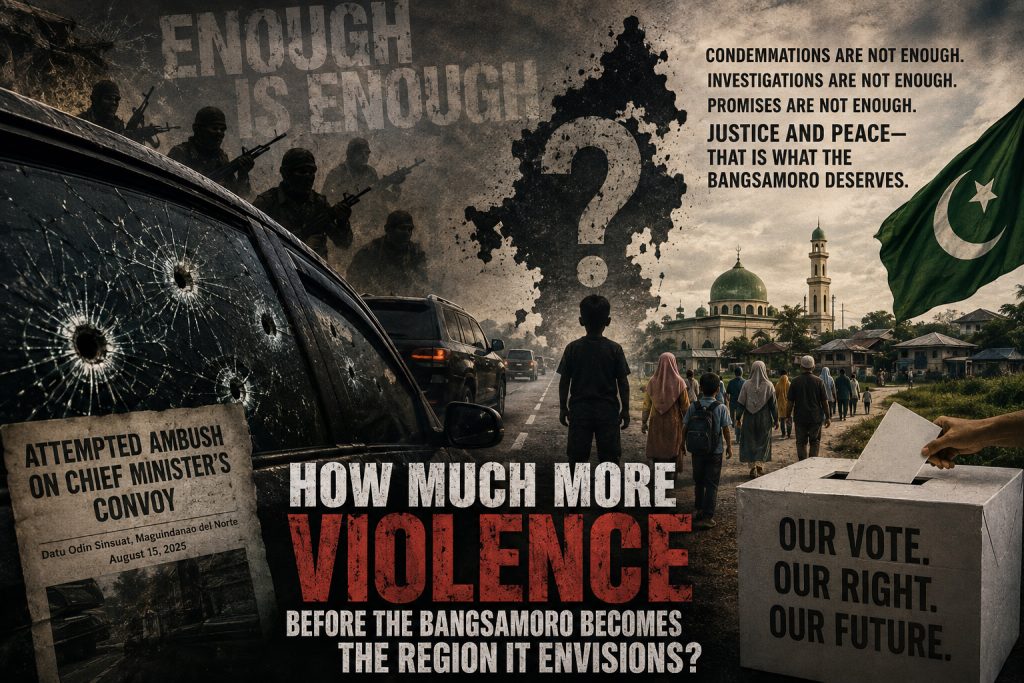
On August 15, Macacua’s convoy came under gunfire along the General Santos–Cotabato National Highway in Barangay Bitu. Three vehicles, including the bulletproof vehicle carrying the Chief Minister, were hit by bullets. Macacua, his companions and security personnel survived unharmed. Authorities are investigating the incident, but the identities of the attackers and their motive have yet to be established.
The Philippine National Police has appropriately cautioned against speculation, including premature claims that the incident was election-related. The circumstances and motive must be established through a proper investigation and due process. But while investigators work to establish the facts, the public should also be allowed to ask a broader question: Why does violence continue to have such a familiar place in the political landscape of the Bangsamoro?
When Violence Becomes “Part of the Transition”
For years, the difficulties confronting the Bangsamoro have often been explained through the language of transition. The institutions are still developing. The peace process is still being consolidated. Political relationships are still evolving. Historical grievances remain unresolved. Armed groups and clan conflicts continue to influence communities. These realities cannot simply be dismissed, and the region’s complicated history cannot be erased by political declarations.
But neither should the word “transition” become a permanent explanation for insecurity.
The Bangsamoro cannot remain indefinitely in a state of transition while its people are repeatedly asked to accept violence as something that cannot be avoided. There must eventually be a point when violence is no longer regarded as an unfortunate feature of political life, but as a fundamental failure that institutions must confront and overcome. A transition toward peace and democratic governance should mean progressively reducing the space in which violence can operate, not repeatedly explaining why violence remains present.
The government itself has emphasized the importance of maintaining peace and security as the region prepares for its first regular Parliamentary Elections. Malacañang ordered an immediate investigation into the attack and stressed that the incident should not undermine the peace process or democratic governance in the Bangsamoro. But that raises a difficult question: How long can the region continue to describe itself as being in transition while people remain vulnerable to political violence?
Transition is supposed to lead somewhere. It should eventually produce stronger institutions, greater public confidence, safer communities and a political culture in which disagreements are settled through democratic processes rather than through intimidation or armed force. If the explanation for violence remains perpetually rooted in the fact that the region is “still transitioning,” then society must ask whether the transition itself is sufficiently changing the conditions that allow violence to persist.
If Even the Chief Minister Is Vulnerable
The attack becomes even more disturbing because the target was not an ordinary citizen. Macacua is the Interim Chief Minister of the Bangsamoro. He travels with security personnel and was inside a bulletproof vehicle when the convoy was attacked. Yet three vehicles in the convoy were struck by gunfire.
He survived, and that is something the region should be grateful for. But the fact that no one was killed should not diminish the seriousness of what happened. The incident demonstrates that even the highest political office in the Bangsamoro is not beyond the reach of armed violence.
If a Chief Minister traveling with security personnel and inside an armored vehicle can become the target of an armed attack, what does that say about the security environment faced by ordinary citizens?
What about the farmer traveling along the highway? The teacher going to school? The trader transporting goods? The civil servant reporting for work? The community leader attending a meeting? The political candidate campaigning in a remote barangay? The voter simply trying to participate in an election?
These people do not travel in bulletproof vehicles. They do not have armed security details. They do not have the institutional protection available to the highest officials.
If those at the highest levels of government are vulnerable, how much more vulnerable are ordinary people?
This is why the incident cannot simply be viewed as an attack against one political leader. It raises questions about the security environment in which the entire Bangsamoro political project is being built.
Condemnations Are Necessary—But They Are Not Enough
The response to the attack has followed a familiar pattern. Authorities condemn the violence. Political organizations express concern. Leaders call for calm. Investigations are ordered. Officials promise that those responsible will be identified and brought to justice. Prayers and sympathy are offered to the victim and his family.
All of these responses are necessary. But they cannot be the end of the conversation.
The Moro National Liberation Front condemned the attack and emphasized that no political disagreement, competing interest or difference in affiliation can justify violence or an attempt to take another person’s life. It also warned against allowing violence to reopen old wounds and undermine the gains achieved through decades of dialogue, negotiation and sacrifice.
The Bangsamoro Federalist Party similarly warned against allowing violence, intimidation and firearms to dictate the political future of the region and called for accountability not only for those who carried out the attack, but for anyone who may have planned, ordered, financed or enabled it.
These statements matter. But the people of the Bangsamoro need more than statements.
Condemnations do not stop bullets. Sympathy does not dismantle the networks that enable violence. Announcing an investigation is not the same as delivering justice.
The public deserves investigations that establish facts, prosecutions when evidence warrants them, and accountability through due process. It should not matter whether the victim is a powerful political official or an ordinary citizen. Justice must not be measured by political status.
Otherwise, every new incident risks becoming another familiar cycle: violence, condemnation, investigation, promises—and eventually another incident.
The Dangerous Normalization of Violence
Perhaps the most dangerous consequence of repeated violence is not only the immediate physical harm. It is the possibility that society gradually becomes accustomed to it.
When people repeatedly hear about shootings, ambushes, armed confrontations and political violence, there is a danger that these incidents eventually become accepted as simply “how things are” in the region. That is precisely what must be resisted.
Violence should never become so familiar that people stop asking why it happened. It should never become so predictable that communities simply wait for the next incident. And it should never become so politically embedded that elections are discussed not only in terms of candidates, platforms and policies, but also in terms of who might be attacked, which areas might become dangerous and whether political disputes could turn violent.
That is not democratic maturity. It is fear becoming part of the political system.
The Bangsamoro people should not be asked to accept the argument that violence is inevitable simply because the region has a complicated history. History explains the problem; it does not justify allowing the problem to continue indefinitely.
What Kind of Bangsamoro Are We Building?
Basilan Governor Mujiv Hataman has said that violence has no place in society and called on candidates and their supporters to remain calm and respect the democratic process. He emphasized that the purpose of the elections is to bring good governance and development to the Bangsamoro—not fear and disorder.
That distinction matters. The question before the Bangsamoro is no longer simply whether the region can hold elections. The deeper question is whether it can build a political culture in which elections are genuinely peaceful and democratic. Can candidates compete without intimidation? Can political opponents disagree without becoming enemies? Can voters participate without fear? Can public officials perform their duties without worrying that political disputes could put their lives at risk? Can communities trust the police, military and justice system to protect them regardless of political affiliation? And, ultimately, can the region demonstrate that political power can be obtained, contested and exercised through democratic institutions rather than through threats, armed force or fear?
These are not abstract questions. They are fundamental measures of whether the Bangsamoro transition is actually delivering the political transformation that its people have been promised. A democratic system cannot be considered fully successful simply because elections are held. It must also create an environment in which people are free to participate without fear and where political disagreements do not carry the possibility of violence.
This is particularly important as the region approaches its first regular Parliamentary Elections. The election should represent more than a constitutional or administrative milestone. It should demonstrate that the Bangsamoro is capable of moving beyond a political culture in which armed power and violence can influence political outcomes. If candidates and voters enter the electoral process already anticipating intimidation, armed confrontation or retaliation, then the region must confront the uncomfortable reality that the transition remains incomplete—not because elections cannot be conducted, but because the culture surrounding political competition has yet to fully change.
That is the real test of the Bangsamoro transition: not merely whether it can conduct an election, but whether it can make its people believe that they no longer have to fear one.
What Does It Mean to Be a Truly Bangsamoro and Islamic Region?
There is another question that deserves serious reflection: What does it mean to build a truly Bangsamoro and Islamic region if the sanctity of human life remains vulnerable to political violence?
The Provincial Government of Lanao del Sur, in condemning the attack, invoked Surah Al-Ma’idah 5:32 and emphasized the sanctity of human life, stating that violence has no place in the teachings of Islam. That principle should not remain confined to statements issued after an attack. It should be reflected in the political culture and institutions that the Bangsamoro is building.
If human life is sacred, then political competition cannot make life expendable. If justice is central to governance, then accountability cannot depend on political power or affiliation. If peace is a fundamental objective of the Bangsamoro struggle, then peace must mean more than the absence of large-scale armed conflict. It must mean that ordinary people can live, work, travel, vote and speak without constantly calculating the risks of violence.
The aspiration for an Islamic and Bangsamoro society should therefore be reflected not merely in institutional identity, religious language or political structures, but in the protection of life, dignity, justice and peaceful coexistence. The credibility of that aspiration will ultimately be measured by how the region treats human life when political interests are at stake.
How Much More Violence?
How much more violence must the region endure before violence is no longer considered an unavoidable part of political life? How many more families must be displaced? How many more communities must live with fear? How many more political candidates must campaign under security threats? How many more government officials must travel behind bulletproof vehicles? How many more investigations must be announced before people see consistent accountability? And how many more times can authorities condemn violence without addressing the conditions that allow it to continue?
These questions are not meant to prejudge the investigation into the attack on Macacua. The PNP has been clear that it will not speculate on the motive, including whether the incident was election-related, until the facts are established. That position must be respected. Whoever is responsible must be identified through evidence and held accountable through due process.
But demanding facts and accountability does not require society to remain silent about the larger problem.
The question is not whether this particular attack was politically motivated. The question is why political violence remains such a persistent concern that every major incident immediately raises fears about its possible impact on elections, governance and peace.
How much more violence will it take before the Bangsamoro collectively decides that violence is not an unavoidable feature of its political transition, but something that must be rejected outright?
The Peace Process Cannot Become an Excuse for Permanent Insecurity
The Bangsamoro people have already paid an enormous price for peace. The MNLF itself acknowledged that the region has endured generations of conflict and paid dearly for the peace being built today. It warned against allowing violence to reopen old wounds, deepen divisions and undermine the gains achieved through decades of dialogue and sacrifice.
That history should not become an argument for tolerating another generation of violence.
It should be the reason to reject its normalization.
The peace process was never supposed to produce a society in which violence is simply managed rather than overcome. Nor should the transition become an endless period in which insecurity is explained, justified or tolerated because the region is still finding its political footing.
A transition must have a destination.
If the destination is genuine peace, then violence must steadily lose its political power. If the destination is democratic governance, then firearms must lose their influence over political competition. If the destination is justice, then accountability must become stronger than political connections. And if the destination is a Bangsamoro society grounded in dignity and faith, then the protection of human life must be more than a principle invoked after someone is attacked.
The Real Measure of the Bangsamoro Project
The success of the Bangsamoro project should not be measured only by the creation of institutions, the passage of laws, the appointment of officials or the conduct of elections. Its ultimate measure should be much simpler: Do people feel safer?
Can a mother send her child to school without fear? Can a farmer travel to a market without worrying about armed confrontation? Can a political opponent criticize another candidate without fearing retaliation? Can communities settle disputes without reaching for firearms? Can candidates campaign without intimidation? Can government officials serve without becoming targets? Can citizens trust that the law—not influence, money, connections or weapons—will determine who is held accountable?
These are the standards by which the Bangsamoro transition should ultimately be judged.
The attack on Chief Minister Macacua fortunately did not claim a life. But the fact that a convoy carrying the region’s highest political official could be attacked should not be dismissed simply because the bullets missed their intended targets.
A bullet does not become less dangerous because it misses.
The investigation must establish what happened, who was responsible and what motivated the attack. The public deserves facts, not speculation. Anyone found responsible must be held accountable through lawful investigation and due process.
But the region must also look beyond this single incident.
The Bangsamoro must decide what kind of political culture it wants to leave to the next generation. It can choose a culture where violence is expected whenever elections approach, where political power is accompanied by fear, and where leaders require extraordinary security simply to travel through their own region. Or it can choose a culture where political competition is intense but peaceful, where disagreements are settled through institutions, where human life is sacred, and where justice is stronger than the gun.
The Bangsamoro has already endured generations of conflict. Its people should not be asked to accept the normalization of violence as the permanent cost of peace.
The question is not simply whether the Bangsamoro is still in transition.
The question is what kind of Bangsamoro it is transitioning toward.
And perhaps the question that should confront every political leader, every institution and every voter as the region approaches its historic elections is this:
How much more violence must the Bangsamoro endure before we finally decide that enough is enough?